.avif)
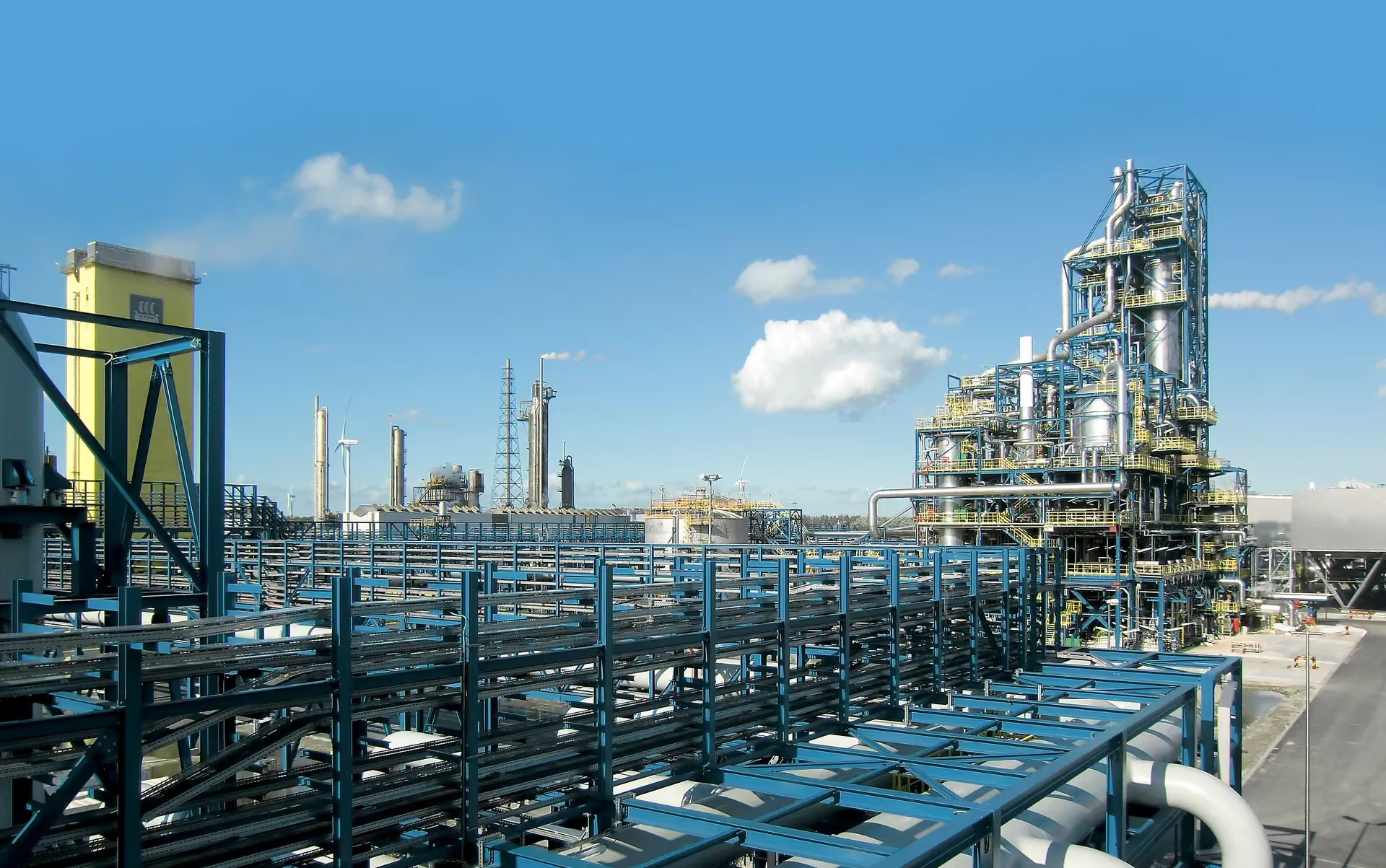
Two new urea plants with a combined annual capacity of 2.54 million tonnes are set to begin production shortly, the Indian government announced on 14 June 2026 a moment when India imported more than 10 million tonnes of urea in a single fiscal year, at prices that have nearly doubled from pre-conflict levels. Urea a nitrogen rich compound that is the world's most widely used fertiliser, manufactured by reacting ammonia with carbon dioxide under high pressure is the foundational input for Indian agriculture, accounting for roughly 79% of all nitrogen fertiliser applied to Indian crops. The commercial stakes are direct: urea futures surged to $684 per tonne by late March 2026, their highest level since October 2022 and more than 70% higher than at the start of the year, as the West Asia conflict drove a sharp spike in natural gas prices the principal feedstock for urea production and restricted flows through the Strait of Hormuz, which handles roughly a third of global fertiliser shipments. For India's fertiliser producers and the government subsidy apparatus behind them, these two plants are not merely capacity additions they are a structural bet that domestic output can outrun a geopolitical cost spiral. Whether that bet pays off depends almost entirely on one variable: where the gas comes from.
India depends on West Asia for both LNG to produce urea domestically and for direct urea imports, with roughly 71% of those imports sourced from the region. The Strait of Hormuz a 33 kilometre wide chokepoint between Iran and the Arabian Peninsula through which approximately a third of global fertiliser trade moves is not incidental to this story; it is the story. The conflict's effective disruption of Hormuz shipping in early 2026 drove international urea prices to approximately $700 per tonne in April 2026, against a pre-war baseline of approximately $265–$300 per tonne. India's domestic urea production dropped sharply to around 18 lakh tonnes per month in March 2026 from 24 lakh tonnes a month earlier, primarily due to supply-side constraints in gas availability and plant operation scheduling. The new plants will each require a dedicated and reliable gas allocation typically around 2.4 MMSCMD (million standard cubic metres per day) per plant. If that supply comes via LNG imports transiting Hormuz, the plants reduce India's urea import bill while replicating the underlying energy import vulnerability in a different column of the balance sheet.
Consider the economics at current price levels. A typical Indian gas-based urea plant operating at full capacity produces approximately 1.27 million tonnes annually. At the pre-war LNG spot price of roughly $10–12/MMBtu, the gas cost per tonne of urea produced runs to approximately $150–$170/tonne. At post-conflict spot LNG prices which exceeded $25–30/MMBtu in emergency procurement that same gas cost rises to $375–$450/tonne, while the global urea price stands at approximately $684–$700/tonne. The margin of $230–$325/tonne looks adequate on paper, but the entire difference between this figure and the farmer-facing retail price of Rs 266.50 per 45kg bag equivalent to roughly $140/tonne is absorbed by the government as subsidy. India's urea subsidy framework sets the Maximum Retail Price at approximately Rs 242–267 per 45kg bag regardless of international price, with the government paying the shortfall directly to fertiliser companies through the Department of Fertilisers. The two new plants do not reduce this subsidy obligation they shift its composition from import-linked to production-linked, which is structurally preferable but not automatically cheaper.
On the buy side, Indian state-run procurement vehicles National Fertilizers Ltd (NFL) and Indian Potash Limited (IPL), which together execute the government's canalised import tenders stand to see import volumes moderate once the new plants reach full capacity. Global urea prices have surged since the start of the conflict, as nearly 45% of global supplies transit through the Persian Gulf; India bought 2.5 million tonnes in its previous emergency tender at prices nearly double pre-conflict levels. Every tonne replaced by domestic output at stable gas costs saves the subsidy pool roughly $350–$550/tonne at current import price levels. For a large integrated fertiliser producer Chambal Fertilisers, Rashtriya Chemicals and Fertilizers, or HURL with existing gas pipeline access and established subsidy-reimbursement relationships, the new capacity environment is straightforwardly positive, provided gas allocation is confirmed and reimbursement cycles remain timely. On the sell side, international urea exporters Omani and Qatari producers who have historically supplied India at scale face a structural reduction in their largest captive import market. Gulf Cooperation Council members, including Saudi Arabia, Qatar, and Oman, supply roughly a quarter of global urea exports, and India has been their single most price-sensitive anchor buyer. That anchor is loosening.
The government confirmed sufficient availability of fertilisers for the ongoing Kharif sowing season Kharif being India's primary monsoon-period crop cycle, running June to September, in which urea application is at its most intensive. For large integrated fertiliser producers with derivatives access, the instrument to watch is the JKM (Japan-Korea Marker) the benchmark LNG spot price for Asia which directly determines the feedstock cost floor for any plant relying on imported gas; a sustained JKM above $20/MMBtu keeps the subsidy burden elevated regardless of domestic capacity additions. For smaller regional distributors and cooperative-level operators without hedging access, the practical equivalent is fixing forward offtake volumes with state distribution channels now, before Rabi season procurement tightens availability in October. For observers, the critical signal is India's next NFL or IPL urea tender, expected before September 2026: if that tender clears below $600/tonne, the global price spike is retreating and the new capacity is already influencing market sentiment. A second consecutive tender clearing above $650/tonne confirms the structural import dependency remains intact and that the feedstock question at the heart of these two new plants has not yet been resolved in India's favour.
.jpg)



'%3e%3cg id='Final-Copy-2_2_' transform='translate(1275.000000, 200.000000)'%3e%3cpath class='st0' d='M7.4,12.8h6.8l3.1-11.6H7.4C4.2,1.2,1.6,3.8,1.6,7S4.2,12.8,7.4,12.8z'/%3e%3c/g%3e%3c/g%3e%3c/g%3e%3cg id='final---dec.11-2020'%3e%3cg id='_x30_208-our-toggle' transform='translate(-1275.000000, -200.000000)'%3e%3cg id='Final-Copy-2' transform='translate(1275.000000, 200.000000)'%3e%3cpath class='st1' d='M22.6,0H7.4c-3.9,0-7,3.1-7,7s3.1,7,7,7h15.2c3.9,0,7-3.1,7-7S26.4,0,22.6,0z M1.6,7c0-3.2,2.6-5.8,5.8-5.8 h9.9l-3.1,11.6H7.4C4.2,12.8,1.6,10.2,1.6,7z'/%3e%3cpath id='x' class='st2' d='M24.6,4c0.2,0.2,0.2,0.6,0,0.8l0,0L22.5,7l2.2,2.2c0.2,0.2,0.2,0.6,0,0.8c-0.2,0.2-0.6,0.2-0.8,0 l0,0l-2.2-2.2L19.5,10c-0.2,0.2-0.6,0.2-0.8,0c-0.2-0.2-0.2-0.6,0-0.8l0,0L20.8,7l-2.2-2.2c-0.2-0.2-0.2-0.6,0-0.8 c0.2-0.2,0.6-0.2,0.8,0l0,0l2.2,2.2L23.8,4C24,3.8,24.4,3.8,24.6,4z'/%3e%3cpath id='y' class='st3' d='M12.7,4.1c0.2,0.2,0.3,0.6,0.1,0.8l0,0L8.6,9.8C8.5,9.9,8.4,10,8.3,10c-0.2,0.1-0.5,0.1-0.7-0.1l0,0 L5.4,7.7c-0.2-0.2-0.2-0.6,0-0.8c0.2-0.2,0.6-0.2,0.8,0l0,0L8,8.6l3.8-4.5C12,3.9,12.4,3.9,12.7,4.1z'/%3e%3c/g%3e%3c/g%3e%3c/g%3e%3c/g%3e%3c/svg%3e) Privacy Choices
Privacy Choices