.avif)
Pakistani agricultural commodity exporters are already absorbing a financing cost penalty estimated at 50–200 basis points on trade finance as lenders reprice sovereign and sectoral risk following India's formal declaration at the UN Human Rights Council on 19 June 2026 that the 1960 Indus Waters Treaty is "outdated" and has been placed in abeyance. The immediate commercial damage is not a tap turned off; it is a discount applied. Crop insurance premiums are moving. Credit lines are tightening. Gulf food security buyers are quietly asking their procurement desks whether Karachi origin can still be relied upon. That repricing is happening now, even though the physical water flows have not yet changed by a single cubic metre.
The Indus Waters Treaty a World Bank brokered agreement signed in 1960 that allocates the six rivers of the Indus basin between India and Pakistan has governed water flows to Pakistan's agricultural heartland for 65 years. Under its architecture, Pakistan received exclusive rights to the three western rivers (Indus, Jhelum, Chenab), which today irrigate roughly 80% of the country's cultivated land. That figure is not incidental context: it means Pakistan's entire grain, cotton, and sugarcane supply chain is physically underwritten by flows that originate in Indian controlled territory. At the UN Human Rights Council, India's First Secretary Anupama Singh argued, according to reports, that Pakistan cannot expect cooperation benefits under the treaty while allegedly sponsoring cross-border terrorism, citing the Pahalgam attack which claimed 26 lives as the trigger for placing the treaty in abeyance.
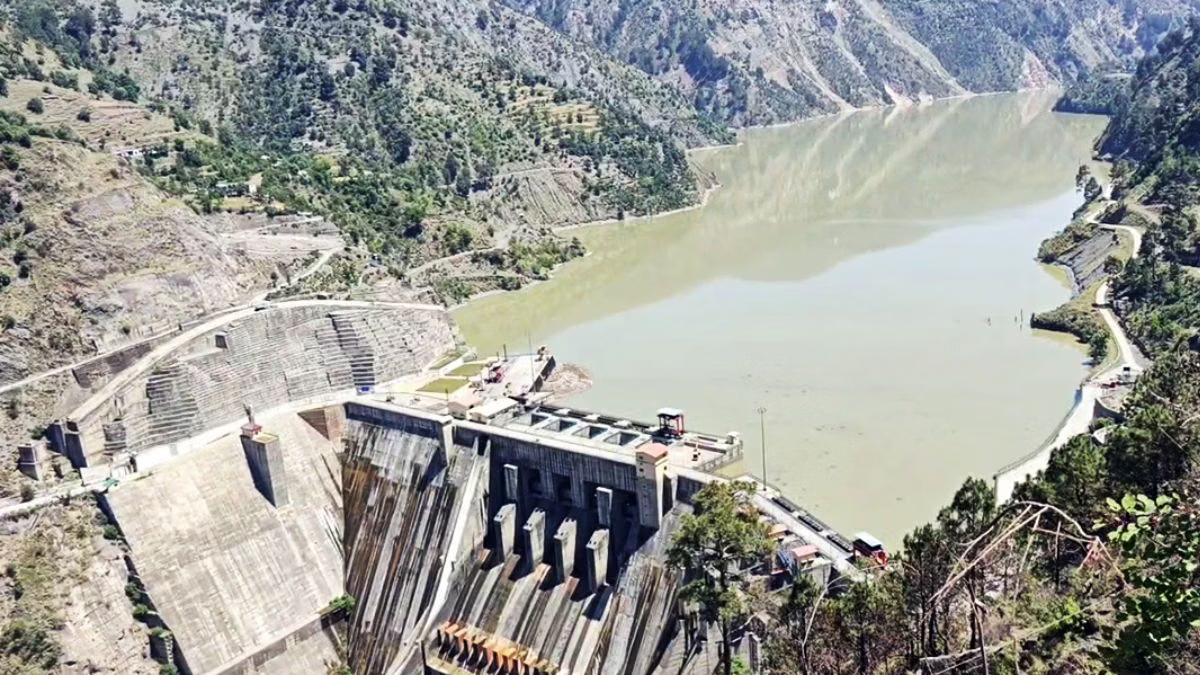
Before any trader prices in a Pakistani agricultural supply collapse, the infrastructure timeline must be understood. India cannot physically redirect Indus river flows overnight. Constructing the dams, barrages, and canal diversions needed to materially reduce downstream flows to Pakistan would require an estimated 5–15 years of engineering work and hundreds of billions of dollars of capital expenditure. The Baglihar Dam dispute and the Kishanganga arbitration two previous Indus treaty flashpoints each took a decade to resolve through engineering and legal process. The structural constraint here is concrete and steel, not political will. Markets that price in an acute Pakistani agricultural collapse on a 12 month horizon are misreading the physical reality. The risk is real but it is a slow-moving structural risk, not an acute supply shock.
What is immediate, however, is the margin anatomy for Pakistani commodity exporters. Consider a Pakistani cotton exporter Pakistan is the world's fourth largest cotton producer shipping a 5,000 tonne cargo to a Turkish textile mill. A typical trade finance instrument for this transaction is a letter of credit (LC), a bank guarantee that releases payment once shipping documents are presented; it is the mechanism that makes cross-border commodity trade possible. Before treaty abeyance, that LC might carry an all-in financing cost of 6.5% annualised for a 90 day instrument. A 100 basis-point repricing adds approximately $0.10–0.15 per kilogram to the cost of capital on a commodity trading at $1.70–1.80/kg. That narrows the exporter's net margin from roughly $0.12–0.15/kg to near breakeven. Add rising crop insurance premiums and domestic bank credit tightening, and the margin anatomy for Pakistani origin is under structural compression even before a single litre of Indus water is diverted.
On the buy side, Gulf food security buyers sovereign procurement agencies in Saudi Arabia, the UAE, and Qatar that purchase wheat and rice through long-term supply frameworks face a direct sourcing decision. Pakistan supplied approximately 4.5 million tonnes of rice in the 2024–25 marketing year, making it one of the top five global rice exporters. If procurement managers at agencies such as the Saudi Grains Organization (SAGO) or the Abu Dhabi Agriculture and Food Safety Authority (ADAFSA) begin factoring a Pakistani supply reliability discount into their sourcing models, the substitution corridors are Indian non-basmati rice, Thai fragrant rice, and Vietnamese long-grain. Those origins currently trade at a $10–25/tonne premium to Pakistani equivalents. The question for Gulf buyers is whether that premium is worth paying now, before uncertainty materialises into disruption, rather than scrambling during a supply event.
On the sell side, the geopolitical discount creates a structural basis arbitrage the price difference between two origins or delivery points for the same commodity grade that sophisticated traders can exploit. Pakistani-origin basmati and long-grain rice is not currently priced with a full geopolitical risk premium. A trader who can source, certify, and deliver Indian or Australian origin into Gulf or European buyers at current market prices captures the spread between Pakistani discounted procurement and premium-origin delivery. For a large integrated commodity trader a Louis Dreyfus, an Olam, or a national grain trading arm with full origin flexibility and hedging infrastructure this arbitrage is actionable today. The instrument is simple: buy Pakistani origin at the widened discount, deliver certified alternative origin to the buyer, and pocket the basis differential. That spread is directionally widening as long as diplomatic uncertainty persists.
For smaller regional operators a mid-sized South Asian grain merchant, a regional cotton trading house without derivatives access the playbook is different. These operators cannot easily certify origin substitution or access basis swaps. Their practical tools are: fixing forward sales prices bilaterally with buyers now, before the risk premium fully embeds in contract terms; diversifying their supplier base toward Indian or Australian origin on at least a partial basis; and renegotiating force majeure clauses in existing supply contracts to include geopolitical water risk as a qualifying event. None of these measures are free locking in forward prices in a rising uncertainty environment means ceding upside if Pakistani supply proves uninterrupted. But the asymmetry of the downside risk a multi-year treaty abeyance that accelerates financing costs and buyer diversion argues for paying that insurance cost now.
The historical anchor here is the 1965 Indo-Pakistani War, during which India briefly suspended Indus flows to Pakistan's canal systems. The disruption lasted weeks, not years, but it demonstrated that the physical infrastructure of water delivery can be weaponised faster than international arbitration can respond. More recently, India's construction of the Kishanganga Hydroelectric Project challenged by Pakistan at the Permanent Court of Arbitration, with a final award issued in 2013 showed that upstream storage and diversion projects, even those technically compliant with treaty terms, can materially alter seasonal flow patterns. That precedent is now live: if India begins accelerating upstream storage projects on the western rivers in the absence of treaty constraint, Pakistani farmers in Punjab and Sindh which produce the bulk of Pakistan's wheat and cotton face altered irrigation availability within a 5–7 year window, not a 15 year one.
For observers tracking this situation, the most specific and time-bound signal to watch is the Pakistan Mercantile Exchange (PMEX) cotton futures settlement price relative to the Cotlook A Index the benchmark for global cotton trade. A sustained widening of the Pakistan-origin discount beyond 5% below the Cotlook A Index, maintained for more than four consecutive weeks, would signal that physical market participants not just financial risk desks are pricing in Pakistani supply risk. A second signal is SAGO's quarterly tender awards: if the Saudi Grains Organization shifts more than 15% of its rice procurement corridor away from Pakistan in its Q3 2026 tender cycle (results typically published in August), that constitutes institutional confirmation that Gulf buyers are acting on the risk, not merely monitoring it. Both signals are publicly observable and require no proprietary data to track.
.jpg)

'%3e%3cg id='Final-Copy-2_2_' transform='translate(1275.000000, 200.000000)'%3e%3cpath class='st0' d='M7.4,12.8h6.8l3.1-11.6H7.4C4.2,1.2,1.6,3.8,1.6,7S4.2,12.8,7.4,12.8z'/%3e%3c/g%3e%3c/g%3e%3c/g%3e%3cg id='final---dec.11-2020'%3e%3cg id='_x30_208-our-toggle' transform='translate(-1275.000000, -200.000000)'%3e%3cg id='Final-Copy-2' transform='translate(1275.000000, 200.000000)'%3e%3cpath class='st1' d='M22.6,0H7.4c-3.9,0-7,3.1-7,7s3.1,7,7,7h15.2c3.9,0,7-3.1,7-7S26.4,0,22.6,0z M1.6,7c0-3.2,2.6-5.8,5.8-5.8 h9.9l-3.1,11.6H7.4C4.2,12.8,1.6,10.2,1.6,7z'/%3e%3cpath id='x' class='st2' d='M24.6,4c0.2,0.2,0.2,0.6,0,0.8l0,0L22.5,7l2.2,2.2c0.2,0.2,0.2,0.6,0,0.8c-0.2,0.2-0.6,0.2-0.8,0 l0,0l-2.2-2.2L19.5,10c-0.2,0.2-0.6,0.2-0.8,0c-0.2-0.2-0.2-0.6,0-0.8l0,0L20.8,7l-2.2-2.2c-0.2-0.2-0.2-0.6,0-0.8 c0.2-0.2,0.6-0.2,0.8,0l0,0l2.2,2.2L23.8,4C24,3.8,24.4,3.8,24.6,4z'/%3e%3cpath id='y' class='st3' d='M12.7,4.1c0.2,0.2,0.3,0.6,0.1,0.8l0,0L8.6,9.8C8.5,9.9,8.4,10,8.3,10c-0.2,0.1-0.5,0.1-0.7-0.1l0,0 L5.4,7.7c-0.2-0.2-0.2-0.6,0-0.8c0.2-0.2,0.6-0.2,0.8,0l0,0L8,8.6l3.8-4.5C12,3.9,12.4,3.9,12.7,4.1z'/%3e%3c/g%3e%3c/g%3e%3c/g%3e%3c/g%3e%3c/svg%3e) Privacy Choices
Privacy Choices