.avif)
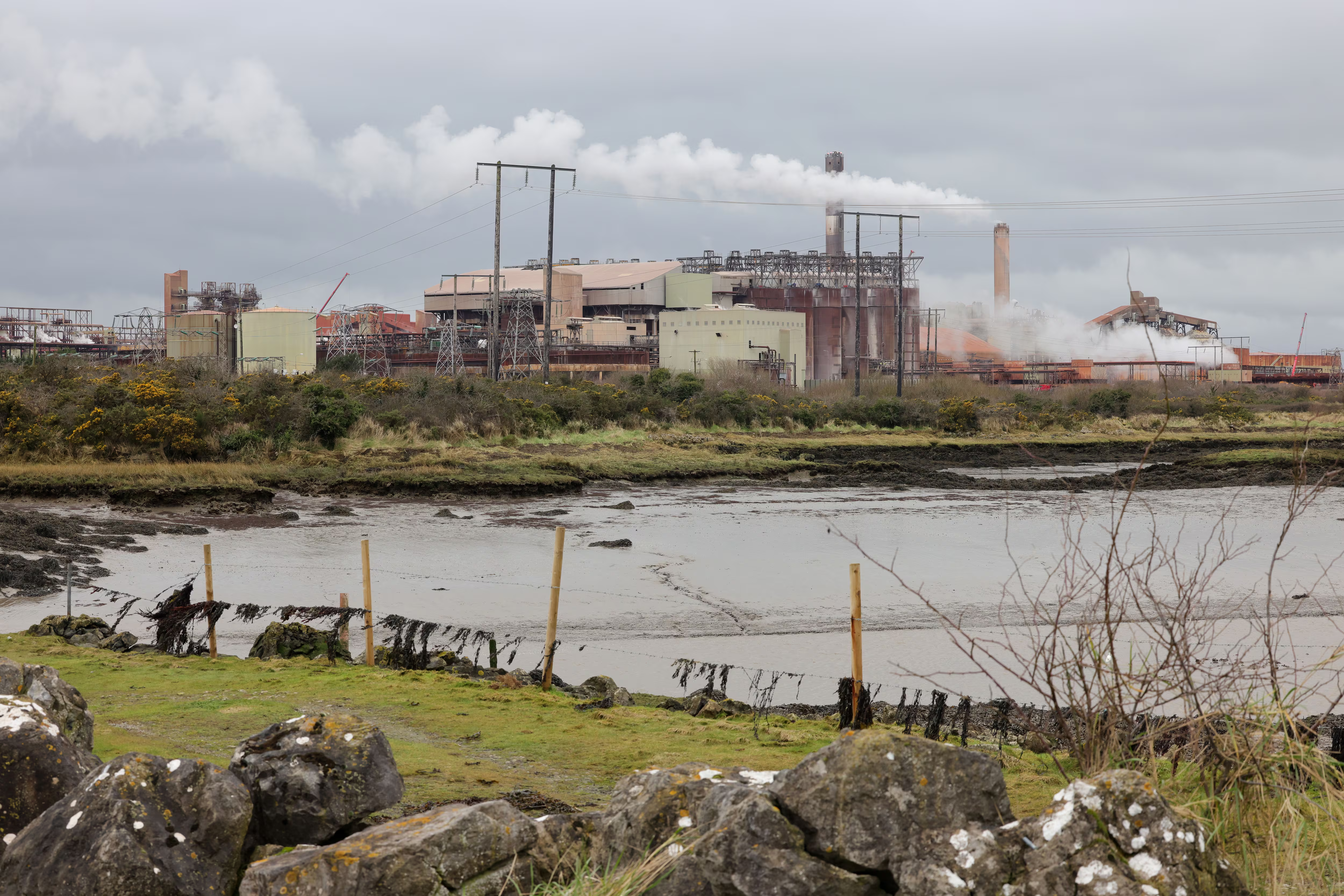
Irish alumina producers face immediate margin compression and reputational costs after shipping 83% of Q1 2026 output to Russia 200,619 tonnes worth approximately $140 million at current alumina pricing of $700/tonne. The revelation directly contradicts Dublin's claims that Aughinish Alumina, Ireland's only producer, primarily serves European markets. For aluminum smelters globally, this creates a two-tier pricing structure: ESG compliant alumina commands premiums while Russian linked supply faces buyer resistance. Aughinish Alumina, owned by Russian metals giant Rusal and Europe's largest alumina refinery, has become the critical chokepoint in this supply chain controversy.
Alumina the white powder extracted from bauxite ore and refined into aluminum metal through electrolysis sits at the center of a regulatory arbitrage that threatens to unravel. Current EU sanctions ban Russian aluminum imports but permit alumina exports to Russia, creating a legal loophole that allows approximately $400 million worth of Irish alumina to flow to Siberian smelters annually. The mechanism is straightforward: bauxite arrives at Aughinish's Shannon Estuary facility, gets processed into alumina, then ships to Rusal's Bratsk and Krasnoyarsk smelters where it becomes aluminum. That aluminum then reaches Moscow based trader ASK, which supplies over 40 EU sanctioned arms manufacturers with more than $650 million worth of metal. The regulatory gap has created a perverse incentive structure where Russian demand props up Irish production while European buyers inadvertently finance military supply chains.
On the buy side: aluminum smelters outside Russia now confront sourcing decisions with immediate cost implications. A typical 200,000 tonne per year smelter consuming 400,000 tonnes of alumina annually faces a 15-25% supply disruption if Irish material becomes unavailable. Alternative alumina from Australia or Brazil commands a $50-80/tonne premium over current Irish pricing, translating to $20-32 million in additional annual costs. ESG mandated buyers automotive manufacturers, packaging companies, construction firms increasingly demand supply chain transparency that Irish alumina cannot provide while maintaining Russian exposure. Aughinish's own lobbying documents admit 45% of exports flow to Russia, though official trade data suggests the figure reached 66.8% in 2025 and 83% in Q1 2026.
On the sell side: Aughinish operates under financial pressure that explains its Russian dependency. The facility requires minimum 80% capacity utilization to cover fixed costs of approximately €300 million annually debt service, energy, labor for 700 direct employees plus 1,000 contractors. At Q1 volumes of 240,000 tonnes total output with 200,619 tonnes shipped to Russia, the plant operates near breakeven with Russian sales providing the margin buffer. Alternative European buyers typically demand 60-90 day payment terms versus Rusal's internal transfer pricing that eliminates counterparty risk. Aughinish posted record pre-tax profits of €103.4 million for 2024, attributed primarily to higher market alumina prices rather than volume growth. Losing Russian demand would force either plant closure or massive restructuring with Irish taxpayers potentially liable for environmental remediation costs exceeding €500 million.
For large integrated aluminum producers (Norsk Hydro, Alcoa, Rio Tinto's smelting operations), the solution involves derivatives-based supply hedging. Three month alumina forwards on the Shanghai Futures Exchange the primary benchmark since Russian material dominated LME warehouses allow price protection while diversifying physical sources. A 500,000 tonne annual consumer can lock 70% of requirements at $720/tonne for Q2-Q3 delivery, accepting a $20/tonne premium over spot but eliminating compliance risk. Aluminum premiums have compressed 60-80 basis points in ESG conscious markets, but this margin erosion gets recovered through clean supply surcharges passed to end users. The financing structure leverages letters of credit backed by non-Russian commodity flows, avoiding sanctions exposed counterparties entirely.
For smaller regional operators independent foundries, secondary smelters, specialty alloy producers without derivatives access, the response requires bilateral supply agreements with explicit ESG warranties. A mid-sized European smelter consuming 50,000 tonnes annually can secure 18 month fixed price contracts with Australian or Brazilian suppliers, paying 12-15% above current Irish pricing but gaining regulatory certainty. The practical equivalent involves pre-financing arrangements where buyers provide working capital to suppliers in exchange for volume commitments, essentially creating captive supply chains. Regional cooperatives pool purchasing power to achieve scale pricing while maintaining compliance documentation that satisfies audit requirements. Inventory management shifts to 45-60 day cover versus historical 20-30 days, increasing working capital needs by €8-12 million for typical operations.
The physical supply chain reveals why this controversy matters beyond regulatory compliance. Alumina prices have more than doubled since early 2024 to over $700/tonne, driven partly by supply disruptions from Guinea and Australia. Rusal has lost access to approximately 40% of its alumina supplies since the Ukraine conflict began Australia banned exports to Russia and the company's Ukrainian refinery was nationalized. This supply deficit makes Irish production critically important for Russian aluminum output, which explains both the volume concentration and Moscow's resistance to sanctions. Current Middle East supply disruptions have halted 9% of global aluminum supply, with major refiners like EGA and ALBA operating at reduced capacity. Each additional supply constraint tightens the market further, creating arbitrage opportunities for sanctions compliant producers.
The financing dimension exposes deeper structural problems. Rusal's ownership of Aughinish creates internal transfer pricing that bypasses normal trade finance mechanisms. Standard alumina transactions require letters of credit issued by international banks, with documentation proving origin, quality, and compliance. Internal corporate transfers within Rusal avoid these checks entirely, allowing Russian military procurement to access Western origin materials without triggering banking sector compliance. Aughinish has extensively lobbied Irish government officials since Russia's 2022 invasion, declaring similar representations on 10 occasions over four years to maintain current arrangements. The lobbying focuses on employment impacts rather than strategic implications, suggesting corporate capture of regulatory processes.
Historically, aluminum sanctions have created massive market disruptions with lasting consequences. In 2018, US sanctions on Deripaska drove aluminum prices up 30% within days until he reduced his Rusal stake from 70% to 45%, allowing sanctions relief ten months later. Currently, around 90% of aluminum stored in LME warehouses is of Russian origin, creating price distortions that disconnect exchange prices from physical markets. As of April 2024, Russian origin copper, nickel, and primary aluminum accounted for 50%, 33%, and 89% of London Metal Exchange stocks respectively. The Irish alumina controversy represents the next phase of this market fragmentation, where raw material flows rather than finished metal become the sanctions battleground.
The immediate commercial consequence centers on counterparty concentration risk that most market participants have ignored. Ireland holds veto power over EU sanctions and takes the rotating EU Council presidency on July 1, 2026, positioning Dublin to block alumina export restrictions. The EU's 21st sanctions package faces negotiation through June-July 2026, targeting suppliers to Russia's military industrial complex. For aluminum industry observers, the key signal is Irish government rhetoric versus enforcement actions. If Dublin maintains its current resistance to sanctions while export volumes to Russia continue rising, expect permanent supply chain bifurcation between ESG compliant and sanctions exposed aluminum. Monitor the Irish Times Central Statistics Office monthly trade data releases any month showing below 70% Russian export share indicates successful supply diversification.




'%3e%3cg id='Final-Copy-2_2_' transform='translate(1275.000000, 200.000000)'%3e%3cpath class='st0' d='M7.4,12.8h6.8l3.1-11.6H7.4C4.2,1.2,1.6,3.8,1.6,7S4.2,12.8,7.4,12.8z'/%3e%3c/g%3e%3c/g%3e%3c/g%3e%3cg id='final---dec.11-2020'%3e%3cg id='_x30_208-our-toggle' transform='translate(-1275.000000, -200.000000)'%3e%3cg id='Final-Copy-2' transform='translate(1275.000000, 200.000000)'%3e%3cpath class='st1' d='M22.6,0H7.4c-3.9,0-7,3.1-7,7s3.1,7,7,7h15.2c3.9,0,7-3.1,7-7S26.4,0,22.6,0z M1.6,7c0-3.2,2.6-5.8,5.8-5.8 h9.9l-3.1,11.6H7.4C4.2,12.8,1.6,10.2,1.6,7z'/%3e%3cpath id='x' class='st2' d='M24.6,4c0.2,0.2,0.2,0.6,0,0.8l0,0L22.5,7l2.2,2.2c0.2,0.2,0.2,0.6,0,0.8c-0.2,0.2-0.6,0.2-0.8,0 l0,0l-2.2-2.2L19.5,10c-0.2,0.2-0.6,0.2-0.8,0c-0.2-0.2-0.2-0.6,0-0.8l0,0L20.8,7l-2.2-2.2c-0.2-0.2-0.2-0.6,0-0.8 c0.2-0.2,0.6-0.2,0.8,0l0,0l2.2,2.2L23.8,4C24,3.8,24.4,3.8,24.6,4z'/%3e%3cpath id='y' class='st3' d='M12.7,4.1c0.2,0.2,0.3,0.6,0.1,0.8l0,0L8.6,9.8C8.5,9.9,8.4,10,8.3,10c-0.2,0.1-0.5,0.1-0.7-0.1l0,0 L5.4,7.7c-0.2-0.2-0.2-0.6,0-0.8c0.2-0.2,0.6-0.2,0.8,0l0,0L8,8.6l3.8-4.5C12,3.9,12.4,3.9,12.7,4.1z'/%3e%3c/g%3e%3c/g%3e%3c/g%3e%3c/g%3e%3c/svg%3e) Privacy Choices
Privacy Choices