.avif)
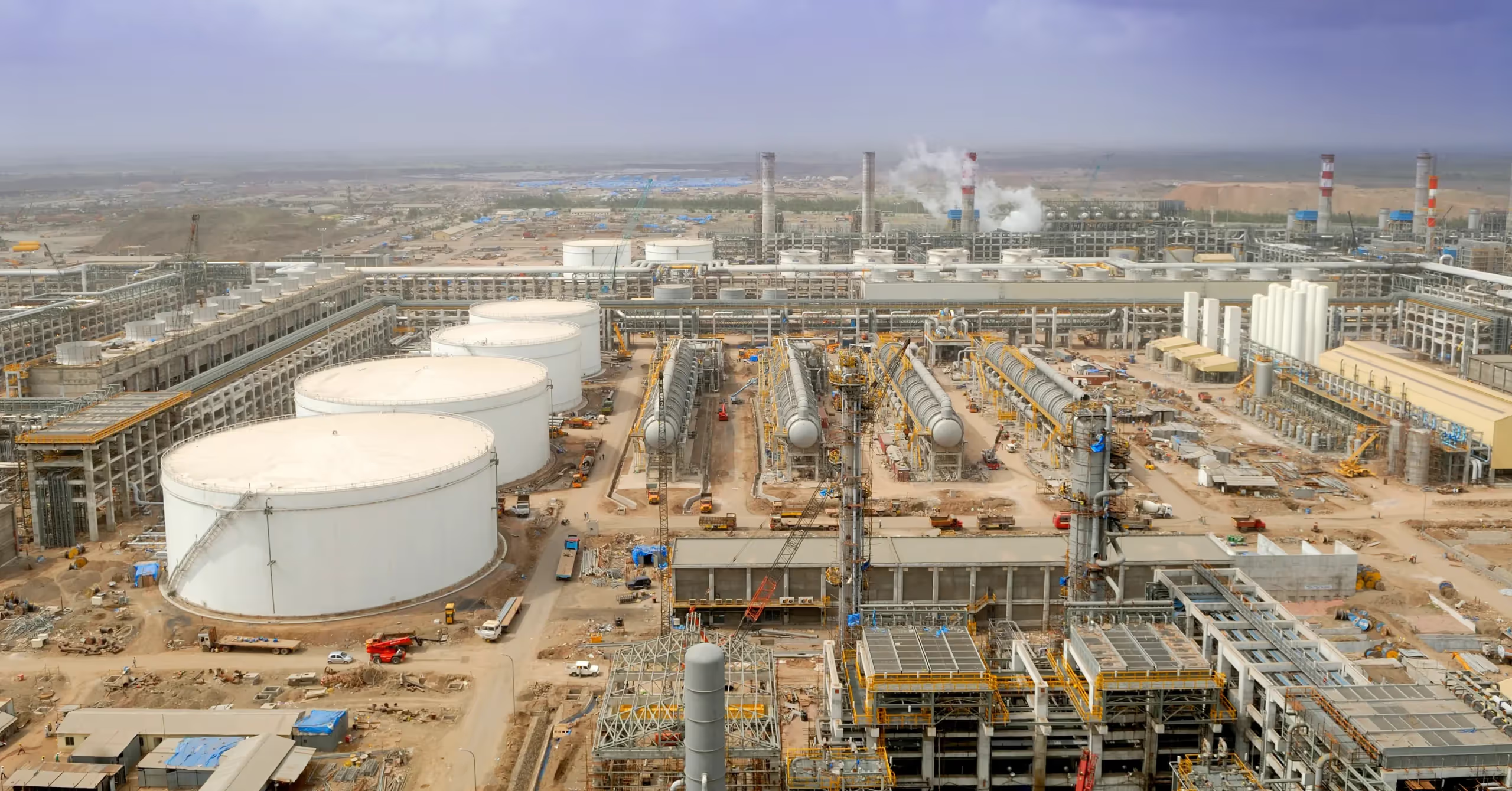
Indian refiners face a 660,000 barrel per day (bpd) processing margin opportunity as Reliance Industries begins a three to four week maintenance shutdown at its Jamnagar refinery starting mid-May. India's Ministry of Petroleum and Natural Gas is coordinating the timing to ensure refinery shutdowns don't happen simultaneously, with the Reliance shutdown beginning only after Nayara Energy's 400,000 bpd Vadinar refinery resumes operations by mid-May. For domestic focused refiners like Indian Oil Corporation and Bharat Petroleum Corporation, this creates a temporary 15-20% boost in processing margins as reduced competition allows higher utilisation of existing capacity. The mathematics are straightforward: removing 660,000 bpd from India's domestic refining pool while demand remains constant tightens the supply-demand balance and enables operating refiners to capture additional margin from increased throughput.
The shutdown involves a crude unit that breaks down oil into various streams for products like petrol, diesel, and jet fuel, plus secondary units that convert those streams into end-products. Reliance operates the world's largest integrated single-site refinery complex at Jamnagar with 1.4 million bpd total capacity, but the 660,000 bpd unit facing maintenance serves India's domestic market, while the separate 704,000 bpd plant focuses on exports. A turnaround a scheduled shutdown for safety checks, catalyst replacement, and equipment upgrades typically requires 18+ months advance planning around operational cycles. The timing coordination reflects broader supply chain stress: Russia backed Nayara Energy has kept its 400,000 bpd Vadinar refinery completely offline for maintenance since April 9, removing over 1 million bpd combined capacity from India's refining system.
On the buy side, India's fuel distributors and marketing companies gain pricing leverage during the Jamnagar outage. State Oil Marketing Companies (OMCs) like Hindustan Petroleum and Bharat Petroleum can secure better terms from operating refiners as domestic supply tightens. Regional distributors serving southern and western India may see improved margins as transport costs from alternative refineries create geographic arbitrage opportunities. On the sell side, Reliance loses approximately $2-3 million in daily processing margin during the 660,000 bpd shutdown a significant opportunity cost that underscores why the company likely delayed this maintenance from its original schedule. Quantum Commodity Intelligence reported that Reliance postponed the shutdown, now aiming to begin work in mid-May. Operating Indian refiners capture this lost margin through higher capacity utilisation at their own facilities.
For large integrated oil companies with derivatives access national oil companies' trading arms, international majors with Indian operations the Jamnagar outage creates hedging opportunities around India-Singapore gasoline and diesel crack spreads. These operators can position for wider regional product spreads during the maintenance period, using futures and swaps to monetise the temporary supply tightness. For smaller regional operators independent fuel importers, cooperative societies, mid-sized distributors without derivatives access, the practical equivalent involves securing term supply contracts with operating Indian refiners before the shutdown begins. Regional operators should negotiate delivery flexibility and price review mechanisms to capture value from the temporary market tightness without derivatives exposure.
The broader context amplifies the commercial impact. Brent crude futures dropped more than 8% to below $101 per barrel following reports of US-Iran diplomatic progress, but India has faced a historic energy crisis over the past two months, with the government ordering state refiners to maximize LPG production at any cost and cutting commercial sector supplies to 70% of normal levels. The US is set to export a record 471,000 tonnes of LPG to India this month, highlighting supply chain reconfiguration. Reliance has already scaled back alkylates output to ramp up LPG production to more than three times pre-conflict levels. Against this backdrop, removing 660,000 bpd of domestic refining capacity even temporarily tests the coordination mechanisms designed to prevent supply disruption.
The infrastructure reality shapes physical constraints. Shifting all production between domestic and export markets isn't straightforward, despite Reliance's dual-refinery setup. Product specifications, pipeline connections, and storage tank configurations limit the flexibility to redirect export-oriented production to domestic markets. This means the 660,000 bpd domestic capacity reduction creates genuine supply tightness that cannot be easily offset by increasing export refinery output for domestic use. Other refiners have delayed scheduled maintenance Indian Oil Corp and Bharat Petroleum Corp postponed their planned work in April to maintain domestic supply, while Nayara proceeded with its Vadinar shutdown. The sequential approach prevents simultaneous outages but concentrates margin opportunities for operating refiners during each maintenance window.
For procurement professionals and market observers, track the India-Singapore gasoline crack spread through May and June widening spreads above $15-20/barrel indicate successful margin capture by operating Indian refiners. Monitor Platts pricing for Mumbai-delivered gasoline and diesel versus international benchmarks; domestic premiums above $5-10/MT signal supply tightness translating into distributor costs. The key forward signal is coordination effectiveness: if Nayara's Vadinar restart faces delays beyond mid-May, extending the overlap with Reliance's planned shutdown, India's fuel supply coordination faces its first major stress test. Watch for government statements on maintenance schedule adjustments any indication of timeline changes suggests the coordination mechanism is reaching its operational limits. Success here validates India's approach to managing energy security through administrative coordination rather than market mechanisms alone.
'%3e%3cg id='Final-Copy-2_2_' transform='translate(1275.000000, 200.000000)'%3e%3cpath class='st0' d='M7.4,12.8h6.8l3.1-11.6H7.4C4.2,1.2,1.6,3.8,1.6,7S4.2,12.8,7.4,12.8z'/%3e%3c/g%3e%3c/g%3e%3c/g%3e%3cg id='final---dec.11-2020'%3e%3cg id='_x30_208-our-toggle' transform='translate(-1275.000000, -200.000000)'%3e%3cg id='Final-Copy-2' transform='translate(1275.000000, 200.000000)'%3e%3cpath class='st1' d='M22.6,0H7.4c-3.9,0-7,3.1-7,7s3.1,7,7,7h15.2c3.9,0,7-3.1,7-7S26.4,0,22.6,0z M1.6,7c0-3.2,2.6-5.8,5.8-5.8 h9.9l-3.1,11.6H7.4C4.2,12.8,1.6,10.2,1.6,7z'/%3e%3cpath id='x' class='st2' d='M24.6,4c0.2,0.2,0.2,0.6,0,0.8l0,0L22.5,7l2.2,2.2c0.2,0.2,0.2,0.6,0,0.8c-0.2,0.2-0.6,0.2-0.8,0 l0,0l-2.2-2.2L19.5,10c-0.2,0.2-0.6,0.2-0.8,0c-0.2-0.2-0.2-0.6,0-0.8l0,0L20.8,7l-2.2-2.2c-0.2-0.2-0.2-0.6,0-0.8 c0.2-0.2,0.6-0.2,0.8,0l0,0l2.2,2.2L23.8,4C24,3.8,24.4,3.8,24.6,4z'/%3e%3cpath id='y' class='st3' d='M12.7,4.1c0.2,0.2,0.3,0.6,0.1,0.8l0,0L8.6,9.8C8.5,9.9,8.4,10,8.3,10c-0.2,0.1-0.5,0.1-0.7-0.1l0,0 L5.4,7.7c-0.2-0.2-0.2-0.6,0-0.8c0.2-0.2,0.6-0.2,0.8,0l0,0L8,8.6l3.8-4.5C12,3.9,12.4,3.9,12.7,4.1z'/%3e%3c/g%3e%3c/g%3e%3c/g%3e%3c/g%3e%3c/svg%3e) Privacy Choices
Privacy Choices