.avif)
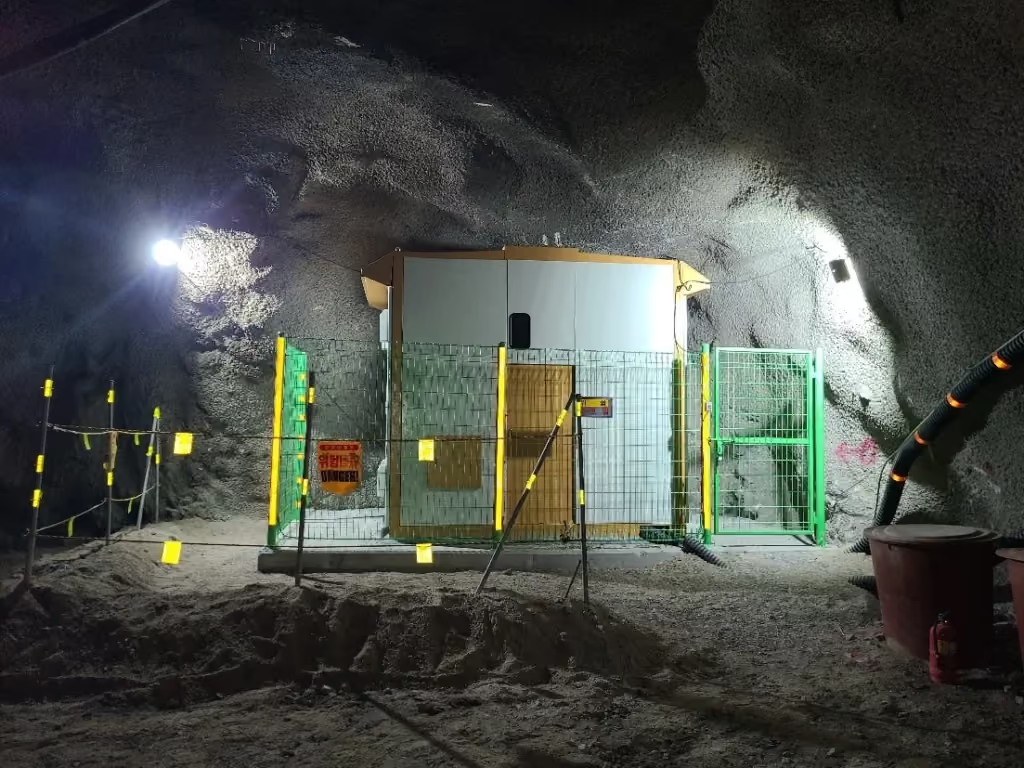
Tungsten processors face input cost pressures of $68,500–112,000/MT for APT as of March 2026, up from $67,954/MT in December 2025, while Almonty's newly commissioned Sangdong mine produces only 2,300 tonnes annually from a 0.51% ore grade insufficient to meaningfully offset Chinese supply restrictions that have reduced global availability by approximately 40%. Ammonium paratungstate (APT) the critical intermediate between tungsten ore and finished products used in cutting tools, electronics, and defense applications has become the bottleneck commodity that determines tungsten supply chains globally. China's designation of only 15 approved companies for tungsten exports effective 2026-2027 centralizes control over 80% of global supply, creating structural scarcity that small-scale new production cannot address in the near term.
Chinese APT export volumes collapsed 70% from 782 tonnes in 2024 to 243 tonnes in the first eleven months of 2025 following February 2025 export controls, while Fastmarkets APT prices surged from $900–940/MTU in January 2026 to $1,650–1,900/MTU by mid-February. The arithmetic is stark: Sangdong's 2,300 tonnes of annual tungsten concentrate represents roughly 0.3% of global tungsten demand, while China controls more than three quarters of global supply. Consider a mid-sized European cutting tool manufacturer requiring 50 tonnes of APT annually. At pre-crisis pricing of $940/MTU, their annual tungsten cost was approximately $47,000. At current levels near $1,650/MTU, the same 50 tonnes costs $82,500 a 75% increase that cannot be absorbed through operational efficiencies. The tungsten hexafluoride shortage facing Samsung and SK Hynix by summer 2026 demonstrates how supply constraints cascade through specialized applications where substitution is impossible.
On the buy side: Large integrated tooling manufacturers (Sandvik, Kennametal, or Sumitomo) with derivatives access can hedge through London Metal Exchange tungsten futures at roughly $145/kg, but premiums for physical delivery now add 15-25% above paper prices. Their procurement teams are extending contract terms from quarterly to annual settlements, accepting higher base prices in exchange for supply certainty. Medium-scale regional manufacturers precision machining shops, carbide recyclers, specialty alloy producers without derivatives access face spot market volatility with no hedging tools. They're adjusting inventory strategies from just in time to 6 month forward buying, despite working capital constraints. For traders and intermediaries: Margins concentrate in physical delivery logistics and storage rather than price arbitrage, as geographical price convergence has eliminated traditional Asian-European spreads.
Market volatility is expected to persist throughout 2026 given depleted inventories, restricted Chinese exports, and limited near-term new supply, with new mine developments in Europe, the US, and Asia remaining years away from entering supply chains. The fundamental supply-demand mismatch cannot be resolved through efficiency gains or demand destruction tungsten's unique properties make substitution nearly impossible for critical applications. CICC forecasts that the global tungsten supply-demand gap will account for over 17% of demand from 2026-2028, establishing a structural deficit that transcends cyclical market dynamics. Recycling tungsten carbide tools can recover 80-90% of tungsten content but requires 18-24 months processing time and represents only 35% of total tungsten consumption globally.
For observers: Monitor Fastmarkets' weekly tungsten APT 88.5% WO3 fob China assessment, currently at $1,090-1,150/MTU as of January 2026, for early signals of Chinese export policy changes. Any resolution of Japan's tungsten import restrictions imposed January 2026 following Taiwan diplomatic tensions would signal broader Chinese export policy shifts within 30-45 days. The strategic imperative for tungsten processors is clear: diversification from Chinese supply is no longer optional, but alternative sources require 3-5 year development timelines that vastly exceed current inventory buffers.




'%3e%3cg id='Final-Copy-2_2_' transform='translate(1275.000000, 200.000000)'%3e%3cpath class='st0' d='M7.4,12.8h6.8l3.1-11.6H7.4C4.2,1.2,1.6,3.8,1.6,7S4.2,12.8,7.4,12.8z'/%3e%3c/g%3e%3c/g%3e%3c/g%3e%3cg id='final---dec.11-2020'%3e%3cg id='_x30_208-our-toggle' transform='translate(-1275.000000, -200.000000)'%3e%3cg id='Final-Copy-2' transform='translate(1275.000000, 200.000000)'%3e%3cpath class='st1' d='M22.6,0H7.4c-3.9,0-7,3.1-7,7s3.1,7,7,7h15.2c3.9,0,7-3.1,7-7S26.4,0,22.6,0z M1.6,7c0-3.2,2.6-5.8,5.8-5.8 h9.9l-3.1,11.6H7.4C4.2,12.8,1.6,10.2,1.6,7z'/%3e%3cpath id='x' class='st2' d='M24.6,4c0.2,0.2,0.2,0.6,0,0.8l0,0L22.5,7l2.2,2.2c0.2,0.2,0.2,0.6,0,0.8c-0.2,0.2-0.6,0.2-0.8,0 l0,0l-2.2-2.2L19.5,10c-0.2,0.2-0.6,0.2-0.8,0c-0.2-0.2-0.2-0.6,0-0.8l0,0L20.8,7l-2.2-2.2c-0.2-0.2-0.2-0.6,0-0.8 c0.2-0.2,0.6-0.2,0.8,0l0,0l2.2,2.2L23.8,4C24,3.8,24.4,3.8,24.6,4z'/%3e%3cpath id='y' class='st3' d='M12.7,4.1c0.2,0.2,0.3,0.6,0.1,0.8l0,0L8.6,9.8C8.5,9.9,8.4,10,8.3,10c-0.2,0.1-0.5,0.1-0.7-0.1l0,0 L5.4,7.7c-0.2-0.2-0.2-0.6,0-0.8c0.2-0.2,0.6-0.2,0.8,0l0,0L8,8.6l3.8-4.5C12,3.9,12.4,3.9,12.7,4.1z'/%3e%3c/g%3e%3c/g%3e%3c/g%3e%3c/g%3e%3c/svg%3e) Privacy Choices
Privacy Choices