.avif)
Crude oil traders face an indefinite timeline disruption after President Trump rejected reports of fixed deadlines on the Iran conflict, with Press Secretary Karoline Leavitt saying Trump "has not set a deadline himself" on Iranian response requirements. The commercial consequence is immediate: demand destruction already approaches 4-5 million barrels per day — roughly 5% of global supply — with Asia bearing the primary impact. At current Brent prices trading around $98-101/barrel, the margin compression for Iranian-dependent buyers is not narrowing — it is locked in place. Treasury Secretary Scott Bessent confirmed the naval blockade will continue indefinitely, predicting Kharg Island storage will reach capacity "in a matter of days", forcing Iranian production cuts that extend supply removal beyond the current 4-5 million barrel daily shortfall.
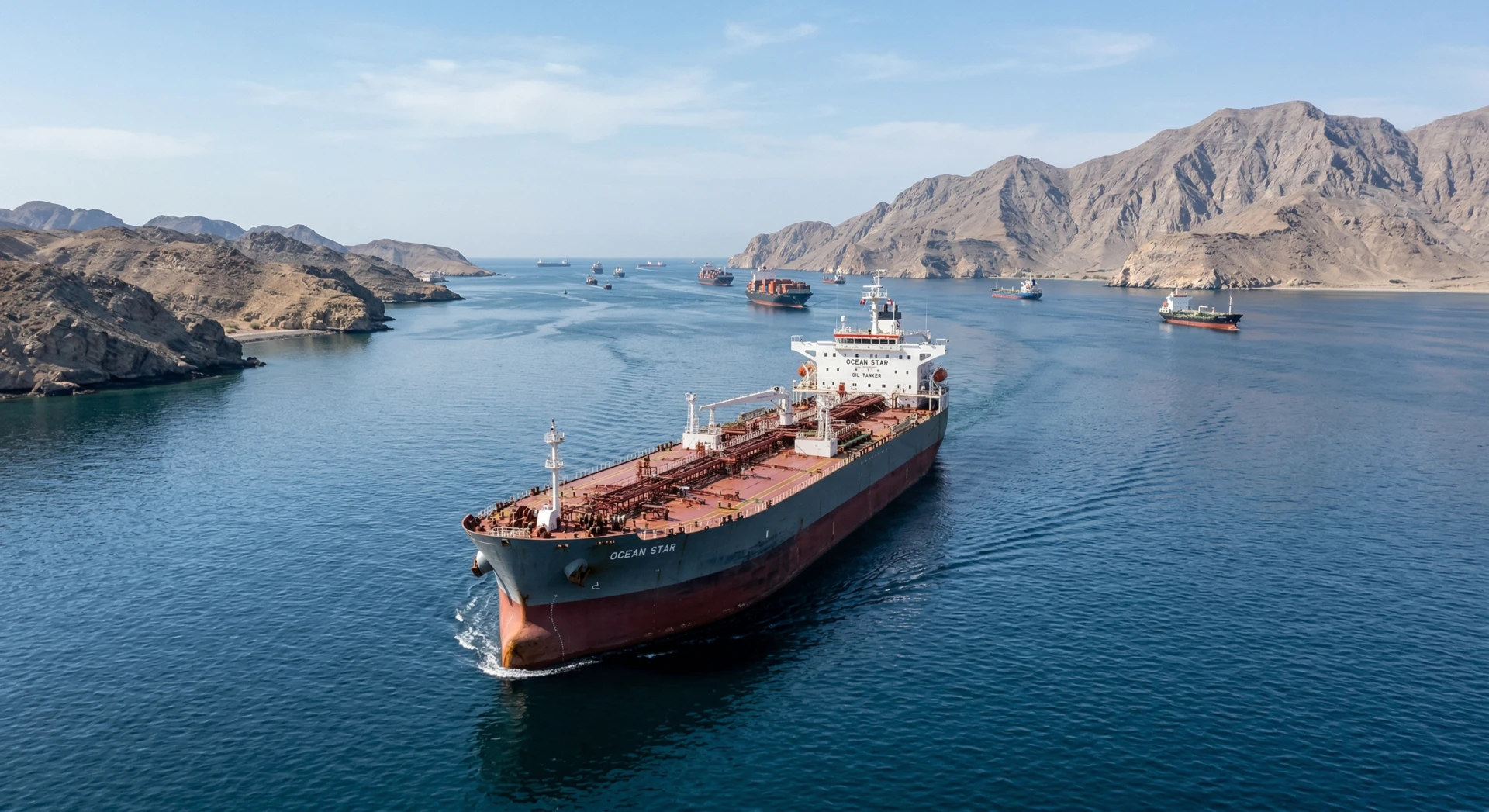
A letter of credit (LC) — the bank guarantee that makes international commodity trade possible — cannot resolve this story's core constraint. Iranian officials call the U.S. blockade "an act of war" and state that "reopening the Strait of Hormuz is impossible" while naval interdiction continues. For crude oil traders, the financing structure becomes secondary to the physical reality: U.S. Central Command reports 31 vessels turned away from Iranian ports, mostly oil tankers. The operational constraint is binary — Iranian crude either reaches market or it does not. Currently, it does not, and the Trump administration provides no timeline for when that changes.
On the buy side: Asian refiners configured for Iranian heavy crude face immediate feedstock gaps. Approximately 85% of Iranian crude flows historically landed at Chinese ports — primarily Qingdao, Rizhao, and Yantai in Shandong Province. Chinese teapot refineries — independent operators built around discounted sanctioned crude — lose access to Iranian barrels trading $8-12 below global benchmarks. For a 100,000 barrel per day teapot refinery, that discount advantage represented $800,000-1.2 million daily in feedstock cost savings. Those savings are gone.
On the sell side: Saudi Arabia, UAE, and Iraqi crude exporters capture the Iranian replacement premium. Saudi crude delivered into Europe hit a two-year high last month, with Arab medium grades transiting Yanbu and Mediterranean ports to substitute for lost Iraqi and Iranian flows. The replacement premium ranges from $5-15/barrel depending on crude quality and delivery point. For Saudi Aramco, that premium on 3 million barrels per day of incremental exports generates $15-45 million in daily additional revenue. The arithmetic is straightforward: Iranian supply removal directly translates into margin concentration among Gulf competitors.
For large integrated traders with derivatives access: Brent-Dubai spread compression from reduced Iranian Heavy availability creates calendar spread opportunities. The back end of the curve trades around $74 for 2026 delivery, while spot Brent holds near $98-101. Vitol, Trafigura, or a national oil company trading arm can position for curve flattening through time spreads or geographic arbitrage between Atlantic and Pacific Basin crudes. The hedge is imperfect — geopolitical duration risk cannot be derivatives-managed — but curve positioning offers partial protection against further escalation.
For smaller regional operators — independent fuel importers, regional cooperatives, mid-sized Asian refiners — without derivatives access: bilateral term contracts with Gulf suppliers become the practical equivalent of hedging. Buyers avoiding Iranian crude for enforcement risk must substitute with alternatives like ADNOC's Murban grade, which trades with "deep liquidity on the ICE exchange". A 50,000 barrel per day Indian refinery can lock six-month Murban supply at fixed premiums to Platts Dubai. The cost is higher than historical Iranian purchases, but the supply certainty justifies the premium.
The supply chain grounding reveals enforcement gaps that traders monitor closely. Iranian crude reaching China routes around the Cape of Good Hope rather than through the Red Sea, avoiding direct interdiction risks but absorbing global freight rate increases. A VLCC (Very Large Crude Carrier — capable of transporting 2 million barrels) earns approximately $20,000-30,000 per day at current rates on the Persian Gulf-China route. Pre-blockade, the same voyage earned $12,000-15,000 daily. The additional freight cost — roughly $3-5/barrel — partly offsets the Iranian discount but does not eliminate it entirely for determined buyers.
decomposition shows where trading profits concentrate during indefinite disruption. Freight operators capture the immediate windfall — tanker day rates have doubled since the blockade began. Physical crude holders benefit from inventory appreciation as supply disruption affects 4-5 million barrels daily. Refining margins expand in consuming regions as product crack spreads widen. Asian refining margins reached their highest level since 2022 due to crude flow disruption. The margin flows from Iranian wellhead to final consumer, with each intermediary — shipper, trader, refiner — extracting premium during scarcity.
Freight market dynamics reveal the hidden leverage in this trade lane. Approximately 20% of world crude supplies passed through the Strait of Hormuz before the war, with analysts estimating July before oil flows reach 90% of pre-war levels. Tanker owners operating on alternative routes — West Africa to Asia, U.S. Gulf Coast to Europe — control the marginal logistics capacity. Frontline or Euronav can command $50,000-80,000 daily rates for VLCC employment on long-haul routes that bypass Middle East risk. The shipping company, not the cargo owner, captures this premium.
Financing dimension analysis shows how credit structures adapt to indefinite timeline uncertainty. Traditional 90-day LC terms assume predictable transit and delivery schedules. With Trump providing "no time frame" for conflict resolution, buyers must secure longer-term financing or accept floating terms that adjust for duration. A Chinese independent refiner purchasing 1 million barrels of substitute crude needs LC coverage for potentially 45-60 days instead of the standard 30-day transit. The additional financing cost — roughly $200,000-300,000 per cargo — represents another margin compression layer that Iranian disruption creates.
Worked example with variables demonstrates the complete cost structure: A mid-sized Korean refinery requiring 80,000 barrels per day of Iranian Heavy crude now substitutes with Saudi Arab Medium. Pre-blockade Iranian Heavy cost: Brent minus $10/barrel. Current Saudi Arab Medium cost: Brent plus $3/barrel. The swing is $13/barrel. Daily additional cost: 80,000 barrels × $13 = $1.04 million. Monthly impact: $31.2 million. That margin transfer flows directly from Korean refiner to Saudi Aramco. The Korean refinery passes higher costs to domestic fuel prices, Saudi Aramco books additional export revenue.
Counterparty concentration risk emerges as the dominant structural concern for crude oil traders. China purchases 85-90% of Iranian crude and represents roughly 13.6% of China's total oil imports. China holds 1.2 billion barrels in crude stockpiles with roughly 108 days of import cover. Beijing's strategic reserve position provides cushion against supply disruption but also creates single-buyer risk for Iranian crude sellers. If Chinese policy shifts toward sanctions compliance, Iranian export options collapse immediately.
Observers tracking this development should monitor specific time-bound signals. Brent crude around $100/barrel represents 50% higher pricing than one year ago, with West Texas Intermediate at $91/barrel. The key indicator is Iraqi crude export resumption through the Strait — "even partial resumption would provide the first meaningful signal of de-escalation". Traders should watch tanker loading data from Basra terminals and AIS tracking for northbound Iraqi flows. A single Iraqi VLCC loading signals policy shift; sustained loading confirms structural change.
The indefinite timeline creates structural uncertainty that derivatives markets cannot fully hedge. Trump claims Iran is "losing $500 million per day" from the blockade, but provides no metric for what constitutes sufficient pressure to end the standoff. Crude oil traders operate in an environment where the supply disruption timeline is determined by presidential discretion rather than market fundamentals or operational constraints. That makes position sizing and risk management fundamentally different from typical geopolitical disruptions with defined escalation pathways or visible resolution mechanisms.

.jpg)
.jpg)

'%3e%3cg id='Final-Copy-2_2_' transform='translate(1275.000000, 200.000000)'%3e%3cpath class='st0' d='M7.4,12.8h6.8l3.1-11.6H7.4C4.2,1.2,1.6,3.8,1.6,7S4.2,12.8,7.4,12.8z'/%3e%3c/g%3e%3c/g%3e%3c/g%3e%3cg id='final---dec.11-2020'%3e%3cg id='_x30_208-our-toggle' transform='translate(-1275.000000, -200.000000)'%3e%3cg id='Final-Copy-2' transform='translate(1275.000000, 200.000000)'%3e%3cpath class='st1' d='M22.6,0H7.4c-3.9,0-7,3.1-7,7s3.1,7,7,7h15.2c3.9,0,7-3.1,7-7S26.4,0,22.6,0z M1.6,7c0-3.2,2.6-5.8,5.8-5.8 h9.9l-3.1,11.6H7.4C4.2,12.8,1.6,10.2,1.6,7z'/%3e%3cpath id='x' class='st2' d='M24.6,4c0.2,0.2,0.2,0.6,0,0.8l0,0L22.5,7l2.2,2.2c0.2,0.2,0.2,0.6,0,0.8c-0.2,0.2-0.6,0.2-0.8,0 l0,0l-2.2-2.2L19.5,10c-0.2,0.2-0.6,0.2-0.8,0c-0.2-0.2-0.2-0.6,0-0.8l0,0L20.8,7l-2.2-2.2c-0.2-0.2-0.2-0.6,0-0.8 c0.2-0.2,0.6-0.2,0.8,0l0,0l2.2,2.2L23.8,4C24,3.8,24.4,3.8,24.6,4z'/%3e%3cpath id='y' class='st3' d='M12.7,4.1c0.2,0.2,0.3,0.6,0.1,0.8l0,0L8.6,9.8C8.5,9.9,8.4,10,8.3,10c-0.2,0.1-0.5,0.1-0.7-0.1l0,0 L5.4,7.7c-0.2-0.2-0.2-0.6,0-0.8c0.2-0.2,0.6-0.2,0.8,0l0,0L8,8.6l3.8-4.5C12,3.9,12.4,3.9,12.7,4.1z'/%3e%3c/g%3e%3c/g%3e%3c/g%3e%3c/g%3e%3c/svg%3e) Privacy Choices
Privacy Choices