.avif)
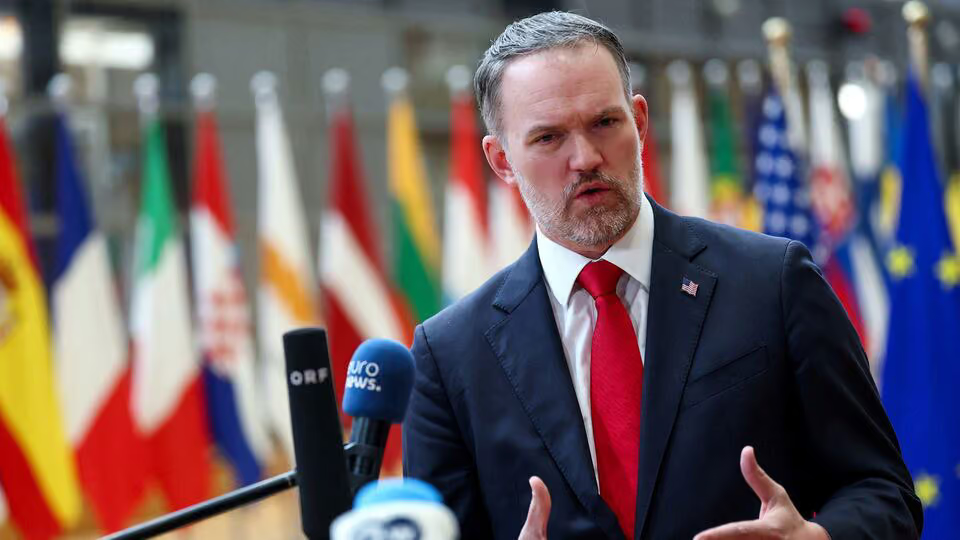
U.S. originator pharmaceutical manufacturers companies like Pfizer, Eli Lilly, and Merck that develop and patent branded medicines stand to gain hundreds of millions of dollars in annual European revenue if this investigation forces Germany to raise reimbursement prices for innovative drugs, but the mechanism through which that happens is far more indirect, and far less certain, than the headline implies.
The U.S. Trade Representative (USTR) the federal office responsible for managing American trade negotiations and enforcing trade law launched a Section 301 investigation on 19 June 2026 into Germany's pharmaceutical reimbursement practices. Section 301 refers to a provision of U.S. trade law that allows the government to investigate foreign practices it considers unfair burdens on U.S. commerce, and crucially to impose retaliatory tariffs if the investigation concludes those practices are actionable. USTR Jamieson Greer framed the probe around a straightforward grievance: a 2024 RAND Corporation study found that U.S. prescription drug prices averaged 2.78 times those in 33 other countries, with the gap sharpest for brand name drugs. Greer's argument is that American patients are effectively cross-subsidising global pharmaceutical research and development costs paying inflated domestic prices so that companies can sell at suppressed regulated prices abroad and still stay solvent. Germany, as Europe's largest pharmaceutical market, is the largest single contributor to that pricing asymmetry. The investigation opens a public comment docket on 25 June 2026, with a public hearing scheduled for September.
The German system at the centre of the dispute is AMNOG the Arzneimittelmarkt-Neuordnungsgesetz, Germany's 2010 law governing how innovative drugs are assessed and priced once they enter the statutory health insurance system (Gesetzliche Krankenversicherung, or GKV). Under AMNOG, a new drug enters the market at the manufacturer's list price for one year while an independent body evaluates its additional clinical benefit compared to existing treatments. That benefit score then determines the negotiated reimbursement price paid by the GKV the network of non-profit public health insurers, known individually as Krankenkassen, that cover roughly 90% of the German population. If the drug shows no additional benefit, the reimbursement is capped at the reference price for existing therapies. In April 2026, Germany's Ministry of Health unveiled a broader healthcare reform package targeting a looming €20 billion funding gap in the GKV, with measures projected to save more than €16 billion and reduce insurance premiums. Part of that package involved reducing spending on innovative medicines though plans for variable discounts were reportedly scaled back after industry opposition, according to reports.
Here is where the numbers matter and where the mechanism becomes genuinely complicated. The Section 301 tool, as used against China to impose punitive tariffs on goods like steel and semiconductors, works because the trade flows in question the actual goods being tariffed are the same goods where the unfair practice occurs. Germany's reimbursement system is a domestic statutory framework, not a trade barrier in the conventional sense. Any Section 301 tariff action against Germany would therefore fall on unrelated German exports to the United States automobiles, industrial machinery, chemicals not on pharmaceuticals directly. Consider a worked example: if Washington imposes a 25% tariff on German auto imports worth $30 billion annually, that generates $7.5 billion in notional tariff revenue, but it does not change what a German Krankenkasse pays for a Pfizer oncology drug by a single euro. The leverage is entirely indirect Germany faces broader economic pain unless it adjusts pharmaceutical pricing separately. This is a blunt instrument problem, and it dilutes the credibility of the threat. The Supreme Court has already struck down significant portions of the Trump administration's earlier tariff architecture, adding further legal uncertainty to any eventual Section 301 action here.
On the sell side, U.S. originator manufacturers with concentrated exposure in high-benefit therapeutic categories oncology, rare diseases, gene therapies stand to capture disproportionate upside if Germany concedes selective pricing improvements to pre-empt broader tariff action. A 10–15% increase in AMNOG reimbursement prices across the top ten innovative drugs sold in Germany could add several hundred million dollars to collective annual European revenues for the largest U.S. pharmaceutical companies. For a large integrated originator with a dedicated market access team, the immediate action is to make formal submissions to the USTR comment docket by 25 June, quantifying the reimbursement gap on specific product lines this is the evidentiary record on which the investigation will rest. For a smaller or mid-sized specialty pharmaceutical company without a dedicated government affairs operation in Washington, the practical equivalent is to participate through industry associations PhRMA, BIO which will aggregate and submit comment packages. On the buy side, German Krankenkassen face direct pressure: any upward revision to innovative drug reimbursement erodes the €16 billion in planned GKV savings, potentially requiring premium increases passed to German workers and employers, or reductions in covered benefits elsewhere.
The forward signal to watch is Germany's legislative response in the weeks following the September public hearing, not the probe itself. If Berlin accelerates the healthcare reform package particularly the provisions reducing innovative medicine spending before the USTR hearing concludes, it signals Germany is not treating the investigation as a serious negotiating lever, and the probability of escalation rises. If Germany instead opens bilateral pricing discussions with Washington, mirroring the April arrangement with the United Kingdom that Greer explicitly cited as the model, the signal is de-escalation and selective market access improvement. Observers should monitor the USTR docket for the volume and specificity of industry submissions by early July, and watch for any statements from the German Federal Ministry of Health (Bundesgesundheitsministerium) on AMNOG reform timelines through August any delay to the cost-saving provisions would indicate Germany is buying negotiating space.


'%3e%3cg id='Final-Copy-2_2_' transform='translate(1275.000000, 200.000000)'%3e%3cpath class='st0' d='M7.4,12.8h6.8l3.1-11.6H7.4C4.2,1.2,1.6,3.8,1.6,7S4.2,12.8,7.4,12.8z'/%3e%3c/g%3e%3c/g%3e%3c/g%3e%3cg id='final---dec.11-2020'%3e%3cg id='_x30_208-our-toggle' transform='translate(-1275.000000, -200.000000)'%3e%3cg id='Final-Copy-2' transform='translate(1275.000000, 200.000000)'%3e%3cpath class='st1' d='M22.6,0H7.4c-3.9,0-7,3.1-7,7s3.1,7,7,7h15.2c3.9,0,7-3.1,7-7S26.4,0,22.6,0z M1.6,7c0-3.2,2.6-5.8,5.8-5.8 h9.9l-3.1,11.6H7.4C4.2,12.8,1.6,10.2,1.6,7z'/%3e%3cpath id='x' class='st2' d='M24.6,4c0.2,0.2,0.2,0.6,0,0.8l0,0L22.5,7l2.2,2.2c0.2,0.2,0.2,0.6,0,0.8c-0.2,0.2-0.6,0.2-0.8,0 l0,0l-2.2-2.2L19.5,10c-0.2,0.2-0.6,0.2-0.8,0c-0.2-0.2-0.2-0.6,0-0.8l0,0L20.8,7l-2.2-2.2c-0.2-0.2-0.2-0.6,0-0.8 c0.2-0.2,0.6-0.2,0.8,0l0,0l2.2,2.2L23.8,4C24,3.8,24.4,3.8,24.6,4z'/%3e%3cpath id='y' class='st3' d='M12.7,4.1c0.2,0.2,0.3,0.6,0.1,0.8l0,0L8.6,9.8C8.5,9.9,8.4,10,8.3,10c-0.2,0.1-0.5,0.1-0.7-0.1l0,0 L5.4,7.7c-0.2-0.2-0.2-0.6,0-0.8c0.2-0.2,0.6-0.2,0.8,0l0,0L8,8.6l3.8-4.5C12,3.9,12.4,3.9,12.7,4.1z'/%3e%3c/g%3e%3c/g%3e%3c/g%3e%3c/g%3e%3c/svg%3e) Privacy Choices
Privacy Choices