.avif)
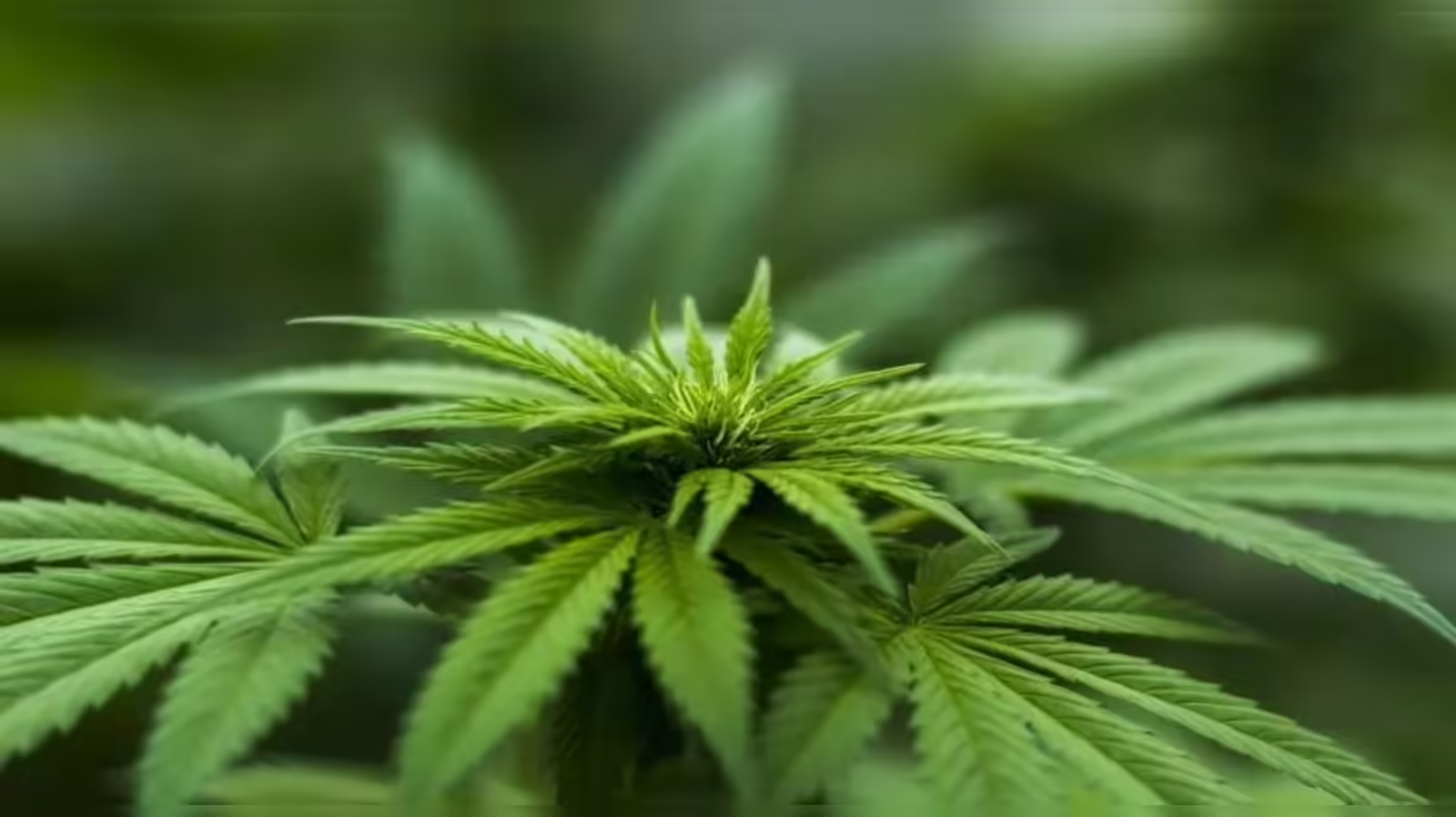
Himachal Pradesh's cabinet approval of regulated cannabis cultivation will not move agricultural input markets this quarter but it will, within 12 to 24 months, create a narrow and lucrative licensing window for the intermediaries who can bridge the gap between hill farmers and qualified industrial buyers, while leaving unprepared input suppliers holding inventory calibrated for crops this policy is designed to replace.
Industrial hemp the low THC (tetrahydrocannabinol, the psychoactive compound) variety of Cannabis sativa, cultivated for fiber, seed oil, and pharmaceutical extracts rather than intoxication is the primary target of the Himachal Pradesh framework, according to reports. The distinction matters commercially. Industrial hemp grown for fiber requires THC content below 0.3% by dry weight, a threshold that determines which buyers, processors, and export markets the crop can access. The medicinal cannabis stream permitted only under strict licensing for pharmaceutical applications including cancer related treatments sits in a separate regulatory category governed by India's NDPS Act (Narcotic Drugs and Psychotropic Substances Act, 1985), which controls the cultivation, processing, and sale of cannabis derived medicines at the central government level. Himachal Pradesh's cabinet can approve a state-level framework, but medicinal cannabis cannot move commercially until the central government issues either an amendment to the NDPS Act or a formal cultivation waiver neither of which has been announced. The minister's comparison to licensed opium cultivation in Madhya Pradesh and Rajasthan undersells the institutional gap: India's opium programme has operated under a continuous licensing infrastructure since the colonial era, with established government procurement through the Opium and Alkaloid Works at Ghazipur. Cannabis has no equivalent.
The physical supply chain problem is concrete. Industrial hemp fiber once harvested requires retting (soaking the stalks in water to separate fiber from the woody core), then decorticating (mechanically stripping that fiber), then spinning. None of this capacity exists at commercial scale in Himachal Pradesh. Consider a licensed farmer in Kullu district planting 2 hectares of hemp, yielding approximately 3–4 tonnes of dry stalk per hectare, or 6–8 tonnes total. At a notional ex-farm price of ₹8,000–10,000 per tonne of retted fiber roughly in line with early stage pilot pricing in Uttarakhand that represents ₹48,000–80,000 in gross revenue per farmer. Without a local decortication unit, that farmer must either sell green stalk at a severe discount to a travelling aggregator, or transport bulky material over mountain roads to distant processors, adding ₹3,000–5,000/tonne in logistics cost and eliminating most of the margin advantage over traditional crops like maize or off-season vegetables. The infrastructure gap is not a future risk. It is the current reality.
On the buy side, textile mills and cosmetics manufacturers sourcing hemp fiber or hemp seed oil will not shift procurement plans until licensed cultivation volumes and consistent fiber specifications are established which requires at minimum one full harvest cycle under the new framework, placing any material supply availability in mid to late 2027 at the earliest. Pharmaceutical buyers face the additional constraint of GMP (Good Manufacturing Practice) certification requirements: any facility processing medicinal cannabis for the Indian pharmaceutical market must meet standards set by the Central Drugs Standard Control Organisation, and no such certified cannabis processing facility is currently operating in Himachal Pradesh, according to available industry records. On the sell side, farmers on marginal hillside land the fallow fields referenced by Minister Negi will not plant without guaranteed offtake, meaning forward purchase agreements or contract farming arrangements must precede any meaningful acreage shift. For agricultural input suppliers, the near-term signal is that hemp requires significantly lower synthetic fertiliser and pesticide inputs than wheat or maize, which compresses conventional agrochemical volumes per hectare. A supplier currently moving, say, ₹15,000–18,000 worth of inputs per hectare of winter wheat in hill districts should model hemp at roughly ₹4,000–6,000 per hectare a 65–70% volume reduction on any land that converts.
For large integrated agricultural input distributors companies with national footprints and product lines spanning seed treatment, micronutrient blends, and crop specific biostimulants the opportunity is to develop hemp specific input packages now, before competitors, and position for early licensing rounds. This means engaging with the Himachal Pradesh Department of Agriculture in the next 90 days to understand which seed varieties will be approved, since certified low THC seed is itself a constrained input with only a handful of registered suppliers in India. For smaller regional input dealers in districts like Kullu, Mandi, or Kangra, the practical equivalent is to avoid aggressive inventory build for hemp-specific products until at least one licensed pilot harvest confirms commercial viability the policy approval is real, but the market is not. For observers tracking whether this framework acquires commercial weight, the specific signal to watch is the Himachal Pradesh Agriculture Department's gazette notification of approved cultivar (seed variety) lists and the issuance of the first tranche of cultivation licenses, both of which must precede any planting season. If those notifications do not appear before the October 2026 rabi sowing window, meaningful commercial activity shifts to kharif 2027 at the earliest.

.jpg)
'%3e%3cg id='Final-Copy-2_2_' transform='translate(1275.000000, 200.000000)'%3e%3cpath class='st0' d='M7.4,12.8h6.8l3.1-11.6H7.4C4.2,1.2,1.6,3.8,1.6,7S4.2,12.8,7.4,12.8z'/%3e%3c/g%3e%3c/g%3e%3c/g%3e%3cg id='final---dec.11-2020'%3e%3cg id='_x30_208-our-toggle' transform='translate(-1275.000000, -200.000000)'%3e%3cg id='Final-Copy-2' transform='translate(1275.000000, 200.000000)'%3e%3cpath class='st1' d='M22.6,0H7.4c-3.9,0-7,3.1-7,7s3.1,7,7,7h15.2c3.9,0,7-3.1,7-7S26.4,0,22.6,0z M1.6,7c0-3.2,2.6-5.8,5.8-5.8 h9.9l-3.1,11.6H7.4C4.2,12.8,1.6,10.2,1.6,7z'/%3e%3cpath id='x' class='st2' d='M24.6,4c0.2,0.2,0.2,0.6,0,0.8l0,0L22.5,7l2.2,2.2c0.2,0.2,0.2,0.6,0,0.8c-0.2,0.2-0.6,0.2-0.8,0 l0,0l-2.2-2.2L19.5,10c-0.2,0.2-0.6,0.2-0.8,0c-0.2-0.2-0.2-0.6,0-0.8l0,0L20.8,7l-2.2-2.2c-0.2-0.2-0.2-0.6,0-0.8 c0.2-0.2,0.6-0.2,0.8,0l0,0l2.2,2.2L23.8,4C24,3.8,24.4,3.8,24.6,4z'/%3e%3cpath id='y' class='st3' d='M12.7,4.1c0.2,0.2,0.3,0.6,0.1,0.8l0,0L8.6,9.8C8.5,9.9,8.4,10,8.3,10c-0.2,0.1-0.5,0.1-0.7-0.1l0,0 L5.4,7.7c-0.2-0.2-0.2-0.6,0-0.8c0.2-0.2,0.6-0.2,0.8,0l0,0L8,8.6l3.8-4.5C12,3.9,12.4,3.9,12.7,4.1z'/%3e%3c/g%3e%3c/g%3e%3c/g%3e%3c/g%3e%3c/svg%3e) Privacy Choices
Privacy Choices