.avif)
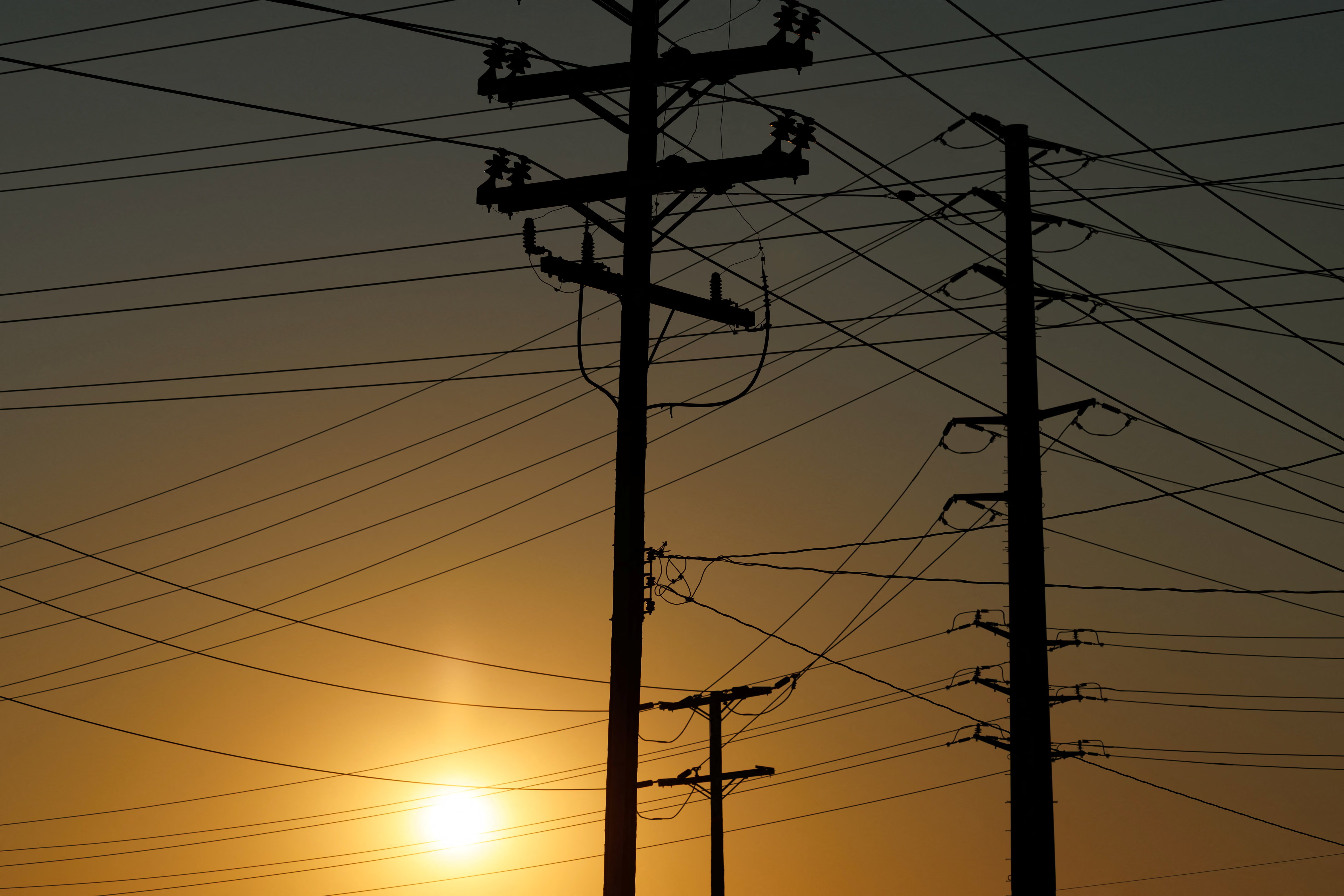
Global infrastructure investors face a live acquisition decision worth approximately $1.5 billion as BHP prepares to divest roughly 1,000 kilometres of dedicated power transmission lines in northern Chile, with a deal potentially closing before the end of 2026. These lines are the electrical backbone of three of the world's most significant copper operations: Escondida the single largest copper mine on the planet by output Spence, and the currently idled Cerro Colorado. For infrastructure capital hunting regulated, long duration yield in emerging markets, the opportunity is structurally attractive. But it carries an embedded complication from day one: Cerro Colorado is not producing, meaning the buyer inherits stranded capacity on one segment of a 1,000 kilometre network before the ink is dry.
The margin anatomy of this transaction is a textbook infrastructure deal dressed in mining clothes. Regulated transmission tariffs fees set by Chile's National Energy Commission (CNE) and periodically reviewed, which transmission owners charge for allowing electricity to flow across their lines generate the revenue. At a $1.5 billion deal value and applying standard infrastructure valuation multiples of 12–18 times EBITDA (earnings before interest, tax, depreciation, and amortisation the operating cash flow measure used to value infrastructure assets), the implied annual EBITDA on these lines is approximately $80–120 million. That is the income stream a buyer is pricing. The critical variable the market does not yet know is the structure of the long-term power purchase agreement, or PPA the contract that will govern how much BHP pays the new owner for electricity transmission access. If that PPA lacks price caps or inflation linked floors, BHP has converted a balance sheet asset into a recurring P&L cost exposed to every future Chilean tariff reset cycle.
On the sell side, BHP's logic is clean capital recycling, and the numbers support the strategy. The company is deploying an asset-light model owning the ore body, not the supporting infrastructure to free balance sheet for higher return mining investment. Energy is a top five operating cost at Escondida, where electricity powers the grinding mills that crush copper ore before flotation. BHP already executed a comparable divestment in Australia, selling a 49% stake in transmission assets serving its Pilbara iron ore operations for $2 billion. That precedent establishes the playbook. The proceeds from Chile would be redeployed toward BHP's Vicuña copper district in Argentina a combined development of the Josemaría and Filo del Sol deposits with initial capital expenditure of $9.7 billion and total investment potentially reaching $18 billion which recently cleared approval under Argentina's RIGI framework (the Large Investment Incentive Regime, a regulatory structure designed to provide tax stability and repatriation rights for large foreign investments). Capital freed from Chilean power lines flows directly into the ground in Argentina.
On the buy side, the acquirer acquires a utility like asset anchored to guaranteed industrial demand but the qualifier matters. Escondida and Spence are operating mines with multi-decade reserve lives, meaning the load on most of the network is real and durable. Consider a global infrastructure fund paying $1.5 billion at a 13x EBITDA multiple, implying approximately $115 million in annual operating earnings. At a 6% cost of capital typical for investment grade infrastructure, the fund needs stable, predictable cash flows for roughly 25 years to justify the entry price. A Chilean tariff reset that increases transmission costs for BHP, or a regulatory intervention introducing carbon linked charges on fossil generation sourced electricity flowing through these lines, would compress BHP's willingness to sign a long duration PPA at fixed rates. The buyer's return model is only as secure as the PPA structure and that document does not yet exist publicly.
The two scales of investor face meaningfully different risk profiles here. For a large integrated infrastructure investor a Brookfield Infrastructure, a Macquarie Asset Management, or the infrastructure arm of a sovereign wealth fund this is a core plus asset with manageable emerging market risk. Chile's regulated transmission sector has a 25 year track record of CNE tariff processes, independent regulatory governance, and no history of expropriation of transmission assets. These investors can hedge Chilean peso revenue exposure through long dated currency swaps, model the Cerro Colorado idle risk as a bounded downside, and price the PPA negotiation as a known variable. For a smaller regional infrastructure investor a Latin American pension fund, a mid-sized energy infrastructure specialist without global derivatives access the stranded capacity risk on Cerro Colorado is not a bounded variable; it is a genuine cash flow gap from day one. A 1,000 kilometre network where one anchor customer segment is producing zero load means fixed operating costs line maintenance, safety compliance, grid connection fees are unrecovered on that portion until the mine restarts or the capacity is recontracted to a third party. That is not fatal, but it changes the entry price calculus meaningfully.
The valuation arbitrage embedded in this deal is worth stating explicitly. Chilean regulated transmission assets have historically priced at a discount to comparable Australian or European infrastructure multiples not because the regulatory framework is weaker, but because global capital assigns an emerging market risk premium to anything denominated in Chilean pesos and governed by South American regulatory cycles. European regulated transmission assets Elia in Belgium, REE in Spain trade at 15–20x EBITDA. If Chilean mining transmission clears at 12–13x due to perceived political risk, a global infrastructure fund with demonstrated emerging market experience is buying at a structural discount to intrinsic value. The arbitrage is not in the commodity it is in the capital market's pricing of geography. For investors who have already deployed in Chilean water, toll roads, or renewable energy, the incremental country risk is near-zero; they are paying a discount for risk they have already absorbed into their platform.
Observers should track three concrete signals before this deal closes. First, watch Chile's CNE for any announced review of mining transmission tariff methodology CNE tariff cycles typically run on four year schedules, with the next major review window opening in 2027; any pre-announcement of methodology changes before deal close would materially reprice the asset. Second, monitor whether BHP files any regulatory disclosure referencing PPA term length or price-indexation structure that single contractual variable determines whether the buyer has a utility or a merchant exposure. Third, watch Cerro Colorado: any BHP announcement of restart planning or care and maintenance investment at that site would immediately reduce the stranded capacity discount embedded in current deal pricing. A mine restart timeline of 18–24 months changes the buyer's underwriting from a liability to a near-term revenue recovery. The deal is priced; the contract is not. That gap is where margin is made or lost.




'%3e%3cg id='Final-Copy-2_2_' transform='translate(1275.000000, 200.000000)'%3e%3cpath class='st0' d='M7.4,12.8h6.8l3.1-11.6H7.4C4.2,1.2,1.6,3.8,1.6,7S4.2,12.8,7.4,12.8z'/%3e%3c/g%3e%3c/g%3e%3c/g%3e%3cg id='final---dec.11-2020'%3e%3cg id='_x30_208-our-toggle' transform='translate(-1275.000000, -200.000000)'%3e%3cg id='Final-Copy-2' transform='translate(1275.000000, 200.000000)'%3e%3cpath class='st1' d='M22.6,0H7.4c-3.9,0-7,3.1-7,7s3.1,7,7,7h15.2c3.9,0,7-3.1,7-7S26.4,0,22.6,0z M1.6,7c0-3.2,2.6-5.8,5.8-5.8 h9.9l-3.1,11.6H7.4C4.2,12.8,1.6,10.2,1.6,7z'/%3e%3cpath id='x' class='st2' d='M24.6,4c0.2,0.2,0.2,0.6,0,0.8l0,0L22.5,7l2.2,2.2c0.2,0.2,0.2,0.6,0,0.8c-0.2,0.2-0.6,0.2-0.8,0 l0,0l-2.2-2.2L19.5,10c-0.2,0.2-0.6,0.2-0.8,0c-0.2-0.2-0.2-0.6,0-0.8l0,0L20.8,7l-2.2-2.2c-0.2-0.2-0.2-0.6,0-0.8 c0.2-0.2,0.6-0.2,0.8,0l0,0l2.2,2.2L23.8,4C24,3.8,24.4,3.8,24.6,4z'/%3e%3cpath id='y' class='st3' d='M12.7,4.1c0.2,0.2,0.3,0.6,0.1,0.8l0,0L8.6,9.8C8.5,9.9,8.4,10,8.3,10c-0.2,0.1-0.5,0.1-0.7-0.1l0,0 L5.4,7.7c-0.2-0.2-0.2-0.6,0-0.8c0.2-0.2,0.6-0.2,0.8,0l0,0L8,8.6l3.8-4.5C12,3.9,12.4,3.9,12.7,4.1z'/%3e%3c/g%3e%3c/g%3e%3c/g%3e%3c/g%3e%3c/svg%3e) Privacy Choices
Privacy Choices