.avif)
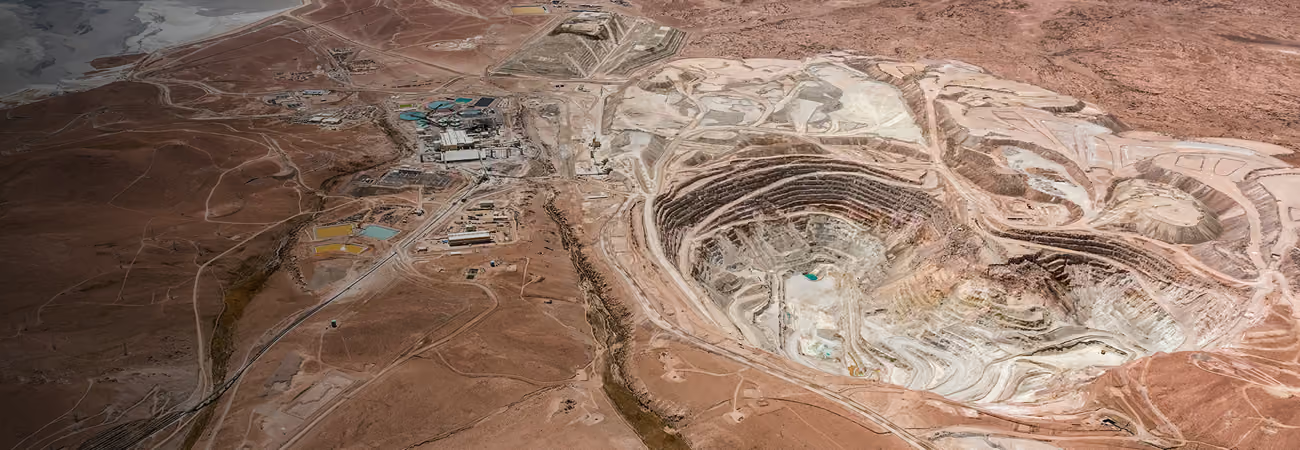
Anglo American and Glencore's $3.2 billion Collahuasi copper mine expansion faces permit reversal after Chile's Second Environmental Tribunal overturned the 2021 environmental authorization for its near-complete desalination plant on May 15. The project's $3.2 billion capital value positions it among Chile's most significant mining infrastructure investments, involving a coastal desalination facility at Puerto Patache pumping treated seawater through a 194 kilometre pipeline to the mine site. The environmental tribunal system a specialized legal framework that provides independent judicial review of administrative approvals beyond pollution disputes now requires the Environmental Assessment Service (SEA) to re-examine community impact assessments and marine environment studies. Collahuasi produces more than 550,000 tonnes of copper annually, employs close to 5,000 people, and represents over 2% of global known reserves.
The tribunal's ruling is limited to two specific aspects: analysis of effects on a local community and impacts on the marine environment. The desalination plant at Punta Patache would operate at 525 litres per second initially, expanding to 1,050 litres per second from year eight, but the tribunal found suction speed verification inadequate, brine sedimentation unmodeled for medium and long-term impacts, and marine monitoring limited to five years despite capacity expansions. The ruling highlights a critical gap in Chile's mining permit framework: the Collahuasi environmental approval was secured in December 2021, reaffirmed by the Committee of Ministers in August 2023, then annulled in May 2026 demonstrating that administrative approval does not constitute permanent resolution of legal exposure, with court challenges materializing years into implementation when significant capital has already been deployed. For investors modeling Chilean mining project risk, this dynamic argues for incorporating longer tails on regulatory uncertainty in project timelines, building scenario analysis around potential re-evaluation periods of 12 to 36 months.
LME copper closed at $13,380 per tonne on May 18, maintaining elevated levels as supply concerns persist. Consider the margin arithmetic for a mid-sized copper trader hedging Collahuasi exposure: a 25,000 tonne LME contract at current levels represents $334.5 million of underlying value. With Collahuasi's 2025 production of 406,100 tonnes down 27.3% year over year due to lower ore grades and recovery, any operational disruption compounds existing supply tightness. For a trading house managing 100,000 tonnes of annual Collahuasi offtake contracts, even a six month delay in the desalination plant translates to water sourcing costs of approximately $8–12 per tonne of copper, erasing margins on spot transactions where the bid-offer spread averages $15–20 per tonne. The infrastructure represents sunk capital approaching completion Anglo American stated the desalination plant would meet a large portion of the mine's water requirements by mid-2026 when fully operational creating immediate stranded asset exposure for the joint venture partners.
On the buy side: Large integrated copper consumers (major wire manufacturers, automotive OEMs with electric vehicle programs) with long-term supply contracts from Collahuasi face potential volume shortfalls if water constraints limit production during the reassessment period. A typical automotive manufacturer securing 15,000 tonnes annually through fixed-price contracts now confronts replacement costs at spot premiums of $50–80 per tonne above contract terms. On the sell side: Collahuasi's consortium Glencore (44%), Anglo American (44%), and Mitsui (12%) faces immediate write-down pressure on infrastructure investment if the tribunal ruling stands. Despite companies stating no immediate disruption to copper production due to alternative water sources, the joint venture must absorb legal costs, potential reconstruction expenses, and extended permitting timelines while servicing debt on near-complete infrastructure. For intermediaries: copper traders positioning for supply disruptions can capitalize on forward curve steepening if permit delays extend beyond Q3 2026, with three-month futures trading at premiums to cash reflecting physical tightness.
For large integrated miners with derivatives access: hedge forward production through LME options structures, selling three-month calls at $14,000 per tonne while buying six month puts at $12,500 per tonne to protect against permit-driven supply disruption. Cost: approximately $180 per tonne for collar protection on 50,000 tonne exposure. For regional copper miners without derivatives access: diversify water sourcing through bilateral agreements with desalination operators, fix trucked water supplies for six month periods, and adjust production schedules to stockpile during optimal water availability windows. The broader permitting landscape faces structural bottlenecks Chile's General Water Directorate has more than 22,000 pending permit applications, representing a systemic mismatch between infrastructure demands and administrative capacity. For observers: monitor SEA announcements on reassessment timelines by July 15, 2026. If the environmental authority fails to provide clarity on specific re-examination requirements within 60 days, expect broader uncertainty across Chile's $100 billion mining project pipeline.




'%3e%3cg id='Final-Copy-2_2_' transform='translate(1275.000000, 200.000000)'%3e%3cpath class='st0' d='M7.4,12.8h6.8l3.1-11.6H7.4C4.2,1.2,1.6,3.8,1.6,7S4.2,12.8,7.4,12.8z'/%3e%3c/g%3e%3c/g%3e%3c/g%3e%3cg id='final---dec.11-2020'%3e%3cg id='_x30_208-our-toggle' transform='translate(-1275.000000, -200.000000)'%3e%3cg id='Final-Copy-2' transform='translate(1275.000000, 200.000000)'%3e%3cpath class='st1' d='M22.6,0H7.4c-3.9,0-7,3.1-7,7s3.1,7,7,7h15.2c3.9,0,7-3.1,7-7S26.4,0,22.6,0z M1.6,7c0-3.2,2.6-5.8,5.8-5.8 h9.9l-3.1,11.6H7.4C4.2,12.8,1.6,10.2,1.6,7z'/%3e%3cpath id='x' class='st2' d='M24.6,4c0.2,0.2,0.2,0.6,0,0.8l0,0L22.5,7l2.2,2.2c0.2,0.2,0.2,0.6,0,0.8c-0.2,0.2-0.6,0.2-0.8,0 l0,0l-2.2-2.2L19.5,10c-0.2,0.2-0.6,0.2-0.8,0c-0.2-0.2-0.2-0.6,0-0.8l0,0L20.8,7l-2.2-2.2c-0.2-0.2-0.2-0.6,0-0.8 c0.2-0.2,0.6-0.2,0.8,0l0,0l2.2,2.2L23.8,4C24,3.8,24.4,3.8,24.6,4z'/%3e%3cpath id='y' class='st3' d='M12.7,4.1c0.2,0.2,0.3,0.6,0.1,0.8l0,0L8.6,9.8C8.5,9.9,8.4,10,8.3,10c-0.2,0.1-0.5,0.1-0.7-0.1l0,0 L5.4,7.7c-0.2-0.2-0.2-0.6,0-0.8c0.2-0.2,0.6-0.2,0.8,0l0,0L8,8.6l3.8-4.5C12,3.9,12.4,3.9,12.7,4.1z'/%3e%3c/g%3e%3c/g%3e%3c/g%3e%3c/g%3e%3c/svg%3e) Privacy Choices
Privacy Choices