.avif)
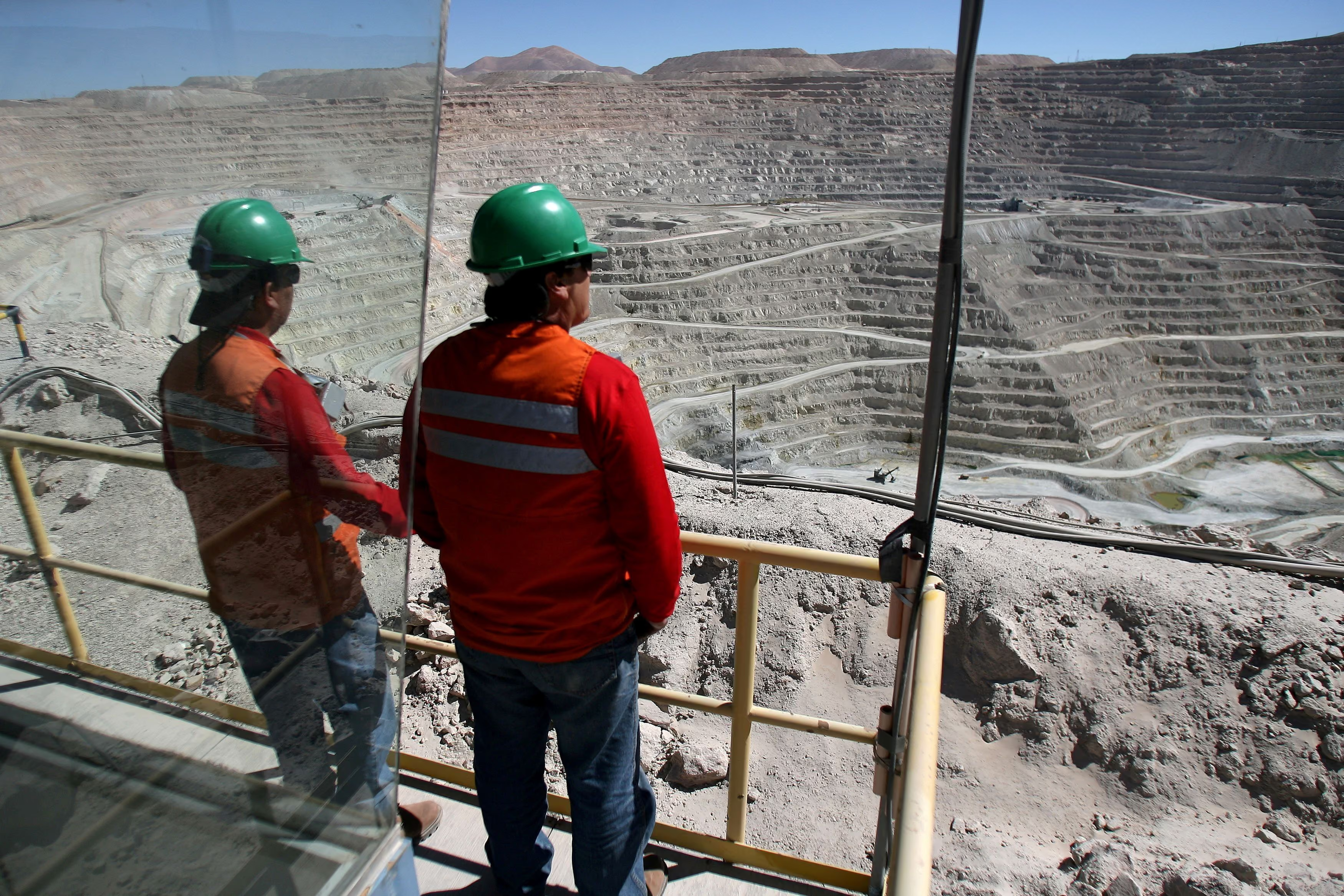
Chilean copper miners face immediate cash flow pressure as Q1 2026 production falls 6% year over year while domestic GDP contracts 0.5%, marking the country's first economic contraction in three years. The mining sector declined 3.1% annually, functioning as the dominant drag on headline growth, while Codelco, the state owned producer, recorded 7.5% lower output and BHP's Escondida mine contracted 15.75% in March alone. For miners operating at current copper prices near $6.25/lb, each percentage point of lost production translates to approximately $280 million in foregone revenue across Chile's 5.3 million tonne annual capacity.
Ore grade deterioration the gradual decline in copper concentration per tonne of rock as mining progresses deeper into a resource directly affects production volumes even when processing rates remain constant and structurally increases cost per pound of copper produced. This is not a temporary operational setback but permanent geological reality. At BHP's Spence mine, production fell 34.4% year on year to 44,600 tonnes, with the drop mainly linked to lower ore grades and challenges associated with managing ore complexity. Codelco's El Teniente mine recorded the largest loss, with output of 18,100 tonnes, 29.5% below January 2025 levels, following the July 2025 incident that killed six workers and disrupted operations. A worked example: Chile's largest mine, Escondida, processes approximately 400,000 tonnes of ore daily. A grade decline from 0.8% to 0.7% copper content reduces daily copper output by 320 tonnes equivalent to losing $700,000 in revenue at current prices, compounding across 365 operating days.
On the buy side, global copper fabricators and manufacturers face immediate supply chain risk from sustained Chilean underperformance. European cable manufacturers, Chinese electronics producers, and North American grid infrastructure contractors cannot easily substitute Chilean cathode the refined copper product that feeds manufacturing with alternatives on short notice. Contract terms typically lock buyers into quarterly delivery schedules, meaning Q2 2026 shortfalls are already impacting production planning. On the sell side, Chilean copper miners lose margin through higher processing costs per unit output as ore grades decline. The economic consequence is a mine that becomes progressively more expensive to operate relative to the copper it delivers. Fiscal space is similarly compressed by lower mining-related tax revenues, reducing the government's counter cyclical spending capacity. For traders and intermediaries, margin concentrates in physical copper inventories and forward contracts, as the gap between available supply and contractual commitments widens.
For large integrated traders Trafigura, Glencore, Codelco's own trading arm with derivatives access: LME three-month copper futures at $13,380/tonne provide direct hedging against Chilean supply disruptions, with each 25 tonne contract representing $334,500 in exposure. Treatment and refining charges (TC/RCs) have hit all-time lows, with the annual benchmark settling at $0 per tonne in January 2026, meaning smelters pay miners rather than charging fees an unprecedented reversal that benefits concentrate producers while squeezing midstream margins. For smaller regional operators mid-sized fabricators, independent copper distributors, regional electrical cooperatives without derivatives access: bilateral supply agreements with non-Chilean producers become critical, even at premium pricing. Securing direct relationships with Peruvian miners, Congolese operations, or North American producers provides practical equivalent protection. Inventory diversification across multiple supply sources reduces single-country concentration risk, particularly given Chile's 25% global market share.
J.P. Morgan projects a refined copper deficit of roughly 330,000 metric tonnes in 2026, driven by supply disruptions combined with surging demand from artificial intelligence infrastructure, energy transition, and defense spending. The copper concentrate market is expected to remain tight for years, with a cumulative deficit of ~3 million tonnes projected by 2036. Codelco's multi-year structural investment programme to unlock access to higher-grade ore bodies at depth across several flagship mines could position the company for production recovery beginning in late 2026 or extending into 2027. For observers: monitor Cochilco's monthly statistical bulletins for Chilean production data, released approximately 45 days after month-end. Watch LME warehouse stock reports for inventory drawdowns below 200,000 tonnes a level that historically triggers supply emergency protocols. Track the Shanghai Futures Exchange copper premium to LME prices; sustained premiums above $100/tonne signal Asian physical tightness that could accelerate Chilean revenue recovery despite lower production volumes.





'%3e%3cg id='Final-Copy-2_2_' transform='translate(1275.000000, 200.000000)'%3e%3cpath class='st0' d='M7.4,12.8h6.8l3.1-11.6H7.4C4.2,1.2,1.6,3.8,1.6,7S4.2,12.8,7.4,12.8z'/%3e%3c/g%3e%3c/g%3e%3c/g%3e%3cg id='final---dec.11-2020'%3e%3cg id='_x30_208-our-toggle' transform='translate(-1275.000000, -200.000000)'%3e%3cg id='Final-Copy-2' transform='translate(1275.000000, 200.000000)'%3e%3cpath class='st1' d='M22.6,0H7.4c-3.9,0-7,3.1-7,7s3.1,7,7,7h15.2c3.9,0,7-3.1,7-7S26.4,0,22.6,0z M1.6,7c0-3.2,2.6-5.8,5.8-5.8 h9.9l-3.1,11.6H7.4C4.2,12.8,1.6,10.2,1.6,7z'/%3e%3cpath id='x' class='st2' d='M24.6,4c0.2,0.2,0.2,0.6,0,0.8l0,0L22.5,7l2.2,2.2c0.2,0.2,0.2,0.6,0,0.8c-0.2,0.2-0.6,0.2-0.8,0 l0,0l-2.2-2.2L19.5,10c-0.2,0.2-0.6,0.2-0.8,0c-0.2-0.2-0.2-0.6,0-0.8l0,0L20.8,7l-2.2-2.2c-0.2-0.2-0.2-0.6,0-0.8 c0.2-0.2,0.6-0.2,0.8,0l0,0l2.2,2.2L23.8,4C24,3.8,24.4,3.8,24.6,4z'/%3e%3cpath id='y' class='st3' d='M12.7,4.1c0.2,0.2,0.3,0.6,0.1,0.8l0,0L8.6,9.8C8.5,9.9,8.4,10,8.3,10c-0.2,0.1-0.5,0.1-0.7-0.1l0,0 L5.4,7.7c-0.2-0.2-0.2-0.6,0-0.8c0.2-0.2,0.6-0.2,0.8,0l0,0L8,8.6l3.8-4.5C12,3.9,12.4,3.9,12.7,4.1z'/%3e%3c/g%3e%3c/g%3e%3c/g%3e%3c/g%3e%3c/svg%3e) Privacy Choices
Privacy Choices