.avif)
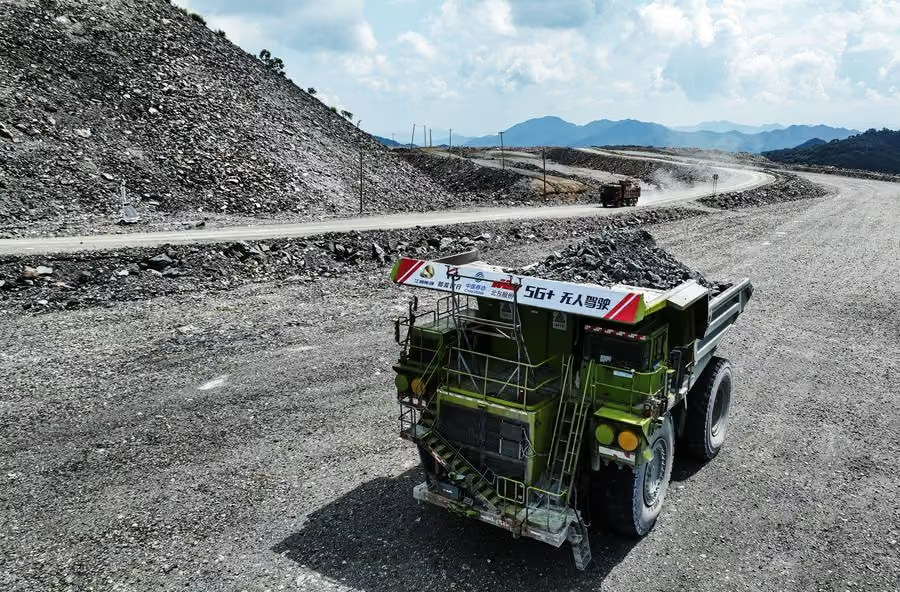
Western buyers of gallium, germanium, rare earth oxides, and processed graphite face structurally constrained supply options with no credible alternative sourcing pathway available at scale before 2030 a reality that China's Ministry of Natural Resources made explicit at a Beijing press conference on 29 April 2026, releasing data confirming China holds the world's largest mineral reserves in 14 categories and ranked first in production for 17 minerals in 2025.
The figures span a wide range of materials that sit at the physical heart of modern industrial economies. Rare earths a group of 17 metallic elements essential for permanent magnets in electric motors and wind turbines tungsten, tin, molybdenum, antimony, gallium, germanium, indium, fluorite, and graphite are among the 14 reserve categories where China leads globally. On the production side, the 17 minerals where China ranked first in 2025 include coal, vanadium, zinc, titanium, phosphorus, and tellurium alongside the reserve leaders already named. Critically, output of 11 of those 17 minerals accounted for more than half of all global production. This is not market leadership in the ordinary sense. When one country produces more than 50% of a globally traded material, buyers have no realistic price discovery mechanism independent of that country's domestic economics, policy decisions, or export controls.
The more commercially decisive figure, however, is not in the reserves or production data at all it is in downstream processing. China leads output in more than 30 metallurgical products, with 17 of them representing approximately half of global production. For minerals like gallium and germanium, Chinese refining and chemical conversion capacity runs at 80–95% of the global total, according to industry estimates. Even where ore deposits exist outside China in Australia, Canada, the DRC, and Brazil the infrastructure to convert raw ore into usable refined product does not exist at scale outside Chinese borders. Building that infrastructure from a standing start takes five to seven years and billions in capital, and no project currently permitted and funded will change the supply balance before 2030. The processing chokepoint is structurally more durable than the reserve dominance the Ministry's press conference chose to headline.
Consider a worked example. A European battery manufacturer sourcing spherical graphite the refined form used in lithium-ion battery anodes pays approximately $1,200–1,500 per tonne for Chinese processed product under current long-term contract terms. The same manufacturer's procurement team has evaluated Australian natural graphite projects. The ore is available. The mine can be permitted. But the nearest non-Chinese spherical graphite processing facility capable of anode grade output at scale does not exist in Europe or North America today. The cost of building it, amortised over initial production volumes, adds an estimated $800–1,200/MT to the delivered cost of the first several years of output effectively doubling the landed price before any logistics premium. The buyer does not switch. The current contract is renewed, at terms set by the Chinese supplier. This dynamic repeats across gallium, germanium, rare earth oxides, and indium with minor variations in the cost arithmetic but identical structural logic.
On the buy side, Western industrial consumers EV manufacturers, defence electronics OEMs, solar panel producers, and semiconductor fabricators face a procurement environment where price negotiation leverage is structurally limited. Where China controls more than 50% of global supply of a processed material, the seller sets the reference price and buyers absorb it or reduce volumes. For a mid-sized European EV drivetrain manufacturer consuming approximately 15 tonnes of neodymium-iron-boron magnet alloy per month neodymium being a rare earth element central to the permanent magnets that power electric motors a 15% increase in rare earth oxide prices (within the range seen during past Chinese export restriction episodes) compresses manufacturing margin by roughly $180–240 per vehicle before any downstream price adjustment. On the sell side, Chinese state mining enterprises and processors hold a structurally reinforced pricing position. The Ministry's public data release itself functions as a sovereign signal: the reserve and production figures remind counterparties in spot and short-term contract negotiations that no credible alternative exists. Premium capture on gallium, germanium, and rare earth oxides could expand 10–30% in any scenario involving export licensing tightening, based on price behaviour observed after China's 2023 gallium and germanium export controls.
For a large integrated trader a Trafigura, a Glencore, or the trading arm of a Japanese sogo shosha (a diversified general trading company with commodity origination and financial hedging capabilities) the practical instrument is a combination of long-term offtake agreements with the few non-Chinese projects approaching production readiness, combined with options on minor metal price indices where derivatives liquidity exists. The Fastmarkets gallium index and the Asian Metal germanium price series are the two most directly relevant reference points. For a smaller regional operator a mid-sized distributor supplying processed rare earth materials to European defence subcontractors, for example derivatives access is limited or non-existent, and the practical equivalent is bilateral supply agreements with explicit price caps, diversification across Chinese suppliers to reduce single counterparty risk, and modest strategic inventory (a 90 day forward stock position is achievable for most processed rare earth products without prohibitive carrying cost at current volumes). Neither strategy removes the structural dependency. Both reduce the worst-case exposure.
The specific signal to watch, with a defined time window, is China's export licensing renewal cadence for gallium and germanium, which operates on an annual cycle, with the next review period visible through the Ministry of Commerce (MOFCOM) announcement schedule in Q3 2026. If China tightens the licensing criteria or reduces the approved export volume quota as it did in August 2023, when gallium prices outside China rose approximately 20% within eight weeks of the control announcement that is the earliest and most commercially actionable warning of a margin event for buyers and a pricing opportunity for sellers. The Ministry of Natural Resources data released on 29 April reinforces the structural backdrop. It does not change the immediate supply position. But it narrows the diplomatic space for Western governments seeking voluntary Chinese cooperation on critical mineral access and increases the probability that the next restriction episode, if it comes, is met with fewer off-ramp options than the last.






'%3e%3cg id='Final-Copy-2_2_' transform='translate(1275.000000, 200.000000)'%3e%3cpath class='st0' d='M7.4,12.8h6.8l3.1-11.6H7.4C4.2,1.2,1.6,3.8,1.6,7S4.2,12.8,7.4,12.8z'/%3e%3c/g%3e%3c/g%3e%3c/g%3e%3cg id='final---dec.11-2020'%3e%3cg id='_x30_208-our-toggle' transform='translate(-1275.000000, -200.000000)'%3e%3cg id='Final-Copy-2' transform='translate(1275.000000, 200.000000)'%3e%3cpath class='st1' d='M22.6,0H7.4c-3.9,0-7,3.1-7,7s3.1,7,7,7h15.2c3.9,0,7-3.1,7-7S26.4,0,22.6,0z M1.6,7c0-3.2,2.6-5.8,5.8-5.8 h9.9l-3.1,11.6H7.4C4.2,12.8,1.6,10.2,1.6,7z'/%3e%3cpath id='x' class='st2' d='M24.6,4c0.2,0.2,0.2,0.6,0,0.8l0,0L22.5,7l2.2,2.2c0.2,0.2,0.2,0.6,0,0.8c-0.2,0.2-0.6,0.2-0.8,0 l0,0l-2.2-2.2L19.5,10c-0.2,0.2-0.6,0.2-0.8,0c-0.2-0.2-0.2-0.6,0-0.8l0,0L20.8,7l-2.2-2.2c-0.2-0.2-0.2-0.6,0-0.8 c0.2-0.2,0.6-0.2,0.8,0l0,0l2.2,2.2L23.8,4C24,3.8,24.4,3.8,24.6,4z'/%3e%3cpath id='y' class='st3' d='M12.7,4.1c0.2,0.2,0.3,0.6,0.1,0.8l0,0L8.6,9.8C8.5,9.9,8.4,10,8.3,10c-0.2,0.1-0.5,0.1-0.7-0.1l0,0 L5.4,7.7c-0.2-0.2-0.2-0.6,0-0.8c0.2-0.2,0.6-0.2,0.8,0l0,0L8,8.6l3.8-4.5C12,3.9,12.4,3.9,12.7,4.1z'/%3e%3c/g%3e%3c/g%3e%3c/g%3e%3c/g%3e%3c/svg%3e) Privacy Choices
Privacy Choices