.avif)
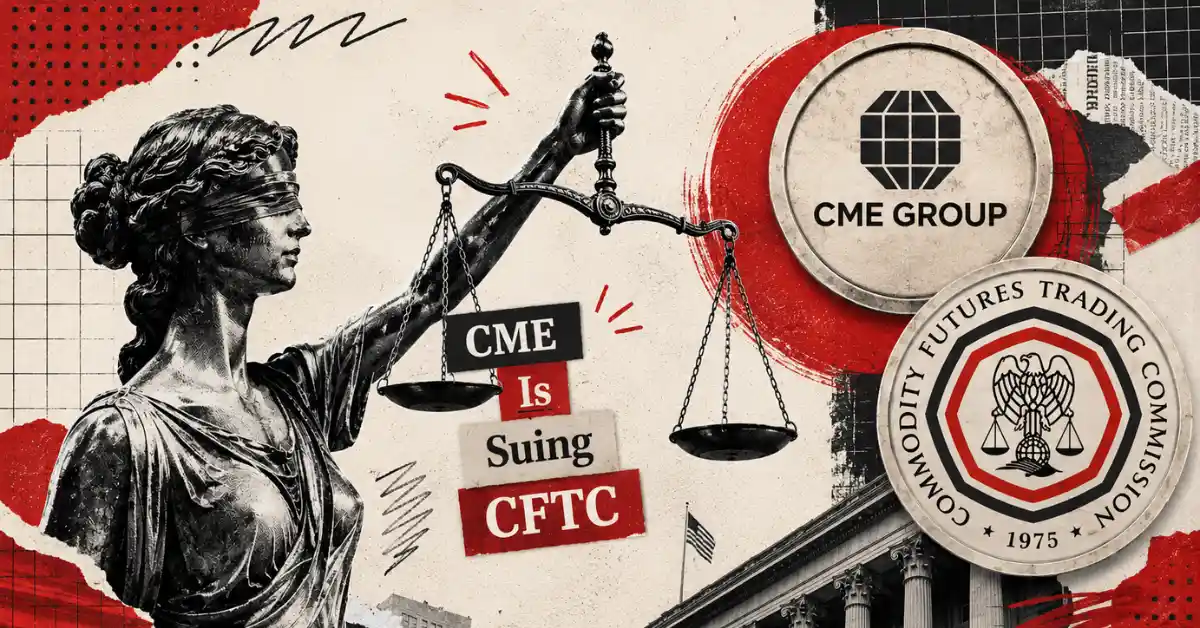
CME Group's benchmark licensing revenue and clearing fee income face structural erosion starting June 19, 2026, when the exchange files suit against the CFTC over its approval of Kalshi's bitcoin perpetual futures a regulatory greenlight that, if it holds, could permanently bifurcate U.S. crypto derivatives market structure away from CME's infrastructure.
A perpetual future a derivatives contract that, unlike a standard futures contract, never expires and instead adjusts its price continuously through a "funding rate" (a periodic payment exchanged between buyers and sellers to keep the contract price anchored to the underlying spot market) has been the dominant instrument on offshore crypto exchanges for years. Binance, OKX, and Bybit collectively process multi-trillion dollars in annual notional volume through crypto perps, entirely outside CFTC jurisdiction. That is the structural reality CME CEO Terry Duffy's lawsuit cannot change. The legal question is narrower but commercially significant: should U.S. regulated perpetual futures be classified as swaps under the Dodd-Frank Act the 2010 legislation that imposed comprehensive oversight on over the counter derivatives rather than as futures? CME's argument is that they should, and that this reclassification would require benchmark products to route through CME's licensed clearing infrastructure. CFTC Chairman Michael Selig has publicly defended the approval, saying "the time had come" to allow regulated perps in the U.S. with "appropriate oversight," setting up a direct institutional collision.
The commercial mechanics of what Duffy is contesting are worth examining carefully. Perpetual futures carry leverage of up to 50 to 1, meaning a trader posting $2,000 in margin controls a $100,000 bitcoin position. The funding rate say, 0.03% every eight hours, a common offshore rate during trending markets costs that trader $30 per eight hour period, or roughly $1,095 annually on a held position. At 50:1, a 2% adverse move wipes the entire margin, triggering automated liquidation before the trader can manually intervene. Duffy's "corrosive" warning to retail investors is arithmetically grounded. The CFTC's counterargument is that bringing perps onshore, under position limits and margin rules, reduces rather than increases that danger. Both positions are defensible the lawsuit will force a court to choose between them, and the resolution will define U.S. crypto derivatives regulation for the next decade.
On the buy side, institutional crypto desks and hedge funds gain the most from the CFTC's approval regardless of CME's litigation outcome. If the perps launch on Kalshi and Coinbase proceeds, a basis arbitrage a trading strategy that profits from price differences between related instruments immediately opens between CME's quarterly bitcoin futures (which expire on fixed dates) and the new perpetual contracts' funding rates. A well-capitalised desk holding a long CME quarterly position against a short Kalshi perp can harvest the funding rate as systematic income, adjusted for basis risk. For a large integrated operator a Goldman Sachs digital assets desk or a dedicated crypto prime broker this is a straightforward structural position sized in the hundreds of millions of notional. On the sell side, CME faces a more difficult calculation: every dollar of clearing fee and licensing royalty that flows to Kalshi or Coinbase's perp infrastructure is a dollar that did not route through CME's system. Exchange stocks fell on the news, which is the market pricing this displacement risk directly. Coinbase's planned perp launch amplifies the threat beyond a single competitor.
For smaller regional operators a mid-sized crypto asset manager or an independent digital commodity fund without direct exchange membership the practical signal to watch is the district court's initial ruling on CME's request for a preliminary injunction, which would pause Kalshi's perp trading pending full litigation. If granted, the product is delayed but the regulatory argument is unresolved. If denied, Kalshi and Coinbase perps trade and volume data begins accumulating creating real-world evidence that will shape the final judgment. Observers should monitor the CME-Kalshi bitcoin basis spread on Bloomberg's crypto derivatives screens from the week of June 23 onward; a widening spread above 0.5% annualised signals that arbitrage flow is already treating the two venues as functionally separate markets. The deeper structural irony which Duffy's lawsuit cannot address is that a CME court victory suppressing U.S. regulated perps does not suppress perps. It redirects retail and institutional flow to Binance and OKX, delivering the precise consumer-protection outcome Duffy claims to be preventing. The real regulatory debate is not whether perps exist in U.S. markets. It is whether they exist with CFTC margin rules and position limits, or without them entirely.


.jpg)




'%3e%3cg id='Final-Copy-2_2_' transform='translate(1275.000000, 200.000000)'%3e%3cpath class='st0' d='M7.4,12.8h6.8l3.1-11.6H7.4C4.2,1.2,1.6,3.8,1.6,7S4.2,12.8,7.4,12.8z'/%3e%3c/g%3e%3c/g%3e%3c/g%3e%3cg id='final---dec.11-2020'%3e%3cg id='_x30_208-our-toggle' transform='translate(-1275.000000, -200.000000)'%3e%3cg id='Final-Copy-2' transform='translate(1275.000000, 200.000000)'%3e%3cpath class='st1' d='M22.6,0H7.4c-3.9,0-7,3.1-7,7s3.1,7,7,7h15.2c3.9,0,7-3.1,7-7S26.4,0,22.6,0z M1.6,7c0-3.2,2.6-5.8,5.8-5.8 h9.9l-3.1,11.6H7.4C4.2,12.8,1.6,10.2,1.6,7z'/%3e%3cpath id='x' class='st2' d='M24.6,4c0.2,0.2,0.2,0.6,0,0.8l0,0L22.5,7l2.2,2.2c0.2,0.2,0.2,0.6,0,0.8c-0.2,0.2-0.6,0.2-0.8,0 l0,0l-2.2-2.2L19.5,10c-0.2,0.2-0.6,0.2-0.8,0c-0.2-0.2-0.2-0.6,0-0.8l0,0L20.8,7l-2.2-2.2c-0.2-0.2-0.2-0.6,0-0.8 c0.2-0.2,0.6-0.2,0.8,0l0,0l2.2,2.2L23.8,4C24,3.8,24.4,3.8,24.6,4z'/%3e%3cpath id='y' class='st3' d='M12.7,4.1c0.2,0.2,0.3,0.6,0.1,0.8l0,0L8.6,9.8C8.5,9.9,8.4,10,8.3,10c-0.2,0.1-0.5,0.1-0.7-0.1l0,0 L5.4,7.7c-0.2-0.2-0.2-0.6,0-0.8c0.2-0.2,0.6-0.2,0.8,0l0,0L8,8.6l3.8-4.5C12,3.9,12.4,3.9,12.7,4.1z'/%3e%3c/g%3e%3c/g%3e%3c/g%3e%3c/g%3e%3c/svg%3e) Privacy Choices
Privacy Choices