.avif)
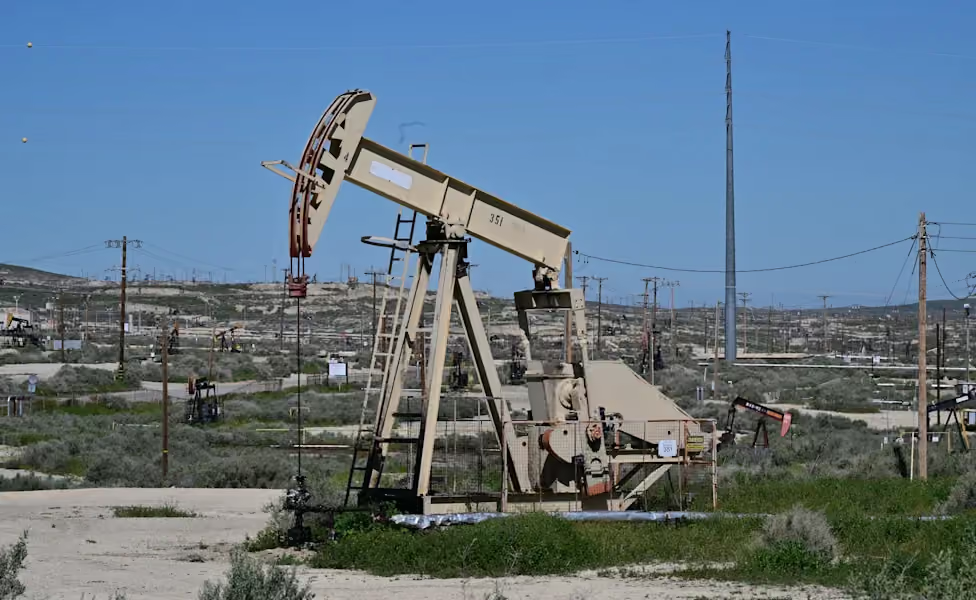
Commodity importers paying in US dollars gained immediate cost relief of 1-2% as the dollar index (DXY) a measure of the greenback's strength against six major currencies slipped to 99.93 following Iran and Israel's decision to halt military strikes after President Trump's intervention. The DXY fell 0.26% in 24 hours as traders shifted from safe-haven assets toward riskier positions, temporarily easing the currency headwind that has pressured import costs since geopolitical tensions escalated. For a mid-sized European grain importer buying $50 million of US corn monthly, this dollar weakness translates to roughly $500,000-$1 million in immediate cost savings meaningful relief after months of elevated procurement expenses.
A letter of credit (LC) the bank guarantee that enables most international commodity trade becomes cheaper to service when the dollar weakens against the importer's home currency. The DXY is critical for emerging markets because a strengthening dollar typically leads to capital outflows, commodity price declines, and currency depreciation. The current retreat reverses this dynamic temporarily. On the buy side: European refineries importing US crude oil see their euro denominated costs drop by approximately 1.5% at current exchange rates. On the sell side: US agricultural exporters face margin compression as their dollar priced goods become relatively more expensive for foreign buyers, potentially reducing demand for American soybeans and wheat in competitive global markets.
The dollar's recent strength was reinforced by expectations of Federal Reserve chair Kevin Warsh implementing more austere monetary policy, with ongoing supply chain disruptions and rising oil prices making near-term rate cuts unlikely. This "Warsh Trade" positioning for a smaller Fed balance sheet and prolonged higher rates had supported dollar strength until geopolitical risk receded. For large integrated trading houses (Cargill, ADM, or national commodity trading arms) with derivatives access: currency forwards and options become cheaper to hedge dollar exposure, reducing the cost of protecting against further volatility. For smaller regional importers independent fuel distributors, regional food processors, cooperative buying groups without derivatives access: the practical equivalent involves fixing bilateral contract terms in local currency or diversifying supplier bases across currency zones.
Wednesday's US Consumer Price Index (CPI) release looms as the critical catalyst, with economists projecting 6% inflation for Q2 2026, up dramatically from 2.7% forecast just three months ago before US-Israel attacks on Iran sent energy prices soaring. April 2026 CPI already reached 3.8% year over year (0.6% month over month), well above the Federal Reserve's 2% target. A hot inflation reading could reverse the dollar's current weakness within hours, as traders price in more aggressive Fed tightening. Market odds show 99.1% probability of no rate change at the June 16-17 FOMC meeting, but persistently high inflation readings could shift expectations toward rate hikes rather than cuts by October.
For observers: monitor the DXY's reaction to Wednesday's 8:30 AM ET CPI release as the definitive signal for commodity import cost trajectories through Q3 2026. Any CPI reading above 2.5% could strengthen the dollar as markets price in sustained Fed hawkishness, while readings below 2.2% would reinforce the current dollar weakness and extend import cost relief. The Iran-Israel pause may prove tactical rather than strategic if hostilities resume, expect immediate dollar strength to resume as safe-haven flows return. Track the euro-dollar exchange rate above 1.15 as the threshold where European importers lose their current cost advantage, and watch crude oil futures as the transmission mechanism between geopolitical risk and currency markets.


.jpg)



'%3e%3cg id='Final-Copy-2_2_' transform='translate(1275.000000, 200.000000)'%3e%3cpath class='st0' d='M7.4,12.8h6.8l3.1-11.6H7.4C4.2,1.2,1.6,3.8,1.6,7S4.2,12.8,7.4,12.8z'/%3e%3c/g%3e%3c/g%3e%3c/g%3e%3cg id='final---dec.11-2020'%3e%3cg id='_x30_208-our-toggle' transform='translate(-1275.000000, -200.000000)'%3e%3cg id='Final-Copy-2' transform='translate(1275.000000, 200.000000)'%3e%3cpath class='st1' d='M22.6,0H7.4c-3.9,0-7,3.1-7,7s3.1,7,7,7h15.2c3.9,0,7-3.1,7-7S26.4,0,22.6,0z M1.6,7c0-3.2,2.6-5.8,5.8-5.8 h9.9l-3.1,11.6H7.4C4.2,12.8,1.6,10.2,1.6,7z'/%3e%3cpath id='x' class='st2' d='M24.6,4c0.2,0.2,0.2,0.6,0,0.8l0,0L22.5,7l2.2,2.2c0.2,0.2,0.2,0.6,0,0.8c-0.2,0.2-0.6,0.2-0.8,0 l0,0l-2.2-2.2L19.5,10c-0.2,0.2-0.6,0.2-0.8,0c-0.2-0.2-0.2-0.6,0-0.8l0,0L20.8,7l-2.2-2.2c-0.2-0.2-0.2-0.6,0-0.8 c0.2-0.2,0.6-0.2,0.8,0l0,0l2.2,2.2L23.8,4C24,3.8,24.4,3.8,24.6,4z'/%3e%3cpath id='y' class='st3' d='M12.7,4.1c0.2,0.2,0.3,0.6,0.1,0.8l0,0L8.6,9.8C8.5,9.9,8.4,10,8.3,10c-0.2,0.1-0.5,0.1-0.7-0.1l0,0 L5.4,7.7c-0.2-0.2-0.2-0.6,0-0.8c0.2-0.2,0.6-0.2,0.8,0l0,0L8,8.6l3.8-4.5C12,3.9,12.4,3.9,12.7,4.1z'/%3e%3c/g%3e%3c/g%3e%3c/g%3e%3c/g%3e%3c/svg%3e) Privacy Choices
Privacy Choices