.avif)
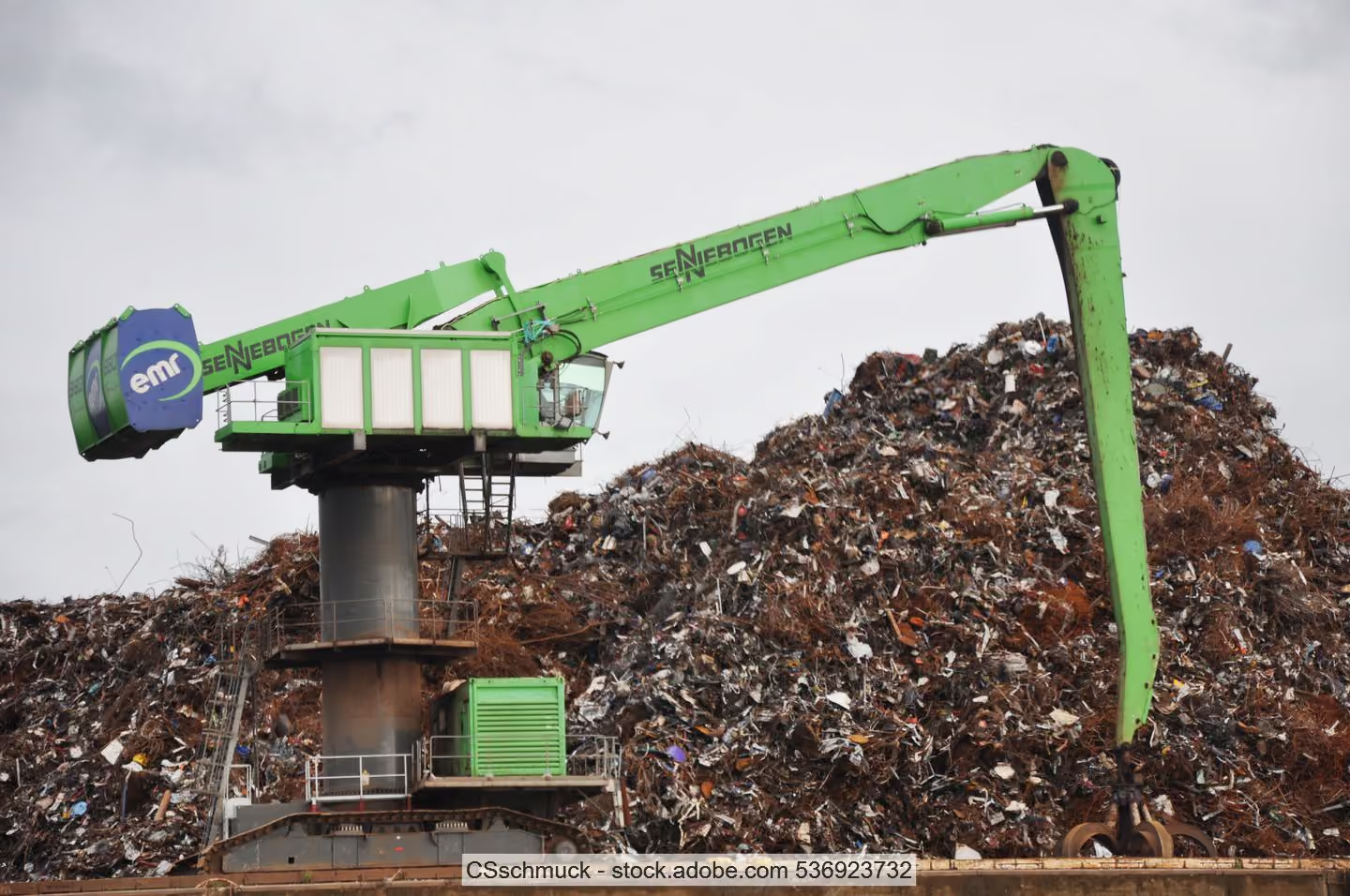
European aluminium recyclers face a margin destruction of several hundred euros per tonne starting January 2026, when EU ETS fallback benchmarks decline by 34% for the 2026-2030 period, forcing companies to purchase substantially more carbon allowances from the market. The cost cannot be passed through because aluminium prices are set internationally, meaning producers cannot simply pass these costs on to customers. With aluminium trading at $3,671 per tonne and carbon allowances at €78.16, each additional tonne of allowances now costs recyclers roughly $85 and the benchmark cuts will multiply that exposure.
The EU Emissions Trading System (ETS) a cap and trade mechanism where companies receive free allowances based on benchmarks and must buy additional permits for excess emissions uses "heat and fuel" fallback calculations for aluminium recycling because these processes lack dedicated product benchmarks but rely on generic heat and fuel fall-back benchmarks. The updated benchmarks amount to a 50% cut compared with original Phase 3 levels, directly translating into higher production costs for recyclers whose technical decarbonisation options remain limited.
Consider a mid-sized European recycler processing 100,000 tonnes annually. Under current benchmarks, this facility might receive 85% of required allowances free, purchasing 15,000 allowances at market rates roughly €1.2 million annually at current prices. The 34% benchmark cut could reduce free allocation to 70%, forcing purchase of 30,000 allowances instead €2.3 million, adding €23 per tonne to processing costs. The 50% reduction would bring carbon costs to an unaffordable 10% of EBITDA for recyclers and 11% of global alumina price for refiners, levels that international competitors do not pay.
On the buy side, European automotive manufacturers and packaging companies sourcing recycled aluminium face indirect cost pressure through higher input prices, though they cannot validate sustainability credentials by switching to primary aluminium without tripling their carbon footprint. Aluminium recycling uses around 95% less energy than producing primary aluminium, making it one of the most effective decarbonisation routes available. On the sell side, recyclers confront an impossible choice: absorb margin destroying costs or exit the market, ceding volume to higher carbon imports.
For large integrated traders like Trafigura or Glencore with derivatives access, the ETS reform creates arbitrage opportunities between European recycled material and imports from China, Russia, and the Middle East. When ETS benchmarks increase the cost gap with competitors outside Europe, the result is not lower global emissions, but more imported aluminium. These traders can structure financing around carbon cost volatility using EUA futures to hedge recycler exposure or take directional positions on European recycling capacity contraction.
For smaller regional recyclers independent scrap processors, municipal operators, industrial cooperatives without derivatives access, the practical equivalent involves long-term supply agreements with buyers willing to pay sustainability premiums, inventory timing to minimize allowance purchases during price spikes, or operational consolidation to improve benchmark efficiency. Most lack the balance sheet strength to absorb €20-30 per tonne margin compression while maintaining competitive pricing against imports that face no equivalent carbon costs.
Physically, recycled aluminium moves through a constrained European collection network where scrap dealers aggregate material at regional hubs, then ship to recycling facilities typically located near automotive clusters in Germany, northern Italy, and eastern France. Unlike primary aluminium smelting that can relocate to low-cost energy jurisdictions, recycling facilities must stay proximate to scrap generation and end-use manufacturing. The ETS reform essentially taxes location-bound recycling operations while exempting mobile import flows.
The freight dimension reveals additional margin pressure. European recyclers typically operate on €100-150 per tonne processing margins, competing against Chinese recycled aluminium landed in Rotterdam at $3,600 per tonne plus freight and premiums. Each €20-30 carbon cost increase directly erodes competitiveness against Asian material that travels 12,000 nautical miles but carries no carbon pricing. Import freight rates from Shanghai to Hamburg average $80-100 per tonne still cheaper than the carbon penalty now facing European recyclers.
For observers monitoring this structural shift, watch the LME aluminium backwardation structure currently showing cash contracts trading at a $60 premium to three month futures for signs that European recycling capacity offline is tightening regional supply. Track European aluminium import volumes from China and the Gulf through Rotterdam and Hamburg port statistics by September 2026. Alumina refining also enables recovery of gallium essential for semiconductors and defence systems whose supply the EU has identified as strategically vulnerable, putting that supply chain at risk.





'%3e%3cg id='Final-Copy-2_2_' transform='translate(1275.000000, 200.000000)'%3e%3cpath class='st0' d='M7.4,12.8h6.8l3.1-11.6H7.4C4.2,1.2,1.6,3.8,1.6,7S4.2,12.8,7.4,12.8z'/%3e%3c/g%3e%3c/g%3e%3c/g%3e%3cg id='final---dec.11-2020'%3e%3cg id='_x30_208-our-toggle' transform='translate(-1275.000000, -200.000000)'%3e%3cg id='Final-Copy-2' transform='translate(1275.000000, 200.000000)'%3e%3cpath class='st1' d='M22.6,0H7.4c-3.9,0-7,3.1-7,7s3.1,7,7,7h15.2c3.9,0,7-3.1,7-7S26.4,0,22.6,0z M1.6,7c0-3.2,2.6-5.8,5.8-5.8 h9.9l-3.1,11.6H7.4C4.2,12.8,1.6,10.2,1.6,7z'/%3e%3cpath id='x' class='st2' d='M24.6,4c0.2,0.2,0.2,0.6,0,0.8l0,0L22.5,7l2.2,2.2c0.2,0.2,0.2,0.6,0,0.8c-0.2,0.2-0.6,0.2-0.8,0 l0,0l-2.2-2.2L19.5,10c-0.2,0.2-0.6,0.2-0.8,0c-0.2-0.2-0.2-0.6,0-0.8l0,0L20.8,7l-2.2-2.2c-0.2-0.2-0.2-0.6,0-0.8 c0.2-0.2,0.6-0.2,0.8,0l0,0l2.2,2.2L23.8,4C24,3.8,24.4,3.8,24.6,4z'/%3e%3cpath id='y' class='st3' d='M12.7,4.1c0.2,0.2,0.3,0.6,0.1,0.8l0,0L8.6,9.8C8.5,9.9,8.4,10,8.3,10c-0.2,0.1-0.5,0.1-0.7-0.1l0,0 L5.4,7.7c-0.2-0.2-0.2-0.6,0-0.8c0.2-0.2,0.6-0.2,0.8,0l0,0L8,8.6l3.8-4.5C12,3.9,12.4,3.9,12.7,4.1z'/%3e%3c/g%3e%3c/g%3e%3c/g%3e%3c/g%3e%3c/svg%3e) Privacy Choices
Privacy Choices