.avif)
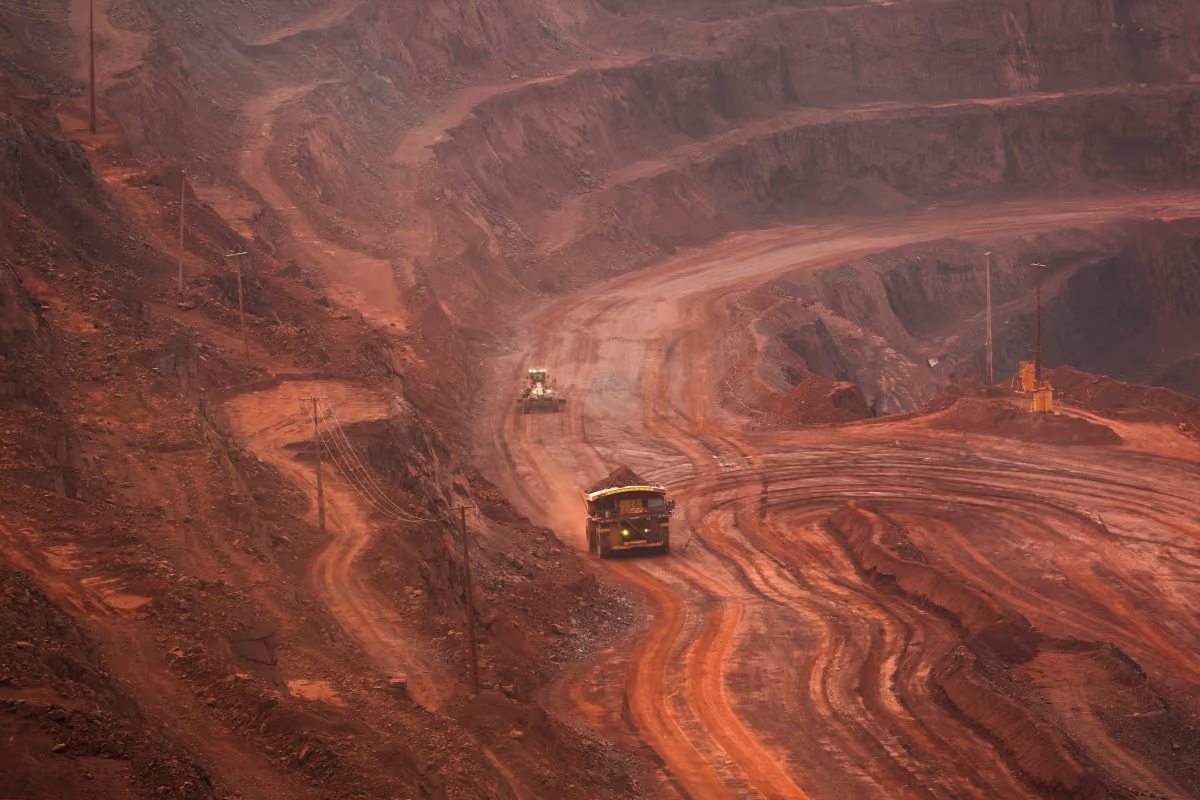
Evion Group raised A$6.6 million to secure an option on Nevada's CARP fluorspar project, targeting a historically producing asset that delivered 44,900 tonnes at 69% CaF2 grade between the late 1950s and early 1970s. The deal structure requires US$3.65 million in total payments and work commitments over four years for 100% project control. Fluorspar a mineral form of calcium fluoride (CaF2) essential for producing hydrofluoric acid (HF) and subsequent fluorochemicals trades at approximately $518/MT CFR Houston basis, with recent Chinese domestic prices around $488/MT. The United States remains 100% import reliant on fluorspar, alongside 15 other critical minerals including graphite and rare earth elements. The Defense Logistics Agency awarded Ares Strategic Mining a $169 million fluorspar supply contract in January 2026, scalable to $250 million over five years, highlighting government supply security concerns.
China exercises dominant influence as both the leading producer and consumer, controlling roughly 60% of global fluorspar production, while simultaneously importing high-grade material to meet chemical industry demand for 97%+ CaF2 acid-grade product. The quality mismatch creates a structural bottleneck many Chinese mines produce lower-grade metallurgical material (60-85% CaF2) used primarily as steel flux, while the growing chemical industry requires high purity acid grade fluorspar for hydrofluoric acid production. The chemical industry processes acid grade fluorspar into HF, the foundational precursor for fluorochemicals including refrigerants, fluoropolymers like PTFE, and lithium hexafluorophosphate (LiPF6) electrolyte salt for lithium-ion batteries. This demand segment drives pricing premiums: acid grade fluorspar (>97% CaF2) trades at $350-600/tonne depending on origin and market conditions, while metallurgical grade material trades at $200-350/tonne.
On the buy side: Large integrated chemical producers (DuPont, 3M, specialty chemical divisions of major conglomerates) with long-term HF supply requirements face a constrained supplier base and limited hedging options. At current prices, securing 10,000 tonnes annually of acid grade fluorspar costs $5-6 million, with supply agreements typically running 2-3 years to ensure feedstock continuity. On the sell side: Established producers in Mexico, South Africa, and Mongolia benefit from proximity to processing infrastructure and established logistics networks that new projects cannot replicate immediately. Chinese domestic prices set the floor for the global market, while Mexican and South African material trades at premiums reflecting transport costs and supply reliability. For traders and intermediaries: Margin concentration occurs in grade arbitrage purchasing lower grade material and upgrading through flotation or chemical processing, capturing the $150-250/tonne differential between metallurgical and acid grades.
For large integrated traders (Trafigura, Vitol-owned metals units, or national trading houses) with derivatives access: Limited hedging instruments exist for fluorspar compared to base metals, making physical inventory management and supplier relationship diversification the primary risk management tools. Long-term offtake agreements with multiple producers become essential, typically structured with quarterly price reviews linked to regional benchmarks. For smaller regional operators mid-sized chemical importers, independent fluorochemicals producers, regional steel service centers without derivatives access: Practical equivalents include fixing 6-12 month supply terms bilaterally, maintaining 60-90 days inventory despite carrying costs, and developing relationships with multiple suppliers across different geographic sources. The Nevada project's 44,900 tonne historical production, even if fully restored, represents less than 0.5% of global fluorspar consumption. For observers: Monitor Fastmarkets' fluorspar assessment CFR Houston recent increases to $518/MT reflect tighter import arrivals and winter logistics pressures. Chinese domestic acid grade prices across major regions (Central China $435/MT, North China $416/MT, East China $425/MT) indicate supply-demand balance domestically.
Recent price dynamics show volatility with average export prices experiencing significant correction in 2024 after 2023 peaks, while Q2 2024 faced pressure from environmental inspections, limited manufacturing rates, and vessel shortages increasing Asia-Europe transportation costs. The fundamental challenge remains infrastructure and scale: CARP's historical direct shipping ore model to Kaiser Steel worked when US steel production was regionally concentrated and transport costs were lower. Today's fluorochemicals industry requires consistent acid grade supply to large HF plants, typically located near Gulf Coast petrochemical complexes or Great Lakes aluminum smelters. A single Nevada project cannot economically serve these markets at Chinese cost parity. The US Department of Energy forecasts fluorspar demand will exceed current supply by 1-4% by 2025, growing to 40-70% supply deficit by 2035, but this crunch affects China as well as Western markets. Watch Chinese production data monthly through Industrial Minerals' reports any significant capacity additions or environmental restrictions immediately ripple through global pricing within 30-45 days due to the concentrated supplier base.




'%3e%3cg id='Final-Copy-2_2_' transform='translate(1275.000000, 200.000000)'%3e%3cpath class='st0' d='M7.4,12.8h6.8l3.1-11.6H7.4C4.2,1.2,1.6,3.8,1.6,7S4.2,12.8,7.4,12.8z'/%3e%3c/g%3e%3c/g%3e%3c/g%3e%3cg id='final---dec.11-2020'%3e%3cg id='_x30_208-our-toggle' transform='translate(-1275.000000, -200.000000)'%3e%3cg id='Final-Copy-2' transform='translate(1275.000000, 200.000000)'%3e%3cpath class='st1' d='M22.6,0H7.4c-3.9,0-7,3.1-7,7s3.1,7,7,7h15.2c3.9,0,7-3.1,7-7S26.4,0,22.6,0z M1.6,7c0-3.2,2.6-5.8,5.8-5.8 h9.9l-3.1,11.6H7.4C4.2,12.8,1.6,10.2,1.6,7z'/%3e%3cpath id='x' class='st2' d='M24.6,4c0.2,0.2,0.2,0.6,0,0.8l0,0L22.5,7l2.2,2.2c0.2,0.2,0.2,0.6,0,0.8c-0.2,0.2-0.6,0.2-0.8,0 l0,0l-2.2-2.2L19.5,10c-0.2,0.2-0.6,0.2-0.8,0c-0.2-0.2-0.2-0.6,0-0.8l0,0L20.8,7l-2.2-2.2c-0.2-0.2-0.2-0.6,0-0.8 c0.2-0.2,0.6-0.2,0.8,0l0,0l2.2,2.2L23.8,4C24,3.8,24.4,3.8,24.6,4z'/%3e%3cpath id='y' class='st3' d='M12.7,4.1c0.2,0.2,0.3,0.6,0.1,0.8l0,0L8.6,9.8C8.5,9.9,8.4,10,8.3,10c-0.2,0.1-0.5,0.1-0.7-0.1l0,0 L5.4,7.7c-0.2-0.2-0.2-0.6,0-0.8c0.2-0.2,0.6-0.2,0.8,0l0,0L8,8.6l3.8-4.5C12,3.9,12.4,3.9,12.7,4.1z'/%3e%3c/g%3e%3c/g%3e%3c/g%3e%3c/g%3e%3c/svg%3e) Privacy Choices
Privacy Choices