.avif)
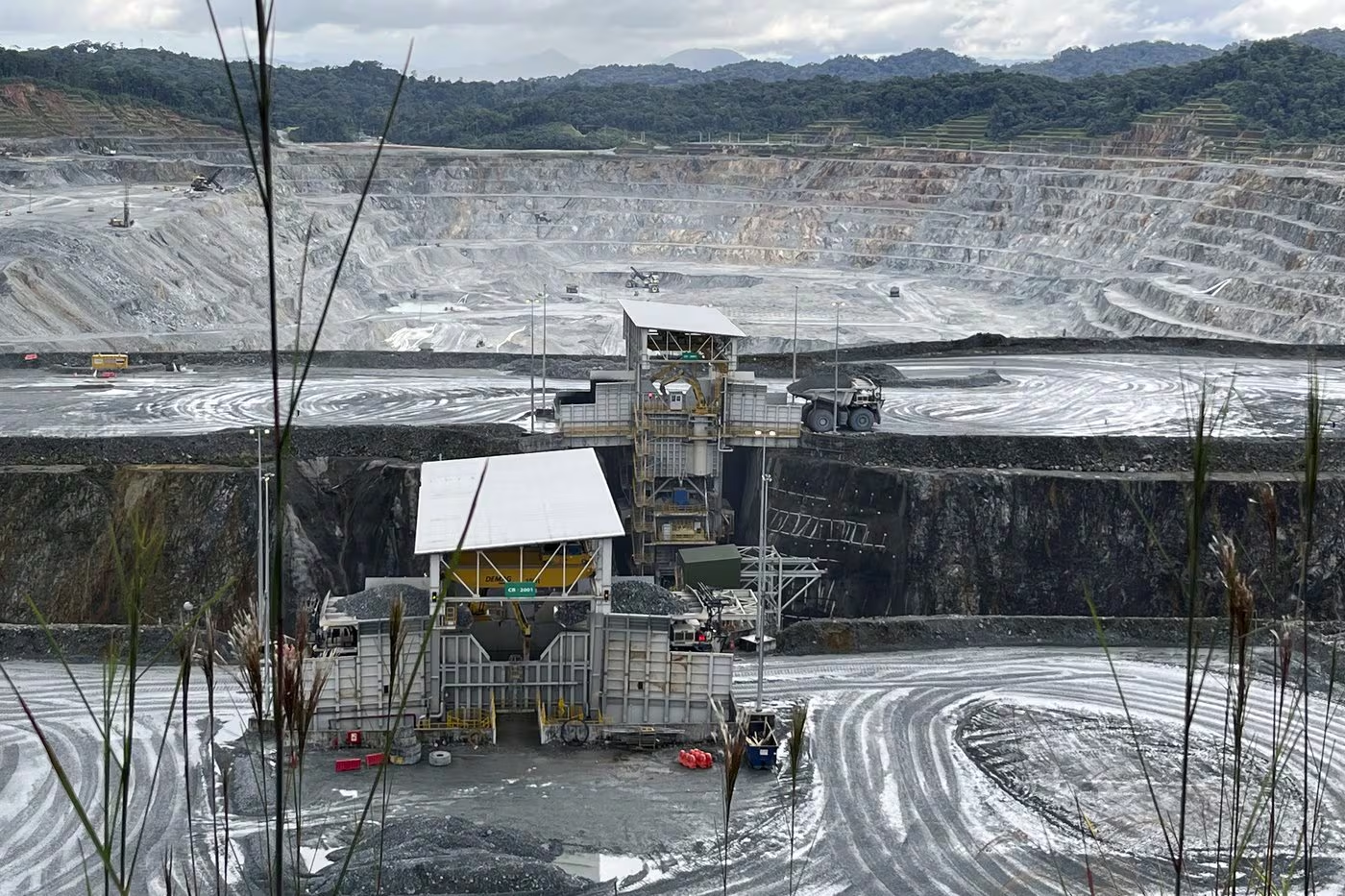
Copper concentrate traders pricing offtake from First Quantum Minerals face a materially altered supply picture from Q2 2026: the company has raised its 2026 copper production guidance to 405,000–475,000 tonnes from 375,000–435,000 tonnes, a 30,000–40,000 tonne increase at both ends, but the increment rests almost entirely on processing and exporting stockpiled ore from Cobre Panamá a mine that has been suspended since late 2023 following a government ordered closure. Revenue rose 18% year on year to $1.404 billion in Q1, yet the company still posted a net attributable loss of $196 million, against a $23 million loss in the same period last year. The gap between revenue growth and loss widening tells concentrate traders precisely what they need to understand before pricing new offtake agreements: this is a company whose cost structure is under acute pressure, even as its headline volumes rise.
The mechanics of the loss are worth decomposing carefully, because they inform the margin anatomy of every concentrate trade linked to First Quantum's Zambian operations. Of the $196 million net loss, $144 million in the first quarter alone came from realized losses on the company's sales hedge programme. A sales hedge where a producer locks in a forward price for a portion of future output is designed to provide revenue certainty. When copper spot prices rise above the hedged level, the producer misses the upside and must pay the difference. That $144 million is not an accounting adjustment: it is cash that did not arrive. Strip it out and the implied EBITDA earnings before interest, taxes, depreciation, and amortization, the standard measure of operational cash generation rises from the reported $326 million to approximately $470 million. That implied figure is robust. The reported figure is the one that services debt and funds operations.
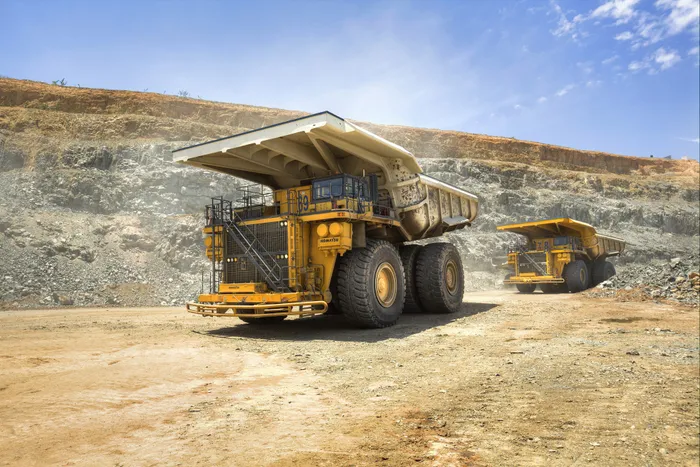
Two additional cost pressures compounded the hedge losses. The Zambian kwacha Zambia's national currency, in which a significant portion of First Quantum's Kansanshi and Sentinel mine operating costs are denominated strengthened relative to the US dollar during Q1. Since copper is priced and sold in US dollars globally, a stronger kwacha means local costs, wages, contractor payments, and energy bills consume more of each dollar of revenue when translated back. Separately, CEO Tristan Pascall explicitly flagged higher fuel prices as a Q2 headwind. For context: open-pit copper mining at the scale of Sentinel, one of Africa's largest copper mines by tonnage, is fuel-intensive. Haul trucks moving ore from pit to crusher can consume thousands of litres of diesel per day per truck, across fleets of dozens of vehicles. If diesel costs rise by, say, $10 per barrel roughly 6–7 cents per litre across a full quarter of Zambian mining operations, the impact on all-in sustaining costs (the total cost to produce and sustain one tonne of copper, including capital maintenance) is material and not easily absorbed.
The Cobre Panamá stockpile announcement requires careful reading before any offtaker marks its volume models upward. The Panamanian government has approved the removal, processing, and export of ore that has been stockpiled at the site since operations were suspended in late 2023. Government approval, however, is not operational readiness. Stockpiled ore ore that has been sitting exposed to tropical humidity and oxidation for two or more years degrades. Sulphide ore, the dominant type at Cobre Panamá, begins to oxidize at surface contact, which reduces recoverable copper grade and can alter the mineralogy in ways that affect flotation circuit performance. Flotation the process by which crushed ore is mixed with water and chemicals so that copper minerals attach to air bubbles and float to the surface as concentrate may achieve lower yields on aged stockpile material than on fresh ore. No public disclosure specifies the per-tonne processing cost, the expected concentrate grade, or whether a smelter offtake counterparty has already been contracted for the resulting material. The upper end of the new guidance range 475,000 tonnes almost certainly assumes smooth execution of all of this. Offtakers should price against the lower end of 405,000 tonnes until operational specifics are disclosed.
The physical export route from Cobre Panamá to Asian smelters matters for concentrate traders actively seeking supply. Before the 2023 closure, copper concentrate from Cobre Panamá was typically loaded at Puerto Cobre or Punta Rincón on Panama's Pacific coast onto bulk carriers vessels in the Supramax or Ultramax class, capable of carrying 50,000–60,000 tonnes of concentrate per voyage for delivery to smelters in China, Japan, and South Korea, a transit of approximately 20–22 days. That route has been inactive since late 2023. Reactivating a port export operation requires reinspection of loading infrastructure, insurance reinstatement, and, critically, engagement with smelter receiving terminals that will need advance scheduling. None of these steps are trivial. For a large integrated trader with derivatives access a Trafigura, a Glencore, or a major national trading company the arbitrage play is to establish optionality now: secure a right of first refusal on Cobre Panamá concentrate at a discount reflecting execution uncertainty, while hedging the copper price exposure on the London Metal Exchange (LME) through forward sales. The discount at which that concentrate clears the market will tell you everything about how the physical market is pricing the stockpile risk.
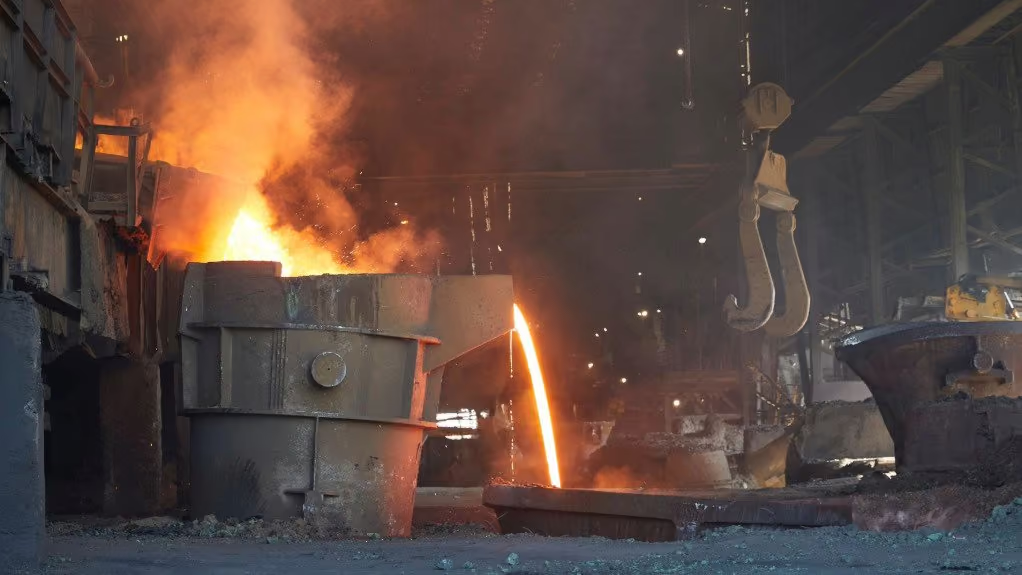
On the buy side, Asian copper smelters particularly in China, where treatment charges (TCs) and refining charges (RCs), the fees smelters charge to process concentrate into refined copper, have been under sustained downward pressure are watching First Quantum's guidance revision with interest but not urgency. TC/RCs are benchmarked annually in negotiations between miners and smelters; in recent years, the benchmark TC has fallen sharply as concentrate supply has tightened globally. Any genuine addition of Cobre Panamá volumes would, at the margin, loosen concentrate supply and give smelters slightly more negotiating leverage in the next benchmark cycle. On the sell side, First Quantum's position as an integrated operator running its own strategic smelter at Kansanshi is a genuine structural advantage. Sulphuric acid, a by-product of copper smelting and an input required for oxide ore leaching (SX-EW processing), is currently in tight global supply. A producer that avoids purchasing acid externally saves a cost that non-integrated peers must absorb. The magnitude of that saving is not disclosed, but in a market where sulphuric acid spot prices have spiked above $200 per tonne in some regions, the avoided procurement cost on annual Zambian volumes is structurally significant.
A worked example illustrates how sensitive First Quantum's reported margins are to currency and hedging mechanics simultaneously. Assume Kansanshi produces 50,000 tonnes of copper in a quarter, sold at an average LME price of $9,500 per tonne. Gross revenue: $475 million. If the hedge programme locks 30% of that volume at $8,800 per tonne $700 per tonne below spot the realized loss on hedged tonnes is approximately $700 × 15,000 tonnes = $10.5 million for that quarter alone from that one operation. Scale that across all Zambian and other hedged volumes and the $144 million Q1 figure becomes comprehensible. Now layer in a kwacha that has strengthened by 8% year on year: Zambian operating costs denominated in kwacha that cost the equivalent of, say, $180 million in Q1 2025 now cost the equivalent of $194 million in Q1 2026 in dollar terms without any operational change. These are not rounding errors. They are the margin.
For smaller regional concentrate traders independent traders sourcing from secondary producers or taking spot cargoes from First Quantum's Zambian operations the practical intelligence is this: hedge losses of this scale suggest First Quantum will be motivated to restructure or reduce its forward hedge book as positions roll off, which could increase the proportion of production sold at spot. Spot sales create short-term volume availability that smaller traders can access, but also create price risk that needs managing without the derivatives infrastructure that large integrated traders possess. The practical equivalent of a hedge for a regional trader is a back to back fixed-price offtake agreement with a nearby smelter locking in a processing fee while leaving the copper price to the market or maintaining shorter inventory positions and faster turnover to minimize price exposure duration. Carrying large concentrate inventories speculatively in the current environment, with costs rising and guidance revisions carrying execution uncertainty, is the wrong posture.
The specific signal for observers to watch between now and end of Q2 2026 is First Quantum's quarterly production report, expected in late July, alongside any Panamanian government or port authority announcement regarding Cobre Panamá export permits and logistics contracts. If Cobre Panamá volumes appear in that report even modestly, at 5,000–10,000 tonnes of contained copper it validates the processing timeline and changes the supply calculus for the second half. If they do not, the guidance upgrade is a Q3–Q4 story at best, and traders who built volume models around the upper end of the 475,000 tonne range will need to revise. Watch also the LME copper forward curve for any steepening into backwardation where near-term prices rise above forward prices which would indicate the physical market is not expecting meaningful new supply in the near term. Backwardation is the market's own verdict on whether the stockpile ore arrives on schedule.




'%3e%3cg id='Final-Copy-2_2_' transform='translate(1275.000000, 200.000000)'%3e%3cpath class='st0' d='M7.4,12.8h6.8l3.1-11.6H7.4C4.2,1.2,1.6,3.8,1.6,7S4.2,12.8,7.4,12.8z'/%3e%3c/g%3e%3c/g%3e%3c/g%3e%3cg id='final---dec.11-2020'%3e%3cg id='_x30_208-our-toggle' transform='translate(-1275.000000, -200.000000)'%3e%3cg id='Final-Copy-2' transform='translate(1275.000000, 200.000000)'%3e%3cpath class='st1' d='M22.6,0H7.4c-3.9,0-7,3.1-7,7s3.1,7,7,7h15.2c3.9,0,7-3.1,7-7S26.4,0,22.6,0z M1.6,7c0-3.2,2.6-5.8,5.8-5.8 h9.9l-3.1,11.6H7.4C4.2,12.8,1.6,10.2,1.6,7z'/%3e%3cpath id='x' class='st2' d='M24.6,4c0.2,0.2,0.2,0.6,0,0.8l0,0L22.5,7l2.2,2.2c0.2,0.2,0.2,0.6,0,0.8c-0.2,0.2-0.6,0.2-0.8,0 l0,0l-2.2-2.2L19.5,10c-0.2,0.2-0.6,0.2-0.8,0c-0.2-0.2-0.2-0.6,0-0.8l0,0L20.8,7l-2.2-2.2c-0.2-0.2-0.2-0.6,0-0.8 c0.2-0.2,0.6-0.2,0.8,0l0,0l2.2,2.2L23.8,4C24,3.8,24.4,3.8,24.6,4z'/%3e%3cpath id='y' class='st3' d='M12.7,4.1c0.2,0.2,0.3,0.6,0.1,0.8l0,0L8.6,9.8C8.5,9.9,8.4,10,8.3,10c-0.2,0.1-0.5,0.1-0.7-0.1l0,0 L5.4,7.7c-0.2-0.2-0.2-0.6,0-0.8c0.2-0.2,0.6-0.2,0.8,0l0,0L8,8.6l3.8-4.5C12,3.9,12.4,3.9,12.7,4.1z'/%3e%3c/g%3e%3c/g%3e%3c/g%3e%3c/g%3e%3c/svg%3e) Privacy Choices
Privacy Choices