.avif)
Chinese integrated steel mills face coking coal procurement costs rising $15–30 per tonne on spot purchases, effective immediately, as a Shanxi safety crackdown removes an estimated 20–30 million tonnes of high-quality domestic supply from the market and the seaborne window to replace it is narrowing by the day.
Coking coal metallurgical coal converted into coke, the carbon-dense fuel and structural agent that gives blast furnaces their reducing chemistry is not interchangeable with thermal coal used in power stations. A blast furnace is an exacting reactor: it needs coke strong enough to support the weight of iron ore above it while simultaneously conducting heat and reducing iron oxide to molten iron. That structural role means quality cannot be freely substituted downward. When a Shanxi mine producing premium hard coking coal closes, the gap it leaves cannot be filled with lower-rank material. This is the central commercial fact shaping the current market: the shortfall is not in coking coal generally it is specifically in high-quality hard coking coal, and that grade must come from a short list of origins: Queensland in Australia, northeastern British Columbia in Canada, and a handful of other premium-grade districts.
The trigger was a mining accident in Shanxi province, China's dominant coking coal region, which prompted a safety inspection sweep that temporarily closed 155 mines. According to consultancy Mysteel data cited in Reuters-linked reporting, approximately 64% of affected capacity had restarted by mid-June 2026, but utilisation across resumed operations was running at only 70–80% of prior levels levels that had themselves been above 100% of rated nameplate capacity. The arithmetic is unforgiving. If 155 mines were running at or above rated output before the crackdown, and only about 100 have resumed at 70–80% efficiency, the effective production loss is well above a simple headcount of closed mines. Traders active in the seaborne market estimate the resulting domestic shortfall at 20–30 million tonnes, concentrated in the premium grades that Shanxi's better mines supplied.
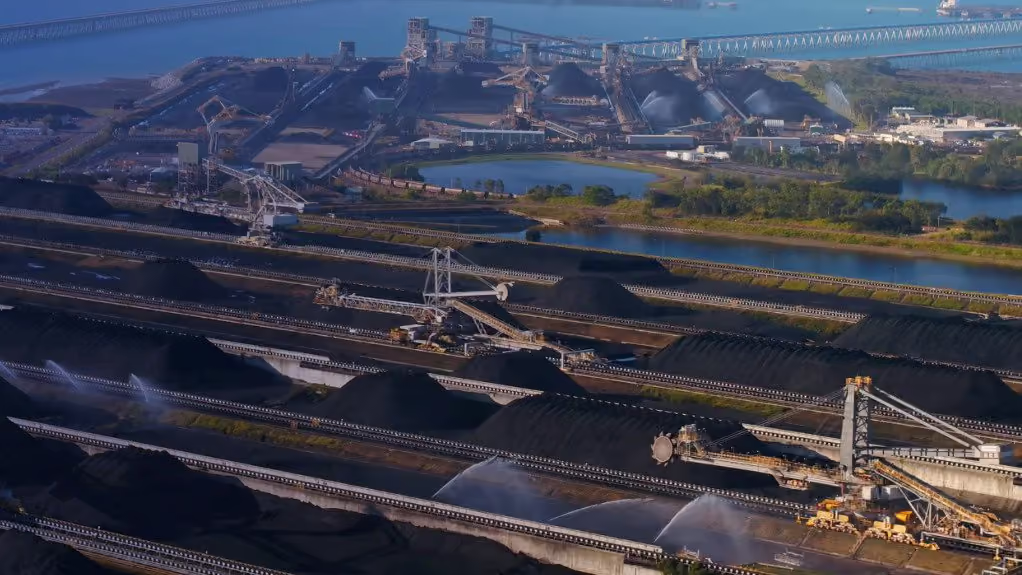
The physical supply chain from Australia to northern China illustrates exactly why urgency is compressing procurement timelines. A Capesize vessel a bulk carrier too large for the Panama Canal, typically 150,000–180,000 deadweight tonnes loads at Dalrymple Bay or Hay Point in Queensland, transits roughly 5,500 nautical miles, and arrives at Caofeidian or Jingtang on China's Bohai Bay coast approximately 12–16 days later. But that transit time is only the final leg. Before loading, a cargo must be assembled at the mine, railed to port, and slotted into a berth a sequence that adds two to four weeks minimum. For deliveries needed in June and July 2026, effective procurement decisions needed to be made in late May or early June at the latest. Buyers now entering the market for prompt seaborne relief face a structurally tighter spot market: the queue is shorter than the gap.
Here is what the margin anatomy looks like for a mid-sized Chinese independent steel mill procuring 100,000 tonnes of premium low-volatile coking coal PLV, or premium low-volatile hard coking coal, is the Australian benchmark grade on the spot seaborne market. Before the Shanxi disruption, equivalent domestic procurement was available at roughly $185–195 per tonne delivered to mill gate. CFR China (cost and freight to Chinese port) for Australian PLV was trading around $210–215 per tonne in early June, implying a $15–25 per tonne import premium after accounting for port handling and inland logistics. Post-disruption, with Chinese buyers competing for prompt cargoes, analysts and traders are estimating a spot premium uplift of $10–25 per tonne above the PLV index meaning delivered cost to mill gate may now reach $230–240 per tonne or more. On 100,000 tonnes, that is $3–5 million in additional raw material cost per cargo cycle, against steel margins that are already minimal or negative for some producers, given that Chinese steel output fell 4.1% in the first months of 2026 amid weaker global demand. The margin compression is not theoretical. It is current.
On the buy side: Chinese blast furnace operators, particularly independent mills without long-term supply agreements locking in earlier prices, are the acute pressure point. Their procurement teams face simultaneous problems a narrowing window for June-July delivery slots, a spot market where Australian producers and trading houses are well aware of the demand signal, and a downstream steel market unwilling to absorb cost pass-through. Mills with tolling agreements or term contracts at pre-disruption prices are largely insulated; those reliant on spot domestic procurement are directly exposed. On the sell side: Australian premium hard coking coal producers BHP's Queensland mines, Whitehaven's Narrabri operations, Glencore's Daunia and Blackwater assets are capturing meaningful spot upside. For a Capesize cargo of 150,000 tonnes, a $15 per tonne FOB premium uplift represents $2.25 million additional revenue per vessel. Canadian producers shipping from Westshore Terminals in Vancouver or Ridley Island in Prince Rupert are a secondary beneficiary, with Pacific freight to China adding roughly $18–22 per tonne at current Capesize rates, still competitive if FOB discounts to Australian origin are maintained.
The Mongolian dimension requires precise framing. China imported 60.07 million metric tonnes of Mongolian coking coal in 2025 approximately half of all met coal imports and analysts project this could rise toward 80 million tonnes in 2026. But Mongolian coal is what industry sources describe as a Tier-2 hard coking coal: low in ash, low in sulfur, and valuable precisely because it blends well with China's higher-sulfur domestic Shanxi and Hebei production. It is a diluent and quality enhancer for the domestic blend, not a replacement for Australian or Canadian premium hard coking coal in a high coke strength recipe. Increasing Mongolian volumes does not resolve the high-quality shortfall. It resolves a different problem cost optimisation in normal supply conditions and the distinction matters enormously for procurement planning. Buyers who assume Mongolian supply growth closes the gap will find they have the wrong grade in their blend.
For large integrated trading houses Trafigura, Vitol Coal, Macquarie's commodity desk with access to freight derivatives and established vessel programmes, the current dislocation is a freight plus physical arbitrage opportunity. The relevant instrument is a combination of FOB Australian cargo procurement, a Capesize time-charter or freight forward agreement (FFA a derivative contract fixing future freight costs) on the C5 Pacific route, and a CFR China sale to a mill or trading counterpart. If the CFR China equivalent price exceeds the landed cost of Australian FOB plus C5 freight plus port costs, the import arbitrage the gap between seaborne landed cost and domestic equivalent is open, and margin concentrates in the entity controlling the freight leg. For a smaller regional coal trader or independent importer without derivatives access, the practical equivalent is simpler: fix CFR terms bilaterally with a loading port supplier, locking both commodity price and freight into a single delivered-price contract, eliminating exposure to spot freight volatility. The critical action is speed every week of delay tightens the June-July delivery slot pool.
Observers should watch two specific, time-bound signals. The first is the SGX TSI Australia Premium Coking Coal FOB index published daily for any move above $225 per tonne FOB, which would indicate the spot premium uplift is exceeding the upper range of current analyst estimates and that mills are paying materially above index to secure prompt cargoes. The second is the Baltic Exchange C5TC route rate the Capesize Pacific round-voyage indicator for any sustained move above $12 per tonne, which would signal that incremental Chinese import demand is beginning to pressure freight as well as commodity prices, compressing the economics for buyers who have not yet fixed freight. Both signals are readable within a two-week window. If the Mysteel utilisation figure for Shanxi mines, reported weekly, fails to recover above 85% by mid-July, the 20–30 million tonne shortfall estimate should be treated as a floor, not a ceiling, and procurement timelines should be advanced accordingly.



'%3e%3cg id='Final-Copy-2_2_' transform='translate(1275.000000, 200.000000)'%3e%3cpath class='st0' d='M7.4,12.8h6.8l3.1-11.6H7.4C4.2,1.2,1.6,3.8,1.6,7S4.2,12.8,7.4,12.8z'/%3e%3c/g%3e%3c/g%3e%3c/g%3e%3cg id='final---dec.11-2020'%3e%3cg id='_x30_208-our-toggle' transform='translate(-1275.000000, -200.000000)'%3e%3cg id='Final-Copy-2' transform='translate(1275.000000, 200.000000)'%3e%3cpath class='st1' d='M22.6,0H7.4c-3.9,0-7,3.1-7,7s3.1,7,7,7h15.2c3.9,0,7-3.1,7-7S26.4,0,22.6,0z M1.6,7c0-3.2,2.6-5.8,5.8-5.8 h9.9l-3.1,11.6H7.4C4.2,12.8,1.6,10.2,1.6,7z'/%3e%3cpath id='x' class='st2' d='M24.6,4c0.2,0.2,0.2,0.6,0,0.8l0,0L22.5,7l2.2,2.2c0.2,0.2,0.2,0.6,0,0.8c-0.2,0.2-0.6,0.2-0.8,0 l0,0l-2.2-2.2L19.5,10c-0.2,0.2-0.6,0.2-0.8,0c-0.2-0.2-0.2-0.6,0-0.8l0,0L20.8,7l-2.2-2.2c-0.2-0.2-0.2-0.6,0-0.8 c0.2-0.2,0.6-0.2,0.8,0l0,0l2.2,2.2L23.8,4C24,3.8,24.4,3.8,24.6,4z'/%3e%3cpath id='y' class='st3' d='M12.7,4.1c0.2,0.2,0.3,0.6,0.1,0.8l0,0L8.6,9.8C8.5,9.9,8.4,10,8.3,10c-0.2,0.1-0.5,0.1-0.7-0.1l0,0 L5.4,7.7c-0.2-0.2-0.2-0.6,0-0.8c0.2-0.2,0.6-0.2,0.8,0l0,0L8,8.6l3.8-4.5C12,3.9,12.4,3.9,12.7,4.1z'/%3e%3c/g%3e%3c/g%3e%3c/g%3e%3c/g%3e%3c/svg%3e) Privacy Choices
Privacy Choices