.avif)
.avif)
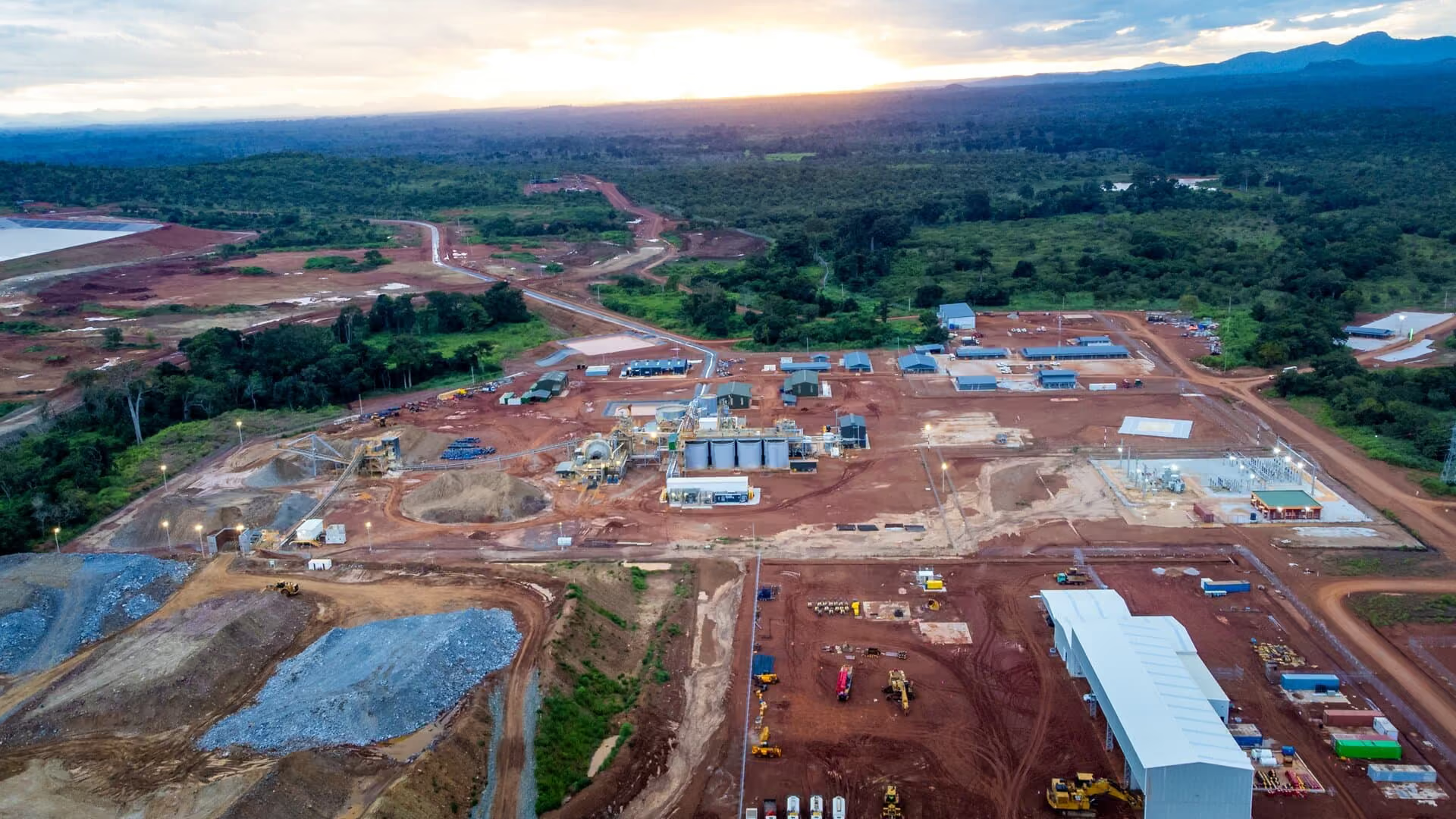
Great Boulder Resources has paid $58.3 million total consideration to acquire Westgold's Peak Hill Gold Project in Western Australia's Murchison region, with the deal structured as $25 million in cash and $33.3 million in Great Boulder shares representing a 19.9% equity stake for Westgold. The Peak Hill project hosts a JORC 2012 Mineral Resource Estimate of 9.4 million tonnes at 1.6 grams per tonne gold for 481,000 ounces of contained gold across five main deposits. At current LBMA gold prices around $4,610 per ounce, the resource represents approximately $2.2 billion in contained metal value though production economics depend entirely on grade, recovery rates, and processing costs.
A toll processing arrangement where Great Boulder pays Westgold to process Peak Hill ore through Westgold's existing mills rather than building its own plant forms the cornerstone of Great Boulder's capital-light production strategy. Under the Ore Purchase Agreement, ore from Peak Hill may be processed at Westgold's Murchison processing hubs, specifically Bluebird, Fortnum and Tuckabianna mills. The Peak Hill project is located within trucking distance of multiple processing facilities and only 100km from Great Boulder's Side Well Gold Project. Standard toll processing fees in Western Australia typically range from $40-70 per tonne depending on ore complexity, metallurgy and mill utilization costs that Great Boulder must absorb rather than retain the full metal value that comes with ownership economics.
On the buy side: Great Boulder secures immediate access to advanced-stage resources without the $150-300 million capital expenditure typically required for a standalone processing plant. The company is raising $40 million in equity to fund the acquisition, extensive drilling campaigns and pre-production work, which would leave the company with an estimated $25 million in net cash upon completion. However, the toll processing model creates operational dependency. Great Boulder's production timeline depends entirely on Westgold's spare capacity allocation across its mill network, which may prioritize Westgold's own ore feed during periods of high gold prices or operational stress.
On the sell side: Westgold gains immediate capital plus ongoing exposure to Peak Hill's upside through a 1.0% net smelter return royalty on all future production from Peak Hill. The Transaction delivers upfront cash, equity exposure and establishes a framework to process Peak Hill ore through Westgold's Murchison hubs. Peak Hill is not in Westgold's 5 year plan, and this divestment supports focus on larger, core mines and processing hubs, with the optimisation program having delivered $208 million in immediate value this financial year. Westgold retains processing margin on Great Boulder ore while reducing capital allocation to non-core assets a portfolio optimization that concentrates resources on higher-return operations.
For large integrated gold producers (Newmont, Barrick, regional majors with multiple mill sites): The model demonstrates how established infrastructure can monetize adjacent resources without direct ownership. Mills operating below capacity can generate incremental processing revenue while maintaining operational flexibility. For smaller regional developers without processing infrastructure: Toll processing arrangements offer production pathways that avoid prohibitive capital requirements, though at the cost of reduced margins and operational dependency. The Great Boulder-Westgold structure combining acquisition, equity participation, royalty streams and processing agreements creates a template for capital-light development in established gold districts.
For observers: Monitor Great Boulder's inaugural gold pour, expected within 12 months according to management guidance. The company's ability to maintain consistent throughput at Westgold's mills will signal whether toll processing can deliver sustainable production economics for junior developers. A successful production ramp validates the capital-light model; processing delays or capacity constraints would highlight the operational risks of infrastructure dependency.



.avif)

'%3e%3cg id='Final-Copy-2_2_' transform='translate(1275.000000, 200.000000)'%3e%3cpath class='st0' d='M7.4,12.8h6.8l3.1-11.6H7.4C4.2,1.2,1.6,3.8,1.6,7S4.2,12.8,7.4,12.8z'/%3e%3c/g%3e%3c/g%3e%3c/g%3e%3cg id='final---dec.11-2020'%3e%3cg id='_x30_208-our-toggle' transform='translate(-1275.000000, -200.000000)'%3e%3cg id='Final-Copy-2' transform='translate(1275.000000, 200.000000)'%3e%3cpath class='st1' d='M22.6,0H7.4c-3.9,0-7,3.1-7,7s3.1,7,7,7h15.2c3.9,0,7-3.1,7-7S26.4,0,22.6,0z M1.6,7c0-3.2,2.6-5.8,5.8-5.8 h9.9l-3.1,11.6H7.4C4.2,12.8,1.6,10.2,1.6,7z'/%3e%3cpath id='x' class='st2' d='M24.6,4c0.2,0.2,0.2,0.6,0,0.8l0,0L22.5,7l2.2,2.2c0.2,0.2,0.2,0.6,0,0.8c-0.2,0.2-0.6,0.2-0.8,0 l0,0l-2.2-2.2L19.5,10c-0.2,0.2-0.6,0.2-0.8,0c-0.2-0.2-0.2-0.6,0-0.8l0,0L20.8,7l-2.2-2.2c-0.2-0.2-0.2-0.6,0-0.8 c0.2-0.2,0.6-0.2,0.8,0l0,0l2.2,2.2L23.8,4C24,3.8,24.4,3.8,24.6,4z'/%3e%3cpath id='y' class='st3' d='M12.7,4.1c0.2,0.2,0.3,0.6,0.1,0.8l0,0L8.6,9.8C8.5,9.9,8.4,10,8.3,10c-0.2,0.1-0.5,0.1-0.7-0.1l0,0 L5.4,7.7c-0.2-0.2-0.2-0.6,0-0.8c0.2-0.2,0.6-0.2,0.8,0l0,0L8,8.6l3.8-4.5C12,3.9,12.4,3.9,12.7,4.1z'/%3e%3c/g%3e%3c/g%3e%3c/g%3e%3c/g%3e%3c/svg%3e) Privacy Choices
Privacy Choices