.avif)
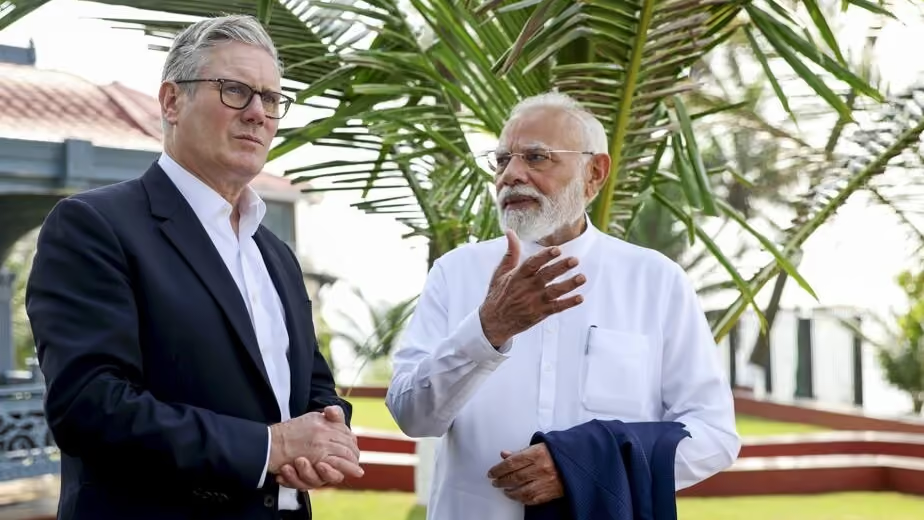
Indian apparel exporters shipping to the United Kingdom stand to recover up to 10–12 percentage points of margin currently surrendered as import duty from July 15, when the India-UK Comprehensive Economic and Trade Agreement (CETA) enters into force and eliminates tariffs on roughly $1.4 billion in annual Indian garment shipments to Britain.
The mechanism is straightforward. The UK currently levies Most Favoured Nation (MFN) duties the standard tariff applied to all trading partners without a special agreement of between 9.6% and 12% on most apparel categories. A mid-sized Indian exporter shipping a $5 million consignment of cotton readymade garments to a UK retail buyer today pays the buyer's agent or absorbs the equivalent of $480,000–$600,000 in landed duty costs, depending on category. After July 15, that charge disappears. In a sector where net export margins typically run 8–12% on FOB (Free on Board the price at which goods are handed to the shipper at the Indian port, with all inland costs included), eliminating a 10% tariff is not a marginal adjustment. It is, in principle, the difference between a viable and an unviable contract. The AEPC (Apparel Export Promotion Council), India's official export body for the sector, has confirmed that duty-free terms will improve price competitiveness and market penetration. India currently holds approximately 7% of the UK's total apparel import bill of $19.84 billion a share that AEPC Chairman A. Sakthivel says the agreement will expand.
The structural constraint the headline numbers obscure is competitive. The UK does not trade apparel in a bilateral vacuum. Bangladesh India's primary competitor in cotton knitwear, shirts, and casualwear already ships duty-free to the UK under the DCTS (Developing Countries Trading Scheme the UK's post-Brexit preferential tariff framework for lower-income nations). Bangladesh's readymade garment sector operates with wage costs materially below India's: factory floor wages in Dhaka run approximately $95–110 per month against $140–180 in comparable Indian manufacturing hubs such as Tiruppur or Ludhiana. What India's CETA delivers is tariff parity with Bangladesh, not a tariff advantage over it. Vietnam, under the UK-Vietnam FTA, is in a similar position. India's exporters gain a level playing field but that field is already occupied by lower-cost producers. The margin headroom created by duty removal will be shared, not kept: UK retail buyers Marks & Spencer, Next, ASOS are experienced negotiators who will seek to capture a share of the tariff saving as lower sourcing prices. Exporters should model the renegotiation risk carefully.
On the buy side, UK apparel importers and sourcing managers gain immediate flexibility. India's strengths larger order minimums, stronger compliance infrastructure, greater product diversity in wovens and technical fabrics become commercially accessible at competitive landed costs for the first time. On the sell side, Indian exporters benefit most in categories where Bangladesh is less dominant: higher complexity woven garments, formal wear, and synthetic blends, where Indian manufacturing capability is relatively stronger and the wage differential matters less. The physical supply chain runs from Indian ports primarily Nhava Sheva (Mumbai) and Chennai to UK entry points at Felixstowe and Southampton, a 20–25 day transit on container vessels. Exporters and freight forwarders should note the tariff arbitrage window: goods in bonded warehouse or in transit at the July 15 entry into force date may qualify for duty-free clearance depending on UK customs entry procedures a scenario worth modelling with a customs broker in the days immediately before the cutover. For a large integrated exporter or trading house with UK buyer relationships already in place, the priority action is locking post-FTA pricing into forward supply contracts before buyers reprice expectations downward. For a smaller regional manufacturer a Tiruppur knitwear unit with $2–5 million annual UK turnover and no dedicated trade finance desk the practical equivalent is approaching UK buyers directly with a revised cost sheet showing the duty saving, retaining at least half of the headroom as margin improvement rather than conceding it entirely in price negotiation.
The medium-term BRICS dimension in the same policy environment is a slower, structurally different story. India's textile and apparel exports to BRICS economies reached Rs 36,535 crore in FY2024 before easing to Rs 34,647 crore in FY2025, while imports from BRICS rose 6.9% to Rs 36,854 crore meaning India is now a net importer of textiles from within the bloc. ASSOCHAM's projection that India could lift overall exports to BRICS to $200 billion by 2030 (from roughly $96 billion across all goods today) is a macro ambition dependent on supply chain integration, digital cooperation, and customs coordination not a near-term trading signal. For observers, the specific and time-bound signal to watch is the UK's HMRC (His Majesty's Revenue and Customs) tariff schedule update confirming zero-rated India-origin apparel codes, expected to publish in the days immediately before July 15. A delay or carve-out in specific categories particularly sensitive UK domestic production lines would compress the margin story materially and should be tracked against the AEPC's public communications in the same window.
.jpg)


'%3e%3cg id='Final-Copy-2_2_' transform='translate(1275.000000, 200.000000)'%3e%3cpath class='st0' d='M7.4,12.8h6.8l3.1-11.6H7.4C4.2,1.2,1.6,3.8,1.6,7S4.2,12.8,7.4,12.8z'/%3e%3c/g%3e%3c/g%3e%3c/g%3e%3cg id='final---dec.11-2020'%3e%3cg id='_x30_208-our-toggle' transform='translate(-1275.000000, -200.000000)'%3e%3cg id='Final-Copy-2' transform='translate(1275.000000, 200.000000)'%3e%3cpath class='st1' d='M22.6,0H7.4c-3.9,0-7,3.1-7,7s3.1,7,7,7h15.2c3.9,0,7-3.1,7-7S26.4,0,22.6,0z M1.6,7c0-3.2,2.6-5.8,5.8-5.8 h9.9l-3.1,11.6H7.4C4.2,12.8,1.6,10.2,1.6,7z'/%3e%3cpath id='x' class='st2' d='M24.6,4c0.2,0.2,0.2,0.6,0,0.8l0,0L22.5,7l2.2,2.2c0.2,0.2,0.2,0.6,0,0.8c-0.2,0.2-0.6,0.2-0.8,0 l0,0l-2.2-2.2L19.5,10c-0.2,0.2-0.6,0.2-0.8,0c-0.2-0.2-0.2-0.6,0-0.8l0,0L20.8,7l-2.2-2.2c-0.2-0.2-0.2-0.6,0-0.8 c0.2-0.2,0.6-0.2,0.8,0l0,0l2.2,2.2L23.8,4C24,3.8,24.4,3.8,24.6,4z'/%3e%3cpath id='y' class='st3' d='M12.7,4.1c0.2,0.2,0.3,0.6,0.1,0.8l0,0L8.6,9.8C8.5,9.9,8.4,10,8.3,10c-0.2,0.1-0.5,0.1-0.7-0.1l0,0 L5.4,7.7c-0.2-0.2-0.2-0.6,0-0.8c0.2-0.2,0.6-0.2,0.8,0l0,0L8,8.6l3.8-4.5C12,3.9,12.4,3.9,12.7,4.1z'/%3e%3c/g%3e%3c/g%3e%3c/g%3e%3c/g%3e%3c/svg%3e) Privacy Choices
Privacy Choices