.avif)
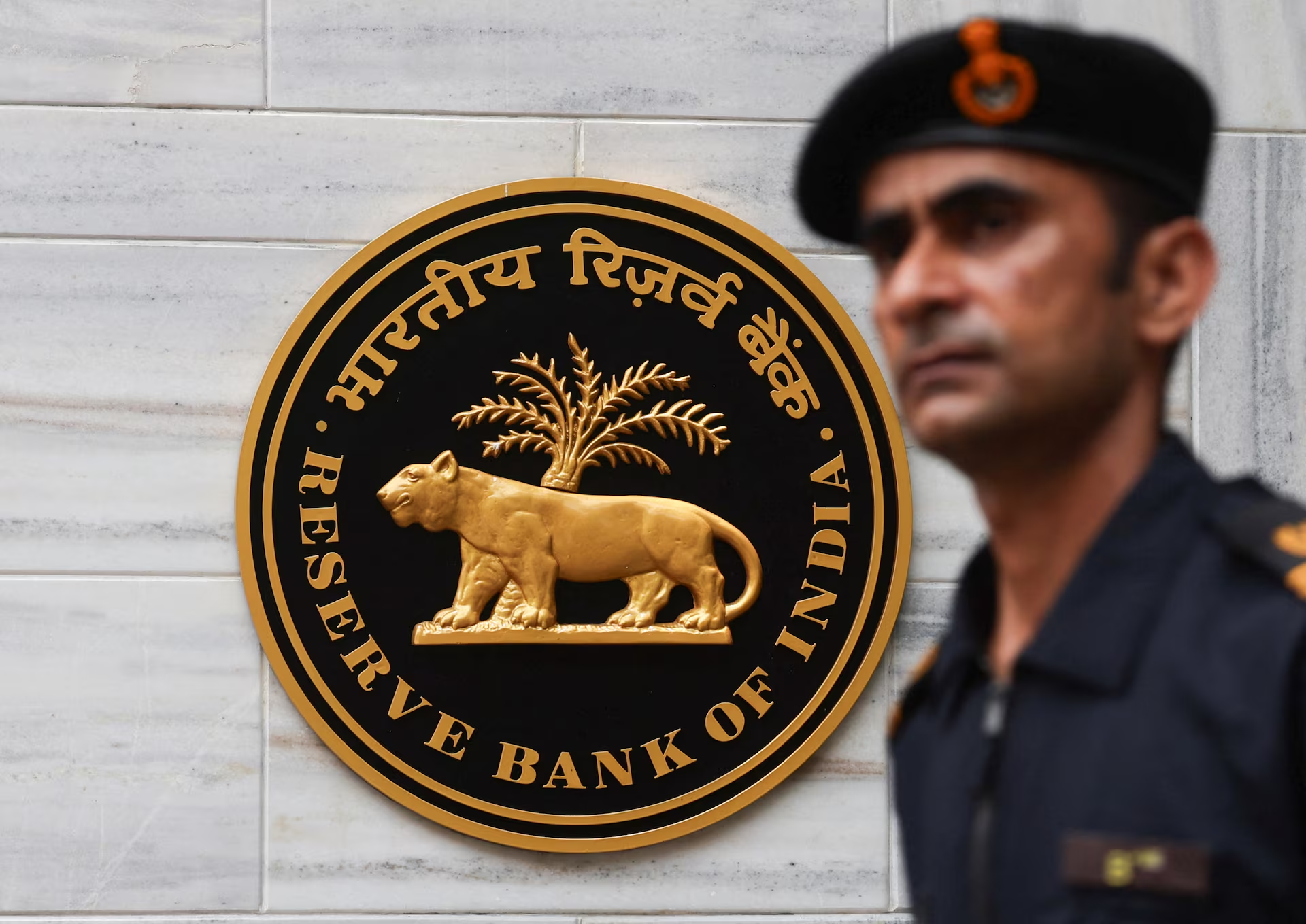
Indian commercial banks are saving an estimated 50–100 basis points on funding costs right now and the mechanism doing the work is a policy subsidy that almost no lending desk has fully priced in for its reversibility.
A certificate of deposit (CD) a fixed-term, tradeable debt instrument that Indian banks issue to raise short-term rupee funding from institutional investors and money market funds has been the default lever for managing balance-sheet liquidity for years. When deposit growth lags loan demand, treasuries print CDs. That lever is now sitting idle. No new one-year CDs were issued across the three trading sessions ending 2 July 2026. June issuance ran approximately 19% below the same period a year earlier, with ₹70,800 crore (roughly $7.4 billion) in foreign currency inflows arriving in the second half of June alone partially displacing the domestic short-term market in real time. The rate signal confirms the shift: one-year CD yields have fallen from a May peak of approximately 7.96% to around 6.84% a compression of 112 basis points in under two months. When a market goes quiet at exactly the moment an alternative funding source opens at lower cost, that is not coincidence. That is substitution.
The substitution is being driven by a specific Reserve Bank of India policy decision: the RBI is absorbing the hedging costs that Indian banks would normally pay when borrowing in foreign currency and converting those proceeds into rupees. To understand why that matters, consider the mechanics. A foreign currency deposit say, a three-year USD deposit placed by an NRI (Non-Resident Indian) arrives in dollars. The bank needs rupees. Converting and holding that exposure requires a hedge: typically a cross-currency swap or forward contract. That hedge has a cost, which historically eroded much of the funding advantage. With the RBI covering that cost, banks can offer NRI depositors 7.75% on three to five year tenors attractive to the depositor while the all-in effective cost to the bank lands below 7%. Compare that to the 7.96% the same bank was paying to issue a one-year CD in May. The arbitrage is not marginal. It is 100 basis points or more on replaced volume, falling directly to the net interest margin the spread between what banks earn on loans and what they pay for funding. For a mid-sized Indian bank with ₹5,000 crore in CD equivalent funding rolled over at 100 bps lower cost, that is ₹50 crore in annual interest savings from a single funding line.
The buy side and sell side of this trade sit in different positions. On the buy side Indian banks sourcing funds the shift is unambiguously positive while the RBI subsidy holds. Axis Bank and peers are actively replacing expensive short-term domestic CDs with longer-dated diaspora backed forex deposits, extending liability duration (the average time until funding must be repaid or rolled over) while cutting cost. For a large bank with a dedicated treasury and derivatives desk, locking in multi-year forex deposits now before the $50 billion inflow target is fully subscribed is straightforward execution. For a smaller regional cooperative bank or urban credit society without a cross-currency desk, the practical equivalent is negotiating fixed bilateral deposit rates on NRI savings accounts for tenors of three years or more, capturing the duration without needing to manage the hedge directly. On the sell side domestic CD investors, money market funds, and short-term fixed-income managers who held one-year CDs yielding close to 8% in May the picture is a compression story. Reinvestment yield on new one year paper has dropped 112 bps. A fund holding ₹1,000 crore in one year CDs rolled monthly has just watched its carry income fall by roughly ₹11 crore annualised on each rollover cycle.
The load-bearing risk in this entire structure is the RBI hedging subsidy and it is a policy choice, not a market equilibrium. If the RBI withdraws or tapers this support, the all-in cost of foreign-currency deposits rises sharply, potentially back above the cost of domestic CDs, collapsing the arbitrage overnight. The $50 billion inflow projection cited by analysts is also contingent on two variables that are not locked in: continued RBI policy support through the quarter, and USD liquidity conditions globally. If US dollar funding tightens driven by Federal Reserve balance sheet decisions or a risk-off event in emerging markets NRI deposit flows could slow materially before the full $50 billion lands. RBL Bank's treasury head Anshul Chandak has indicated that CD issuance will likely stay subdued through July to September, with rates expected to harden from September onward only if the RBI deploys liquidity draining tools. That is the specific signal to watch: the RBI's Liquidity Adjustment Facility (LAF) daily absorption figures, published each morning by the RBI, show whether the central bank is draining or injecting system liquidity. A sustained shift from injection to absorption running for five or more consecutive sessions before September would indicate the RBI is tightening the conditions that make this forex funding trade work. At that point, CD issuance would resume, rates would reprice upward, and the funding cost advantage would begin to close. Watch the LAF. It is the earliest available signal that the policy architecture underneath this structural shift is changing.


.jpg)




'%3e%3cg id='Final-Copy-2_2_' transform='translate(1275.000000, 200.000000)'%3e%3cpath class='st0' d='M7.4,12.8h6.8l3.1-11.6H7.4C4.2,1.2,1.6,3.8,1.6,7S4.2,12.8,7.4,12.8z'/%3e%3c/g%3e%3c/g%3e%3c/g%3e%3cg id='final---dec.11-2020'%3e%3cg id='_x30_208-our-toggle' transform='translate(-1275.000000, -200.000000)'%3e%3cg id='Final-Copy-2' transform='translate(1275.000000, 200.000000)'%3e%3cpath class='st1' d='M22.6,0H7.4c-3.9,0-7,3.1-7,7s3.1,7,7,7h15.2c3.9,0,7-3.1,7-7S26.4,0,22.6,0z M1.6,7c0-3.2,2.6-5.8,5.8-5.8 h9.9l-3.1,11.6H7.4C4.2,12.8,1.6,10.2,1.6,7z'/%3e%3cpath id='x' class='st2' d='M24.6,4c0.2,0.2,0.2,0.6,0,0.8l0,0L22.5,7l2.2,2.2c0.2,0.2,0.2,0.6,0,0.8c-0.2,0.2-0.6,0.2-0.8,0 l0,0l-2.2-2.2L19.5,10c-0.2,0.2-0.6,0.2-0.8,0c-0.2-0.2-0.2-0.6,0-0.8l0,0L20.8,7l-2.2-2.2c-0.2-0.2-0.2-0.6,0-0.8 c0.2-0.2,0.6-0.2,0.8,0l0,0l2.2,2.2L23.8,4C24,3.8,24.4,3.8,24.6,4z'/%3e%3cpath id='y' class='st3' d='M12.7,4.1c0.2,0.2,0.3,0.6,0.1,0.8l0,0L8.6,9.8C8.5,9.9,8.4,10,8.3,10c-0.2,0.1-0.5,0.1-0.7-0.1l0,0 L5.4,7.7c-0.2-0.2-0.2-0.6,0-0.8c0.2-0.2,0.6-0.2,0.8,0l0,0L8,8.6l3.8-4.5C12,3.9,12.4,3.9,12.7,4.1z'/%3e%3c/g%3e%3c/g%3e%3c/g%3e%3c/g%3e%3c/svg%3e) Privacy Choices
Privacy Choices