.avif)
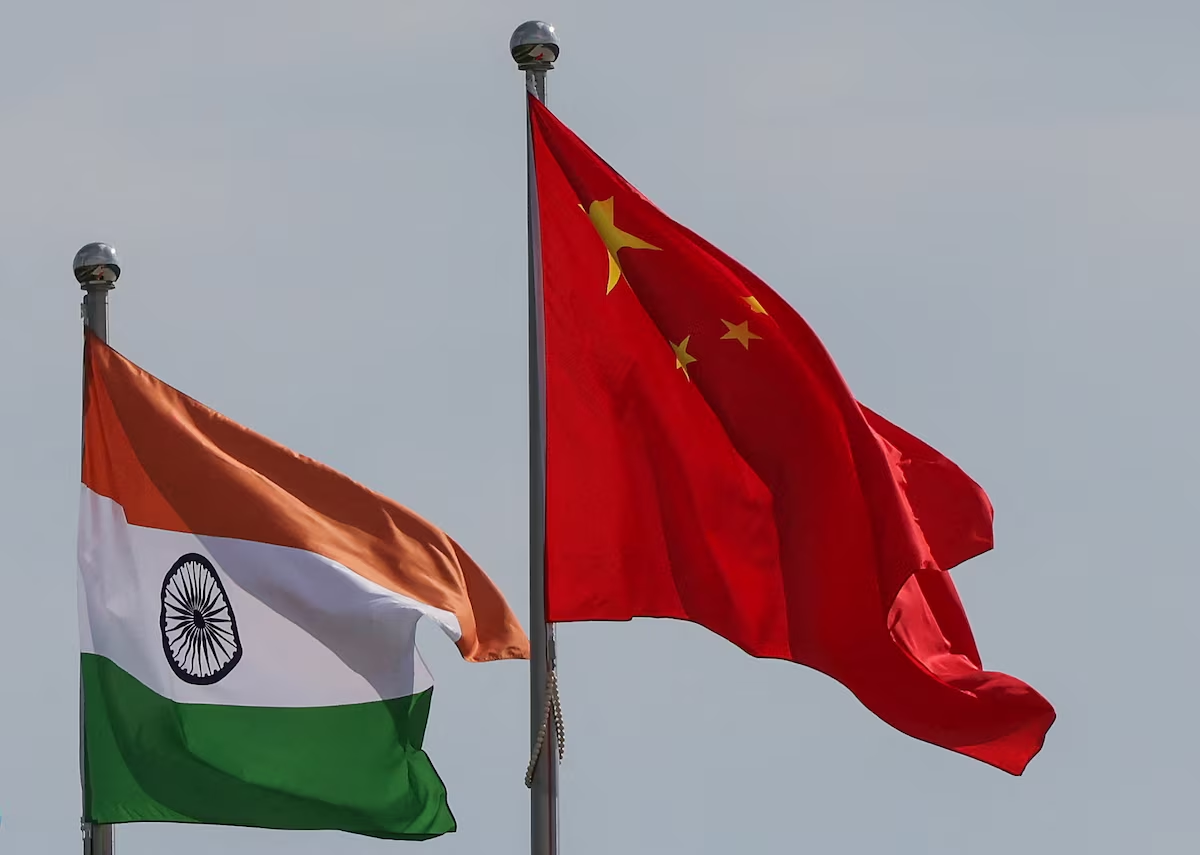
Indian solar module manufacturers gained breathing room on May 22 when India blocked China's first WTO dispute panel request targeting New Delhi's solar cell tariffs and domestic content incentives. The protection is tangible but temporary China can renew its panel request at the next Dispute Settlement Body meeting, where a panel is automatically established under WTO rules. For Indian manufacturers like Waaree Energies or Premier Energies, the immediate calculus is clear: government policy creates a 20-30% price umbrella against Chinese competitors, but that advantage exists within a supply chain where China controls over 80% of the global solar module value chain. The WTO dispute settlement process a formal mechanism where member countries can challenge trade measures they view as discriminatory typically takes 12-18 months from panel establishment to binding ruling, creating a defined window of protection.
Chinese solar module prices are projected to increase 20-30% through 2026, driven by China's elimination of the 9% VAT export rebate effective April 1, 2026 and silver price increases that have risen "vertically" since the start of 2026. Consider a mid-sized Indian solar developer procuring 100MW of modules: Chinese modules at current pricing of $0.085/W cost approximately $8.5 million for the array. Post-VAT elimination, the same procurement reaches $0.12/W or $12 million a $3.5 million increase. Indian domestic modules, previously 25-30% more expensive, now approach price parity with landed Chinese costs. The margin compression affects every layer: developers face higher capex, EPCs rebuild project economics, and module manufacturers both Indian and Chinese recalibrate pricing strategies as the race to the bottom phase of solar procurement ends.
On the buy side, Indian solar developers find themselves in an unprecedented position where government policy and market forces align to narrow the China-India price gap. Large integrated developers like Adani Green or ReNew Power can absorb 15-20% higher module costs through optimized balance of system costs, improved financing terms, or strategic inventory management ahead of price increases. Buyers who secured supply by January 31 achieved 18-22% savings versus post-April pricing, demonstrating how procurement timing became the primary variable in project returns. On the sell side, Indian manufacturers like Vikram Solar or Goldi Solar face the unusual scenario where protective trade policy coincides with Chinese cost inflation, creating a window to build sustainable margins rather than compete purely on price. The 20-30% price protection from tariffs no longer represents pure policy support it reflects genuine cost convergence as Chinese manufacturing loses its artificial subsidization.
For large integrated solar developers with multi-gigawatt pipelines and access to hedging instruments, the strategy involves forward contracting with both Chinese and Indian suppliers to diversify supply chain risk while locking favorable pricing. Forward market assessments show Q1 2026 loading prices at $0.081/W with ranges between $0.078-0.084/W, providing price discovery for long-term contracts. Smaller regional developers state electricity board contractors, commercial rooftop installers, distributed solar cooperatives face more acute procurement pressure without derivatives access. Their practical equivalent involves diversifying supplier relationships between Indian manufacturers and Southeast Asian alternatives, negotiating staged delivery contracts to spread price risk, and adjusting project timelines to match favorable procurement windows. The elimination of pure arbitrage between Chinese and Indian modules forces operational efficiency rather than sourcing optimization.
For observers tracking this market pivot, China's renewed WTO panel request at the next DSB meeting becomes the definitive signal of trade pressure sustainability. If the panel rules against India's domestic content requirements by mid-2027, Indian manufacturers lose policy protection precisely as Chinese cost advantages rebuild through manufacturing scale and technology improvements. The secondary indicator is EU carbon prices, currently fluctuating between €60-€95, which determine the carbon border adjustment mechanism's impact on solar module trade flows and whether decarbonization policy continues supporting domestic manufacturing versus pure cost optimization. Watch the gap between Chinese FOB pricing and Indian domestic pricing monthly convergence below 15% indicates sustainable domestic competitiveness, while divergence above 25% signals policy-dependent market distortion requiring either stronger trade protection or accelerated domestic capacity scaling.


.jpg)




'%3e%3cg id='Final-Copy-2_2_' transform='translate(1275.000000, 200.000000)'%3e%3cpath class='st0' d='M7.4,12.8h6.8l3.1-11.6H7.4C4.2,1.2,1.6,3.8,1.6,7S4.2,12.8,7.4,12.8z'/%3e%3c/g%3e%3c/g%3e%3c/g%3e%3cg id='final---dec.11-2020'%3e%3cg id='_x30_208-our-toggle' transform='translate(-1275.000000, -200.000000)'%3e%3cg id='Final-Copy-2' transform='translate(1275.000000, 200.000000)'%3e%3cpath class='st1' d='M22.6,0H7.4c-3.9,0-7,3.1-7,7s3.1,7,7,7h15.2c3.9,0,7-3.1,7-7S26.4,0,22.6,0z M1.6,7c0-3.2,2.6-5.8,5.8-5.8 h9.9l-3.1,11.6H7.4C4.2,12.8,1.6,10.2,1.6,7z'/%3e%3cpath id='x' class='st2' d='M24.6,4c0.2,0.2,0.2,0.6,0,0.8l0,0L22.5,7l2.2,2.2c0.2,0.2,0.2,0.6,0,0.8c-0.2,0.2-0.6,0.2-0.8,0 l0,0l-2.2-2.2L19.5,10c-0.2,0.2-0.6,0.2-0.8,0c-0.2-0.2-0.2-0.6,0-0.8l0,0L20.8,7l-2.2-2.2c-0.2-0.2-0.2-0.6,0-0.8 c0.2-0.2,0.6-0.2,0.8,0l0,0l2.2,2.2L23.8,4C24,3.8,24.4,3.8,24.6,4z'/%3e%3cpath id='y' class='st3' d='M12.7,4.1c0.2,0.2,0.3,0.6,0.1,0.8l0,0L8.6,9.8C8.5,9.9,8.4,10,8.3,10c-0.2,0.1-0.5,0.1-0.7-0.1l0,0 L5.4,7.7c-0.2-0.2-0.2-0.6,0-0.8c0.2-0.2,0.6-0.2,0.8,0l0,0L8,8.6l3.8-4.5C12,3.9,12.4,3.9,12.7,4.1z'/%3e%3c/g%3e%3c/g%3e%3c/g%3e%3c/g%3e%3c/svg%3e) Privacy Choices
Privacy Choices