.avif)
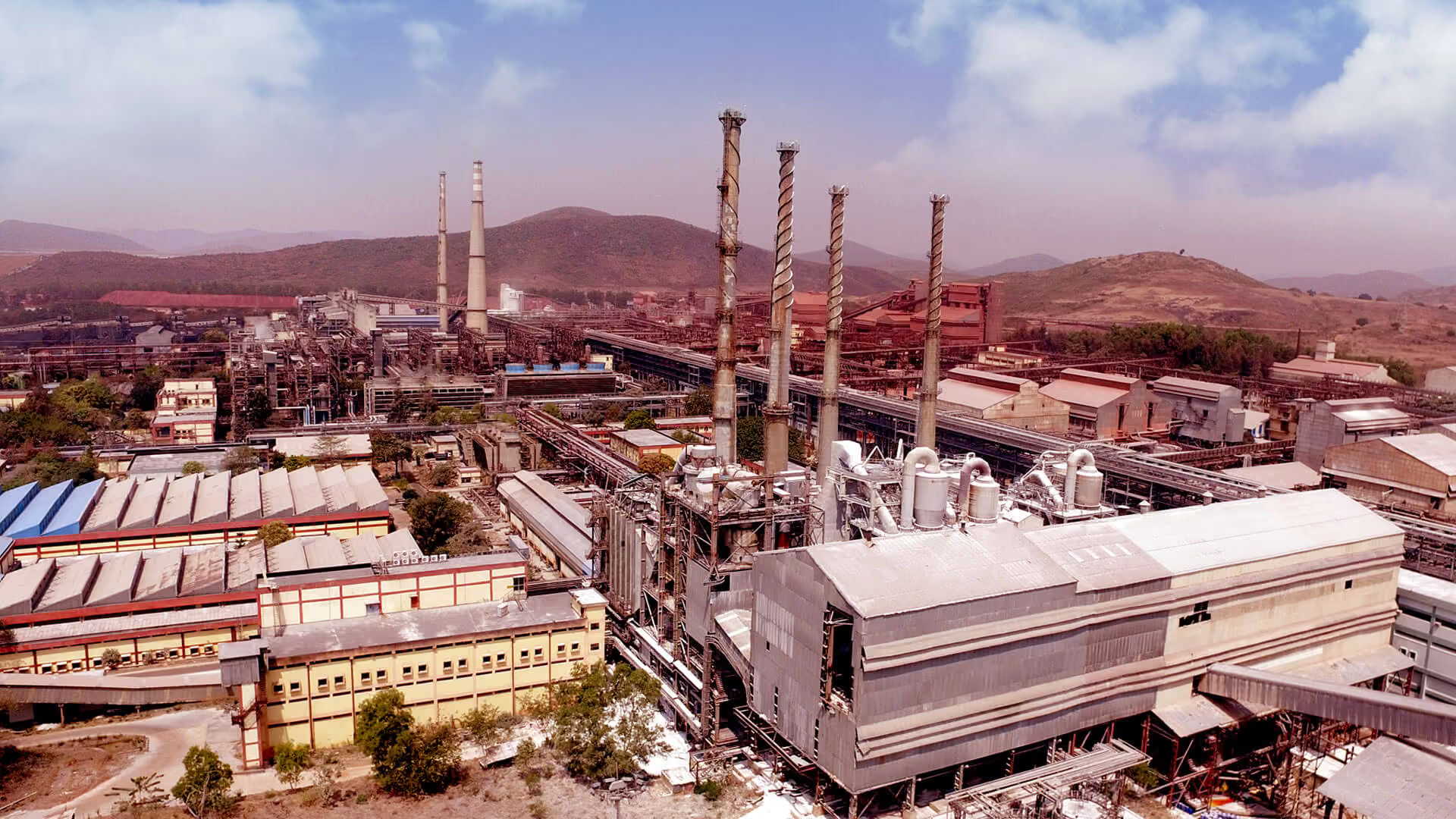
National Aluminium Company's export strategy faces a $28 per tonne margin erosion as West Asian smelter shutdowns force the Indian state-owned producer to redirect 650,000 tonnes of annual alumina shipments half its export volume to Southeast Asian markets. West Asia accounts for 40-50 per cent of the company's alumina shipments, with NALCO reporting that global spot alumina prices have now fallen to $305-310 per tonne as supply disruptions create oversupply in available markets. The margin impact is immediate: contracts originally priced for UAE and Bahraini smelters at $330-340 per tonne are being redirected to Indonesian buyers at $305-315 per tonne, with freight costs adding another $8-12 per tonne for the longer Southeast Asian routes.
The supply chain disruption stems from Iranian attacks on March 28 that significantly damaged Emirates Global Aluminium's 1.4 million ton per year Al Taweelah site in Abu Dhabi and Aluminium Bahrain's 1.65 million ton per year plant in Bahrain. These facilities representing 1.6 million tons of aluminum production each in 2025 have forced around 3 million tons of annual capacity offline, close to half of Middle East aluminum production. For context: a 50,000 tonne alumina cargo shipped from NALCO's Damanjodi refinery to Dubai historically earned a delivered margin of $25-30 per tonne. The same cargo redirected to Jakarta now earns $5-8 per tonne after accounting for the $28 per tonne price differential and extended shipping time.
An alumina exporter's margin anatomy reveals why this disruption matters beyond headline tonnage figures. Alumina a white, granular material refined from bauxite ore trades as both a commodity input and a logistics challenge. NALCO produced 23 lakh tonnes of alumina in 2025-26, of which 13.08 lakh tonnes were exported, making export margins critical to overall profitability. The company's Q4 2026 results demonstrate this vulnerability: consolidated net profit dropped 16.6 per cent to Rs 1,722.44 crore on revenue decline to Rs 5,012.82 crore. Each dollar per tonne of margin compression on 1.3 million tonnes of exports equals approximately $1.3 million in annual profit impact.
The freight dimension exposes a fundamental structural shift in alumina trade flows. Historically, India-West Asia alumina routes operated on 7-10 day sailing times with established port infrastructure at Jebel Ali and Khalifa Port optimised for bulk alumina handling. Export orders are now shifting towards countries such as Indonesia and other international markets, requiring 14-18 day sailing times to Indonesian ports with less specialized alumina handling capacity. This route extension increases working capital requirements: the same cargo that previously generated cash flow in 10 days now ties up capital for 18 days. For a mid-sized alumina trader financing operations through revolving credit facilities, this represents a 75% increase in financing costs per cargo.
On the buy side, West Asian aluminum smelters face acute input shortages that have shifted global supply-demand dynamics. Alba has been facing disruptions to incoming supplies of alumina feedstock, suspending sales to customers earlier this month, while Qatar was forced to halt some aluminum production due to a shortage of natural gas. A typical smelter consuming 2 tonnes of alumina per tonne of aluminum output cannot simply pause operations smelters take months to restart after curtailment, with feedstock pipelines being long and specialised. European aluminum consumers previously sourcing 100,000 tonnes annually from EGA now compete for alternative supply from Norway, Iceland, or Russia, driving regional premiums higher.
On the sell side, pure-play alumina exporters like NALCO confront a pricing environment where demand destruction has outpaced supply reduction. Current spot alumina prices stand at around $305–310 per tonne, with aluminium smelters in West Asia operating at reduced capacity and requiring time to return to full-scale production. The temporal mismatch is crucial: smelter demand collapsed immediately in March, but alternative buyers in Indonesia, China, and Australia cannot absorb redirected volumes without 3-6 months of contract renegotiation. EGA has publicly indicated that restoring full output at the Abu Dhabi facility could require up to 12 months, meaning the alumina oversupply condition persists through 2027.
For large integrated aluminum producers with captive alumina refineries Rio Tinto, Alcoa, Norsk Hydro this dislocation creates margin concentration opportunities. These operators can reduce external alumina purchases at $305 per tonne while their aluminum output captures current aluminum prices of $3,503 per tonne, up to $3,680 per tonne, the highest in over four years. The spread between alumina input cost and aluminum output price exceeds $300 per tonne historically this spread ranges $150-200 per tonne. For smaller regional aluminum producers dependent on purchased alumina, this represents a temporary margin windfall, but only if they can secure reliable alumina supply given the disrupted trade flows.
For observers monitoring this trade disruption, the key signals concentrate in alumina inventory data and Indonesian import statistics. Alumina imports into the Middle East fell 63% year on year in March 2026, functioning as an early warning signal for smelter output collapse. Indonesian alumina import volumes published monthly by the country's statistics bureau with a 6 week lag will reveal whether Southeast Asian smelters can absorb the redirected Indian supply. Watch for June 2026 Indonesian import data, released in mid-August: volumes above 150,000 tonnes would indicate successful flow redirection, while volumes below 100,000 tonnes suggest broader demand destruction is underway.





'%3e%3cg id='Final-Copy-2_2_' transform='translate(1275.000000, 200.000000)'%3e%3cpath class='st0' d='M7.4,12.8h6.8l3.1-11.6H7.4C4.2,1.2,1.6,3.8,1.6,7S4.2,12.8,7.4,12.8z'/%3e%3c/g%3e%3c/g%3e%3c/g%3e%3cg id='final---dec.11-2020'%3e%3cg id='_x30_208-our-toggle' transform='translate(-1275.000000, -200.000000)'%3e%3cg id='Final-Copy-2' transform='translate(1275.000000, 200.000000)'%3e%3cpath class='st1' d='M22.6,0H7.4c-3.9,0-7,3.1-7,7s3.1,7,7,7h15.2c3.9,0,7-3.1,7-7S26.4,0,22.6,0z M1.6,7c0-3.2,2.6-5.8,5.8-5.8 h9.9l-3.1,11.6H7.4C4.2,12.8,1.6,10.2,1.6,7z'/%3e%3cpath id='x' class='st2' d='M24.6,4c0.2,0.2,0.2,0.6,0,0.8l0,0L22.5,7l2.2,2.2c0.2,0.2,0.2,0.6,0,0.8c-0.2,0.2-0.6,0.2-0.8,0 l0,0l-2.2-2.2L19.5,10c-0.2,0.2-0.6,0.2-0.8,0c-0.2-0.2-0.2-0.6,0-0.8l0,0L20.8,7l-2.2-2.2c-0.2-0.2-0.2-0.6,0-0.8 c0.2-0.2,0.6-0.2,0.8,0l0,0l2.2,2.2L23.8,4C24,3.8,24.4,3.8,24.6,4z'/%3e%3cpath id='y' class='st3' d='M12.7,4.1c0.2,0.2,0.3,0.6,0.1,0.8l0,0L8.6,9.8C8.5,9.9,8.4,10,8.3,10c-0.2,0.1-0.5,0.1-0.7-0.1l0,0 L5.4,7.7c-0.2-0.2-0.2-0.6,0-0.8c0.2-0.2,0.6-0.2,0.8,0l0,0L8,8.6l3.8-4.5C12,3.9,12.4,3.9,12.7,4.1z'/%3e%3c/g%3e%3c/g%3e%3c/g%3e%3c/g%3e%3c/svg%3e) Privacy Choices
Privacy Choices