.avif)
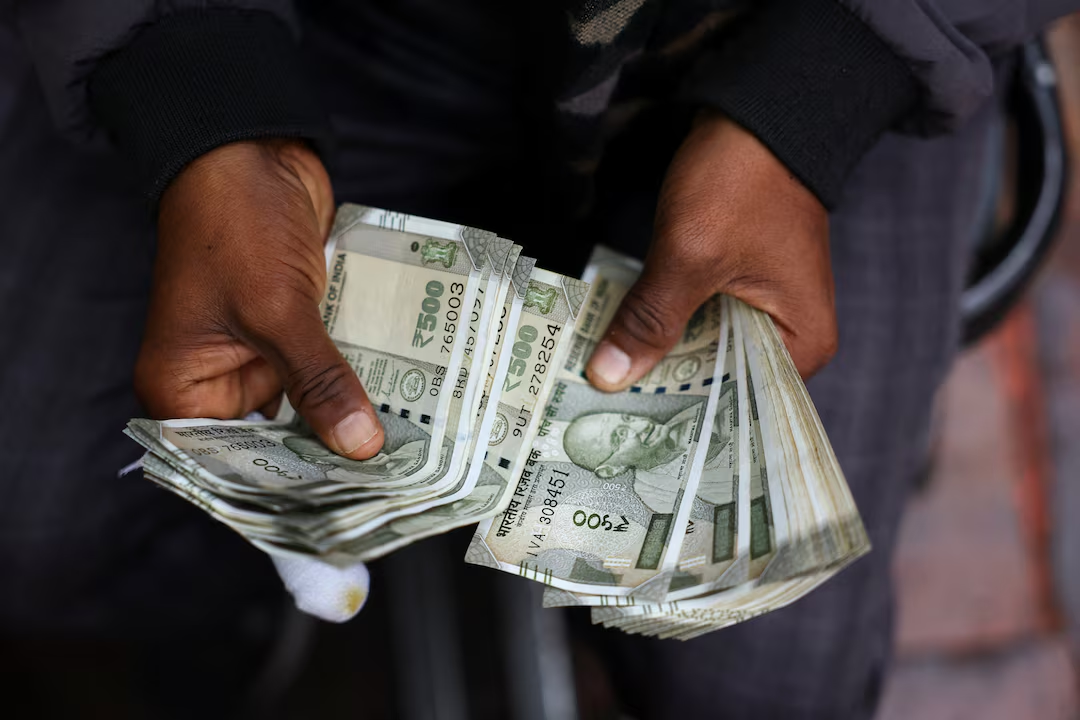
Indian commodity importers face a new basis risk equation as rupee settlement volumes surge 41.2% year on year to Rs 1.60 lakh crore in 2025-26, while benchmark prices remain dollar-denominated. A mid-sized oil importer settling a $50 million crude purchase through Special Rupee Vostro Accounts (SRVAs) dedicated accounts that foreign banks maintain with Indian lenders to hold rupees for trade settlement now pays Rs 475 crore at current exchange rates near 95.2 per dollar. The savings on foreign exchange conversion costs, typically 25-50 basis points, amount to Rs 12-24 lakh per transaction. However, the price discovery still happens in dollars against Brent or Dubai benchmarks, creating a mismatch between contract pricing currency and settlement currency that traditional commodity hedging does not address.
The compound annual growth rate of rupee invoiced imports hit 20.9% during August 2022–July 2025, with absolute invoicing volumes reaching Rs 2.85 lakh crore in 2025-26. This acceleration reflects India's systematic push through Special Rupee Vostro Accounts now operational across 30 countries, but the growth concentrates in bilateral trade with specific partners rather than broad based commodity market adoption. By February 2026, trade worth Rs 14,000 crore was settled in rupees monthly, with over 30 countries participating. The mechanism works through correspondent banking relationships where foreign banks hold rupees in dedicated accounts with Indian authorized dealer banks, eliminating the traditional dollar intermediation step but introducing currency conversion timing risk.
On the buy side: Large integrated commodity traders with sophisticated treasury operations can manage the basis risk through cross-currency swaps, hedging the rupee-dollar exposure separately from underlying commodity price risk. A major trading house importing 2 million tonnes of coal annually through rupee settlement saves approximately $2-4 million in transaction costs while deploying currency forwards to manage the INR-USD basis risk. Their advantage lies in accessing both onshore and offshore rupee derivative markets for comprehensive hedging strategies.
On the sell side: Regional commodity suppliers and smaller exporters face operational complexity without corresponding risk management tools. A mid-sized Indonesian palm oil exporter receiving rupee payments must either accept currency risk on the rupee-dollar conversion or seek hedging through their local banking relationship, often at wider spreads than major international banks offer. The ability to invoice in rupees reduces foreign exchange conversion costs for trade partners, but many lack the treasury infrastructure to manage the residual currency mismatch effectively. Indian commodity importers gain margin through avoided conversion costs, while their banks earn spread on rupee trade finance facilities without dollar funding requirements.
For observers: Watch the RBI's monthly data on SRVA utilization rates and the spread between onshore and offshore rupee forward curves by end Q3 2026. Current approval covers 30 countries' banks for rupee trade settlement, but expansion beyond this network will signal whether the mechanism achieves genuine commodity market penetration or remains limited to bilateral political arrangements. The key metric is rupee settlement as a percentage of India's total commodity import bill currently under 5% rather than absolute growth rates that reflect a low base.
.jpg)

'%3e%3cg id='Final-Copy-2_2_' transform='translate(1275.000000, 200.000000)'%3e%3cpath class='st0' d='M7.4,12.8h6.8l3.1-11.6H7.4C4.2,1.2,1.6,3.8,1.6,7S4.2,12.8,7.4,12.8z'/%3e%3c/g%3e%3c/g%3e%3c/g%3e%3cg id='final---dec.11-2020'%3e%3cg id='_x30_208-our-toggle' transform='translate(-1275.000000, -200.000000)'%3e%3cg id='Final-Copy-2' transform='translate(1275.000000, 200.000000)'%3e%3cpath class='st1' d='M22.6,0H7.4c-3.9,0-7,3.1-7,7s3.1,7,7,7h15.2c3.9,0,7-3.1,7-7S26.4,0,22.6,0z M1.6,7c0-3.2,2.6-5.8,5.8-5.8 h9.9l-3.1,11.6H7.4C4.2,12.8,1.6,10.2,1.6,7z'/%3e%3cpath id='x' class='st2' d='M24.6,4c0.2,0.2,0.2,0.6,0,0.8l0,0L22.5,7l2.2,2.2c0.2,0.2,0.2,0.6,0,0.8c-0.2,0.2-0.6,0.2-0.8,0 l0,0l-2.2-2.2L19.5,10c-0.2,0.2-0.6,0.2-0.8,0c-0.2-0.2-0.2-0.6,0-0.8l0,0L20.8,7l-2.2-2.2c-0.2-0.2-0.2-0.6,0-0.8 c0.2-0.2,0.6-0.2,0.8,0l0,0l2.2,2.2L23.8,4C24,3.8,24.4,3.8,24.6,4z'/%3e%3cpath id='y' class='st3' d='M12.7,4.1c0.2,0.2,0.3,0.6,0.1,0.8l0,0L8.6,9.8C8.5,9.9,8.4,10,8.3,10c-0.2,0.1-0.5,0.1-0.7-0.1l0,0 L5.4,7.7c-0.2-0.2-0.2-0.6,0-0.8c0.2-0.2,0.6-0.2,0.8,0l0,0L8,8.6l3.8-4.5C12,3.9,12.4,3.9,12.7,4.1z'/%3e%3c/g%3e%3c/g%3e%3c/g%3e%3c/g%3e%3c/svg%3e) Privacy Choices
Privacy Choices