.avif)
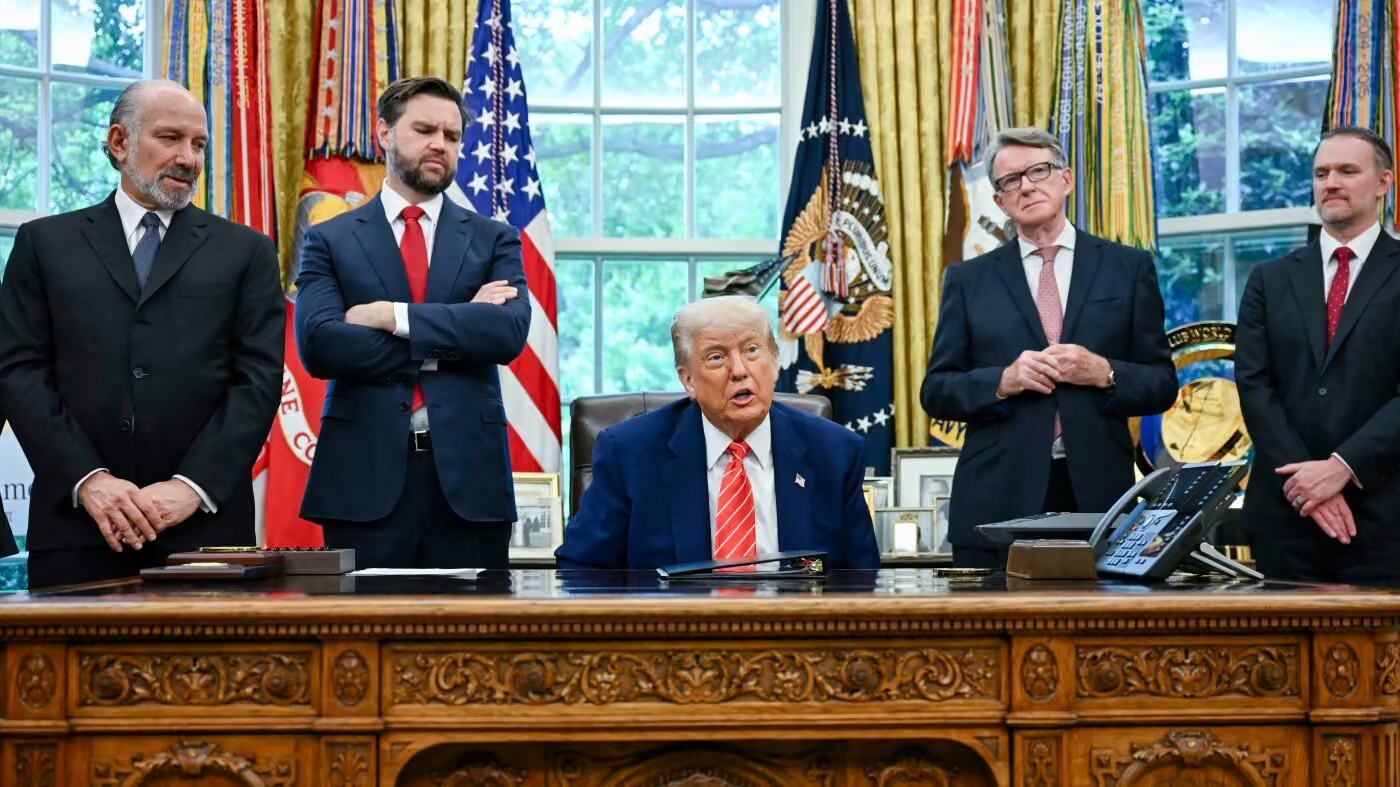
Agricultural exporters face immediate margin compression after President Trump said June 10 he is "not looking to renew" the United States, Mexico and Canada Agreement (USMCA), threatening $1.6 trillion in trilateral trade flows including deeply integrated agricultural supply chains. The uncertainty premium starts immediately even though any actual disruption is a decade away, regulatory risk must be priced into contracts starting now. Consider a mid-sized grain exporter shipping 50,000 tonnes of corn from Iowa to Mexican feed mills. The uncertainty adds an estimated 50-200 basis points to forward contract margins as counterparties demand protection against regulatory change. With CBOT corn futures at $4.18 per bushel near four-month lows those basis points represent real money on thin agricultural margins.
USMCA doesn't actually expire until 2036, but Trump's refusal to commit to the July 1 renewal milestone triggers annual reviews that create persistent political uncertainty. Without renewal, the agreement enters rolling annual reviews as negotiations over autos and other sectors are expected, while Trump did not rule out exiting with six months' notice. A Letter of Credit (LC) a bank guarantee that payment will be made once shipping documents are presented becomes more expensive when trade agreements face political review. Banks price regulatory risk into their guarantee fees. Businesses might keep shipping goods tariff-free, yet hesitate to build new plants or sign long contracts. In trade, uncertainty can behave like a tax.
The scale of agricultural integration is immense: Canada and Mexico represented $4 billion in U.S. soy complex exports during the 2024-25 marketing year, accounting for more than 13 percent of total U.S. soy exports, with Mexico alone purchasing $3.3 billion worth of U.S. soybeans, soybean meal, and soybean oil. Since USMCA went into effect, overall U.S. agricultural exports to Mexico and Canada have increased by $10.7 billion and $7.6 billion respectively. These flows move through a web of cross-border processors, elevators, and distribution networks built around tariff-free access. Corn from Nebraska travels by rail to Mexican poultry operations. Canadian canola oil moves south to U.S. food manufacturers. Under USMCA, an integrated North American supply chain ensures year-round, affordable supply tariff reductions lowered food prices enough to save the average household roughly $700 per year on grocery prices.
reveals where the uncertainty tax falls hardest. For large integrated traders Cargill, ADM, Bunge derivatives markets provide hedging instruments against regulatory risk through political risk insurance and currency swaps. These operators can structure forward sales with regulatory escape clauses, passing uncertainty costs to end buyers. As one industry representative testified to Congress: "Entire industries, companies, farmers and families depend on this agreement." But smaller regional operators independent grain elevators, regional cooperatives, mid-sized feed processors lack access to sophisticated hedging instruments. They absorb uncertainty premiums directly into operating margins, reducing their ability to compete for cross-border contracts against larger players who can price and transfer regulatory risk.
Mexican and Canadian auto exports to the U.S. currently face a 25% tariff on non-U.S. portions of the vehicle demonstrating how sectoral tariffs already complicate USMCA compliance. The Trump administration has kept pressure on Canada and Mexico through sectoral tariffs and demands for tougher rules, even while many USMCA compliant goods continue to receive preferential treatment. Agricultural exporters must now navigate this hybrid environment where some flows remain protected while others face targeted duties. A Kansas wheat exporter selling to Canadian mills enjoys USMCA protection, but uncertainty about future coverage affects contract pricing. Buyers demand concessions shorter terms, price flexibility, regulatory escape clauses that compress seller margins.
Freight patterns amplify the uncertainty effect because North American agricultural logistics are built around predictable trade flows. With $4 billion in goods moving across the U.S. border with Mexico and Canada daily, rail capacity and trucking routes are optimized for high-volume, cross-border movements. Grain unit trains run on fixed schedules between U.S. elevators and Mexican ports. Canadian grain moves through U.S. terminals for overseas export. Regulatory uncertainty reduces the efficiency of these dedicated routes as operators hedge against potential disruption. Rail operators may demand higher rates for cross-border movements to compensate for political risk. Truckers adjust capacity allocation away from routes that could face policy changes.
On the buy side, Mexican feed mills and Canadian food processors face their own uncertainty premium. They must secure alternative supply sources in case USMCA protections disappear, creating redundant procurement costs and inventory positions. A Mexican poultry processor dependent on U.S. corn and soy must now maintain relationships with Brazilian suppliers as backup relationships that require minimum purchase commitments even when not utilized. On the sell side, U.S. agricultural exporters lose their preferential access advantages as buyers diversify supply bases. Competition intensifies from South American and other suppliers who can offer longer-term certainty even at higher base prices.
Negotiations continue with a second round in Washington June 16-17 focusing on agriculture and "level playing field" discussions, followed by a third round in Mexico City during the week of July 20. Trump said: "We don't need anything Canada has, we don't need anything that Mexico has, but they need everything that we have, and they have to treat us better." This negotiating stance suggests the U.S. will demand concessions in agricultural market access, biotechnology approvals, and dispute resolution mechanisms. Agricultural exporters must price these potential changes into current contracts creating the uncertainty premium that reduces margins immediately even though policy changes remain hypothetical.
Trade experts note "fundamentally, there are 10 years left to this trade agreement unless the U.S. president triggers the escape clause" and that Trump would threaten "the nuclear option" of withdrawing because his negotiating approach has always been to talk tough in public. For observers, the key signal is the July 1 milestone when the U.S. must commit to USMCA extension or enter annual review mode. Watch CBOT corn basis spreads to Mexican delivery points widening spreads indicate growing uncertainty premiums. Monitor Canadian canola-U.S. soybean oil price relationships for signs of supply chain reconfiguration. Track rail freight rates on cross-border agricultural routes for uncertainty pricing by logistics providers. The regulatory risk is immediate; the physical disruption timeline gives markets years to adapt.

.jpg)


'%3e%3cg id='Final-Copy-2_2_' transform='translate(1275.000000, 200.000000)'%3e%3cpath class='st0' d='M7.4,12.8h6.8l3.1-11.6H7.4C4.2,1.2,1.6,3.8,1.6,7S4.2,12.8,7.4,12.8z'/%3e%3c/g%3e%3c/g%3e%3c/g%3e%3cg id='final---dec.11-2020'%3e%3cg id='_x30_208-our-toggle' transform='translate(-1275.000000, -200.000000)'%3e%3cg id='Final-Copy-2' transform='translate(1275.000000, 200.000000)'%3e%3cpath class='st1' d='M22.6,0H7.4c-3.9,0-7,3.1-7,7s3.1,7,7,7h15.2c3.9,0,7-3.1,7-7S26.4,0,22.6,0z M1.6,7c0-3.2,2.6-5.8,5.8-5.8 h9.9l-3.1,11.6H7.4C4.2,12.8,1.6,10.2,1.6,7z'/%3e%3cpath id='x' class='st2' d='M24.6,4c0.2,0.2,0.2,0.6,0,0.8l0,0L22.5,7l2.2,2.2c0.2,0.2,0.2,0.6,0,0.8c-0.2,0.2-0.6,0.2-0.8,0 l0,0l-2.2-2.2L19.5,10c-0.2,0.2-0.6,0.2-0.8,0c-0.2-0.2-0.2-0.6,0-0.8l0,0L20.8,7l-2.2-2.2c-0.2-0.2-0.2-0.6,0-0.8 c0.2-0.2,0.6-0.2,0.8,0l0,0l2.2,2.2L23.8,4C24,3.8,24.4,3.8,24.6,4z'/%3e%3cpath id='y' class='st3' d='M12.7,4.1c0.2,0.2,0.3,0.6,0.1,0.8l0,0L8.6,9.8C8.5,9.9,8.4,10,8.3,10c-0.2,0.1-0.5,0.1-0.7-0.1l0,0 L5.4,7.7c-0.2-0.2-0.2-0.6,0-0.8c0.2-0.2,0.6-0.2,0.8,0l0,0L8,8.6l3.8-4.5C12,3.9,12.4,3.9,12.7,4.1z'/%3e%3c/g%3e%3c/g%3e%3c/g%3e%3c/g%3e%3c/svg%3e) Privacy Choices
Privacy Choices