.avif)
Excelerate Energy CEO Steven Kobos confirmed he is "prepared to deploy more capital in Jamaica" just one year after the company paid US$1.055 billion for New Fortress Energy assets, but Caribbean LNG importers face a tightening market as regasification capacity additions outstrip demand growth. With net profit margins compressed to 3% versus 3.9% year-earlier and Excelerate reporting total Q1 2026 adjusted EBITDA of $122 million up 22% year on year, with the Jamaica acquisition as the primary growth driver the expansion decision tests whether operational resilience can overcome structural oversupply pressure across the region.
The Dominican Republic, Jamaica, and Panama collectively hold 1.3 billion cubic feet per day (Bcf/d) of regasification capacity a Floating Storage and Regasification Unit (FSRU) is a specialized vessel that stores LNG and converts it from liquid to gas for onshore distribution but U.S.-origin cargoes supplied only 85% of the 0.4 Bcf/d actually imported by these three countries in 2024. This implies roughly 0.9 Bcf/d of idle capacity, equivalent to storing 30 million cubic meters of natural gas unused daily. For a mid-sized Caribbean utility importing 20,000 tonnes of LNG monthly, that excess capacity represents approximately 45 additional cargoes sitting unutilized across the region capacity that must still service debt and operational costs regardless of throughput.
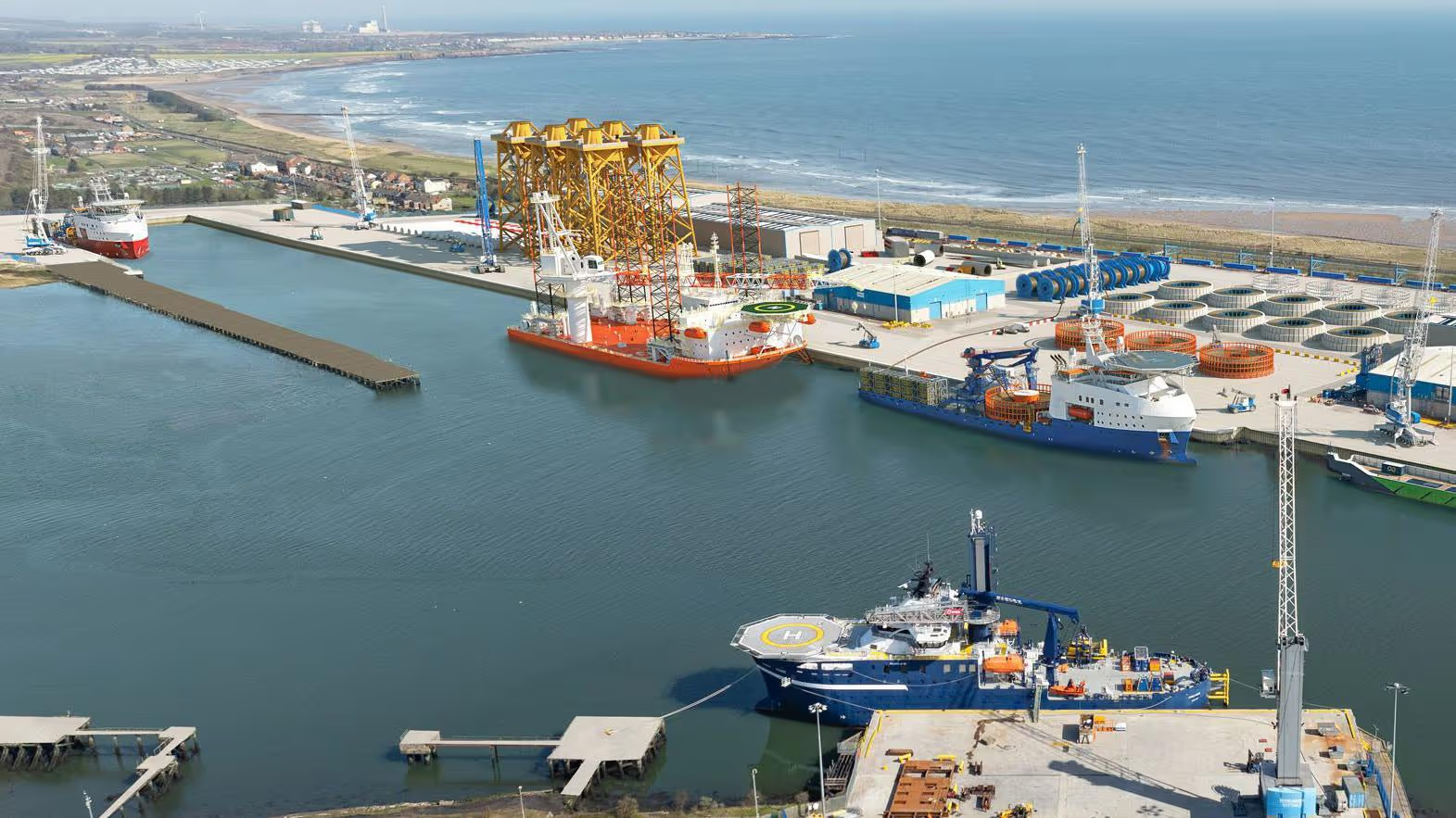
Jamaica operates two regasification terminals totaling 0.4 Bcf/d capacity: the onshore terminal in Montego Bay and Excelerate's FSRU at Old Harbour. On the buy side, Excelerate's long-term contracts insulate Jamaica from spot LNG price volatility where TTF (Title Transfer Facility, the European gas benchmark) has "skyrocketed" due to Middle East conflict maintaining predictable pricing despite global disruption. On the sell side, Excelerate faces pressure to justify expansion capex when full year 2026 EBITDA guidance projects $480-510 million against committed growth capital of $270-300 million. For large integrated players like Excelerate with FSRU fleets, the Jamaica expansion leverages existing infrastructure to capture incremental volumes without proportional cost increases. For smaller regional distributors fuel importers, hotel chains, industrial cooperatives Excelerate's integrated model offers stable supply but limited negotiating power on pricing.
The company's deployment of FSRU Excelerate Acadia to Jordan under a nine month charter demonstrates how operators monetize stranded capacity, but additional Caribbean terminals under construction in Honduras (Q1 2026 completion) and Bahamas (December 2026) will further fragment regional demand. Consider the arithmetic: if existing 1.3 Bcf/d capacity utilizes only 31% (0.4 Bcf/d demand), adding another 0.2 Bcf/d through new terminals drops average utilization below 27% assuming demand growth matches the modest 6% recorded in 2024. Each percentage point of utilization typically translates to $3-5 million annual revenue for an average Caribbean FSRU, making the difference between profitable operations and cash drain.
Management expects "approximately 200 million tonnes of new LNG supply to come online by end of decade," creating intensified need for regasification capacity, but Caribbean importers should monitor Jamaica gas demand growth through Q3 2026 and compare utilization rates at Montego Bay versus Old Harbour terminals. Excelerate's Chief Commercial Officer confirmed teams are "knocking on doors" across Jamaica and the Caribbean, signaling competitive pressure for existing offtake agreements. For observers, Henry Hub spot prices at $4.98/MMBtu (up from $3.12/MMBtu) indicate U.S. gas cost pressures that eventually flow through to Caribbean delivered prices within 60-90 days, potentially dampening demand just as capacity additions peak.





'%3e%3cg id='Final-Copy-2_2_' transform='translate(1275.000000, 200.000000)'%3e%3cpath class='st0' d='M7.4,12.8h6.8l3.1-11.6H7.4C4.2,1.2,1.6,3.8,1.6,7S4.2,12.8,7.4,12.8z'/%3e%3c/g%3e%3c/g%3e%3c/g%3e%3cg id='final---dec.11-2020'%3e%3cg id='_x30_208-our-toggle' transform='translate(-1275.000000, -200.000000)'%3e%3cg id='Final-Copy-2' transform='translate(1275.000000, 200.000000)'%3e%3cpath class='st1' d='M22.6,0H7.4c-3.9,0-7,3.1-7,7s3.1,7,7,7h15.2c3.9,0,7-3.1,7-7S26.4,0,22.6,0z M1.6,7c0-3.2,2.6-5.8,5.8-5.8 h9.9l-3.1,11.6H7.4C4.2,12.8,1.6,10.2,1.6,7z'/%3e%3cpath id='x' class='st2' d='M24.6,4c0.2,0.2,0.2,0.6,0,0.8l0,0L22.5,7l2.2,2.2c0.2,0.2,0.2,0.6,0,0.8c-0.2,0.2-0.6,0.2-0.8,0 l0,0l-2.2-2.2L19.5,10c-0.2,0.2-0.6,0.2-0.8,0c-0.2-0.2-0.2-0.6,0-0.8l0,0L20.8,7l-2.2-2.2c-0.2-0.2-0.2-0.6,0-0.8 c0.2-0.2,0.6-0.2,0.8,0l0,0l2.2,2.2L23.8,4C24,3.8,24.4,3.8,24.6,4z'/%3e%3cpath id='y' class='st3' d='M12.7,4.1c0.2,0.2,0.3,0.6,0.1,0.8l0,0L8.6,9.8C8.5,9.9,8.4,10,8.3,10c-0.2,0.1-0.5,0.1-0.7-0.1l0,0 L5.4,7.7c-0.2-0.2-0.2-0.6,0-0.8c0.2-0.2,0.6-0.2,0.8,0l0,0L8,8.6l3.8-4.5C12,3.9,12.4,3.9,12.7,4.1z'/%3e%3c/g%3e%3c/g%3e%3c/g%3e%3c/g%3e%3c/svg%3e) Privacy Choices
Privacy Choices