.avif)
China will halt sulfuric acid exports from May 2026, eliminating a critical feedstock for phosphate fertilizer production just as Strait of Hormuz disruptions have blocked roughly one-third of global seaborne fertilizer trade. For a mid-sized phosphate producer — a regional fertilizer company or agricultural cooperative — importing 25,000 tonnes of Chinese sulfuric acid annually at $320/tonne, the ban forces immediate sourcing from alternative suppliers at $520-620/tonne. The $200-300/tonne premium translates to $5-7.5 million in additional costs, often exceeding the facility's annual operating margin. There is no substitute. Unlike other industrial chemicals, sulfuric acid — a corrosive liquid with a low value-to-weight ratio of roughly $300 per tonne — cannot be economically shipped beyond 2,000 kilometres. Regional acid markets operate in isolation, meaning Chinese supply cannot be replaced by distant producers.
China's National Development and Reform Commission imposed a quota of 700,000 tonnes for January-April 2026, down from 1.3 million tonnes in the same period of 2025. China exported approximately $349 million worth of sulfuric acid in 2024, more than any other country, with major buyers including the United States, Chile, and Indonesia. The timing compounds an existing supply shock: sulfuric acid prices have been rising since the Iran conflict began, as the effective closure of the Strait of Hormuz blocks sulfur shipments from the Middle East, where it's produced as a byproduct of oil and gas refining. Nearly half of all global seaborne sulfur trade passes through the Strait. The dual disruption — Hormuz blocking sulfur feedstock and China cutting finished acid exports — creates an unprecedented supply squeeze across multiple industrial sectors.
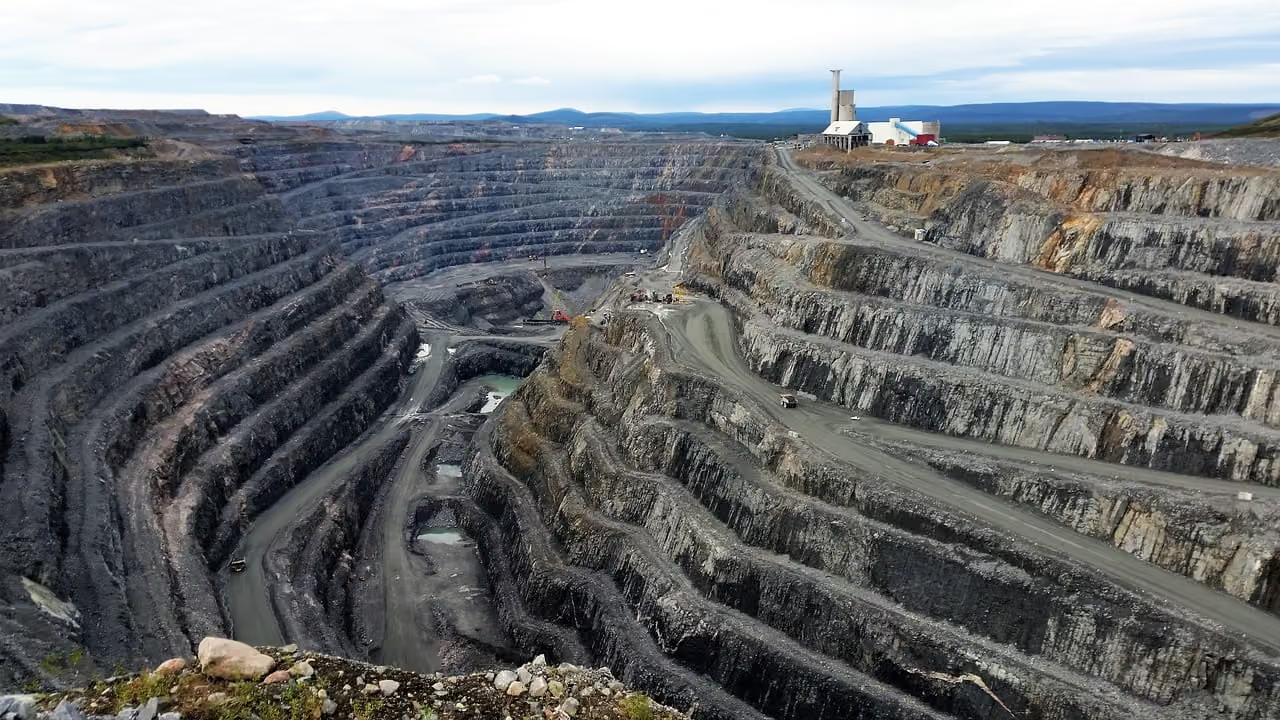
Sulfuric acid sits at the centre of two critical global workflows. First, phosphate fertilizer production: sulfuric acid is required to produce phosphate fertilizers such as DAP and MAP by dissolving raw phosphate rock into a liquid form that plants can absorb. Second, copper extraction: approximately 20% of global copper production uses sulfuric acid leaching — a process where the acid dissolves copper from low-grade ore. Around a fifth of copper output in Chile — the world's No. 1 producer — involves processing that depends on sulfuric acid. Without reliable acid supply, these operations face immediate production constraints. The chemical cannot be substituted — no alternative exists for either phosphate processing or copper leaching at industrial scale.
On the buy side: Large integrated fertilizer producers (CF Industries, Nutrien, Yara) with diversified supply chains can partially offset Chinese losses by securing acid from regional sources — European smelters, Middle East producers when Hormuz reopens, or captive sulfur-burning facilities. Their scale provides negotiating power and alternative sourcing options. However, even major players face $150-250/tonne cost increases as they compete for limited non-Chinese supply. On the sell side: Regional sulfuric acid producers outside China — particularly copper and zinc smelters generating acid as a byproduct — suddenly control scarce supply. European smelters (Aurubis, Boliden) and North American facilities see margins expand $300-500/tonne as buyers scramble for alternative sources. Their acid, previously a low-value waste product, becomes strategically valuable.
For large integrated traders with access to derivative markets: China's ban creates immediate arbitrage opportunities between regional acid markets. A major trading house can secure European smelter acid at $450/tonne and deliver to Chilean copper operations at $750/tonne, capturing $300/tonne less logistics costs of approximately $80/tonne — a $220/tonne margin on each cargo. Forward contracts become critical: locking 6-12 month supply agreements with non-Chinese producers before other buyers recognise the shortage. For smaller regional operators without derivatives access: the practical equivalent involves diversifying supply immediately — signing bilateral agreements with multiple regional producers, accepting higher costs to secure volume. A mid-sized phosphate facility might split purchases between three suppliers rather than relying on single-source Chinese acid, paying premiums for supply security. The financing burden shifts from operational expense to working capital — securing letters of credit for multiple suppliers rather than established Chinese relationships.
The freight dimension concentrates margins with vessel operators and logistics providers. Prices have already surged in Chile, which buys over 1 million tonnes of Chinese sulfuric acid every year. Chilean buyers must now source from European or North American suppliers, extending shipping routes from 35-day Pacific transits to 60-day Atlantic crossings. A specialized chemical tanker carrying 15,000 tonnes of sulfuric acid earns approximately $25/tonne on a China-Chile route — $375,000 per voyage. The same vessel routing Europe-Chile commands $45/tonne — $675,000 per voyage. The additional $300,000 per cargo accrues entirely to the shipping operator, not the cargo owner. Vessel availability becomes critical: specialized chemical tankers capable of handling sulfuric acid are limited, creating a secondary bottleneck in the supply chain.
Financing structures determine which operators survive the transition. Sulfuric acid trade traditionally operates on 30-60 day payment terms with established Chinese suppliers. The shift to alternative sources requires immediate cash or letters of credit — many regional suppliers demand payment on delivery given market volatility. A phosphate producer financing $2 million monthly acid purchases previously managed working capital with Chinese suppliers' extended terms. Alternative European suppliers require confirmed letters of credit, increasing financing costs from 2-3% annually to 8-12% given banking risk premiums on chemical trade. The financing structure often determines access to supply — operators with strong banking relationships and credit facilities secure volume, while leveraged buyers face shortages regardless of their willingness to pay premium prices.
The copper smelting sector faces parallel constraints with different margin anatomy. Beijing's planned export halt will cover sulfuric acid produced as a byproduct of copper and zinc smelting, cutting supply to overseas buyers just as war disruption has already squeezed the market. A tighter acid market threatens higher costs and possible bottlenecks for miners and processors in major producing regions, including African copper belts and Indonesia's nickel sector. A mid-sized African copper operation processing 40,000 tonnes annually requires roughly 60,000 tonnes of sulfuric acid for leaching operations. Chinese acid previously cost $280/tonne delivered. Alternative supply from South African smelters commands $480/tonne, adding $12 million annually to operating costs. The margin compression often exceeds the operation's cash flow, forcing production cuts or temporary shutdowns.
Historically, sulfuric acid shortages have triggered rapid industrial adjustments. During the 1970s oil embargo, when Middle East sulfur supplies were disrupted, European chemical producers rapidly expanded sulfur-burning capacity using alternative feedstocks. The adjustment took 18-24 months and required significant capital investment. The current situation differs fundamentally: the sulfuric acid market was already tight before the latest Middle East disruption, increasing 500% before the latest conflict in Iran started. There is no spare capacity to activate, and building new sulfur-burning plants requires 2-3 years. The supply gap cannot be closed quickly through traditional industrial responses.
For observers monitoring this developing crisis: watch the Baltic Dry Index Chemical Tanker routes — specifically Europe-South America pricing. When European chemical tanker rates exceed $50/tonne (currently $38/tonne), it signals severe supply stress as buyers compete for limited vessel capacity. Monitor Chilean copper production announcements within 45 days — major operations (Codelco, Anglo American's Chilean assets) will announce production adjustments if acid supply cannot be secured. The clearest signal of market breakdown: if Moroccan phosphate exports decline 15% month-over-month by June 2026, it confirms that China and Morocco's reliance on sulfur imports from the Middle East, with China importing roughly four million metric tons annually from the Gulf while Morocco's OCP Group depends on approximately 3.7 million metric tons, has created an irreversible supply chain rupture requiring structural market adjustment.
.jpg)


'%3e%3cg id='Final-Copy-2_2_' transform='translate(1275.000000, 200.000000)'%3e%3cpath class='st0' d='M7.4,12.8h6.8l3.1-11.6H7.4C4.2,1.2,1.6,3.8,1.6,7S4.2,12.8,7.4,12.8z'/%3e%3c/g%3e%3c/g%3e%3c/g%3e%3cg id='final---dec.11-2020'%3e%3cg id='_x30_208-our-toggle' transform='translate(-1275.000000, -200.000000)'%3e%3cg id='Final-Copy-2' transform='translate(1275.000000, 200.000000)'%3e%3cpath class='st1' d='M22.6,0H7.4c-3.9,0-7,3.1-7,7s3.1,7,7,7h15.2c3.9,0,7-3.1,7-7S26.4,0,22.6,0z M1.6,7c0-3.2,2.6-5.8,5.8-5.8 h9.9l-3.1,11.6H7.4C4.2,12.8,1.6,10.2,1.6,7z'/%3e%3cpath id='x' class='st2' d='M24.6,4c0.2,0.2,0.2,0.6,0,0.8l0,0L22.5,7l2.2,2.2c0.2,0.2,0.2,0.6,0,0.8c-0.2,0.2-0.6,0.2-0.8,0 l0,0l-2.2-2.2L19.5,10c-0.2,0.2-0.6,0.2-0.8,0c-0.2-0.2-0.2-0.6,0-0.8l0,0L20.8,7l-2.2-2.2c-0.2-0.2-0.2-0.6,0-0.8 c0.2-0.2,0.6-0.2,0.8,0l0,0l2.2,2.2L23.8,4C24,3.8,24.4,3.8,24.6,4z'/%3e%3cpath id='y' class='st3' d='M12.7,4.1c0.2,0.2,0.3,0.6,0.1,0.8l0,0L8.6,9.8C8.5,9.9,8.4,10,8.3,10c-0.2,0.1-0.5,0.1-0.7-0.1l0,0 L5.4,7.7c-0.2-0.2-0.2-0.6,0-0.8c0.2-0.2,0.6-0.2,0.8,0l0,0L8,8.6l3.8-4.5C12,3.9,12.4,3.9,12.7,4.1z'/%3e%3c/g%3e%3c/g%3e%3c/g%3e%3c/g%3e%3c/svg%3e) Privacy Choices
Privacy Choices