.avif)
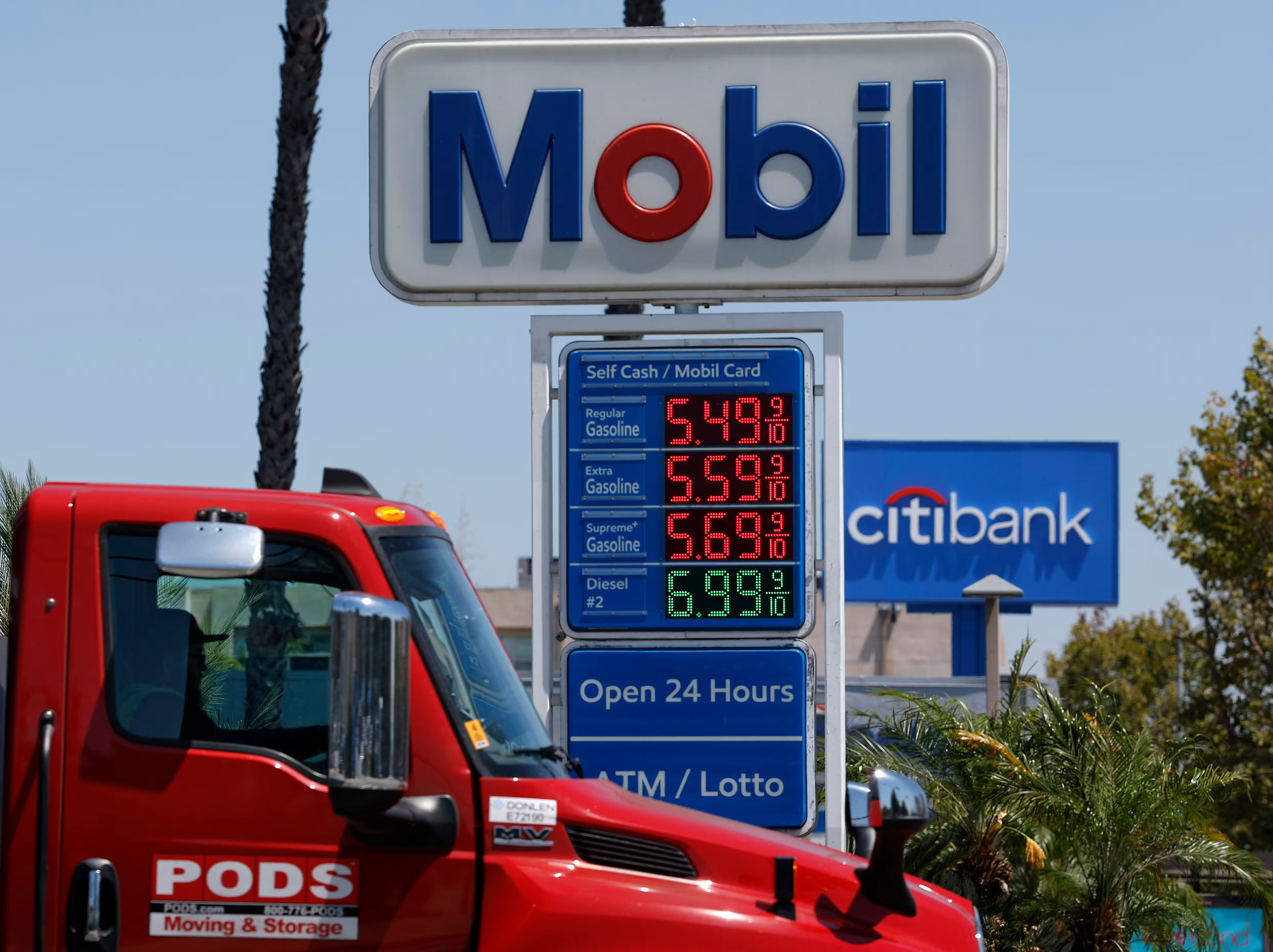
U.S. integrated oil majors are facing simultaneous DOJ and congressional pressure to compress retail gasoline margins ahead of their natural hedge roll-off a forced acceleration that, if enacted, could cost refiners an estimated 3–8 cents per gallon in margin sacrifice beginning as early as July 2026, with no guarantee of sustained supply throughput in return.
The core commercial tension here is a mismatch between political time and physical market time. Retail gasoline prices in the United States are not driven by WTI crude the benchmark for U.S. oil futures in real time. They are driven by the RBOB crack spread: the difference between the price of reformulated blendstock for oxygenate blending (RBOB the futures contract that most closely tracks U.S. pump gasoline costs) and the underlying crude input. When a refiner buys crude at $95/barrel and sells gasoline futures forward at an implied $108/barrel equivalent, that locked crack spread represents a contractual obligation, not a discretionary pricing choice. Even if spot crude falls to $75/barrel the following month, the refiner cannot reprice those locked positions until the hedge rolls off. The DOJ investigation, according to reports, appears to frame this lag as intentional price gouging but the mechanism it is examining is standard hedging practice, not market manipulation.
To make this concrete: consider a mid-continent U.S. refiner processing 200,000 barrels per day. In late March 2026, with WTI trading near $98/barrel, that refiner locked crude procurement hedges at approximately $94–$96/barrel and sold forward RBOB contracts at a crack spread implying a $14–$16/barrel refining margin a margin that, at volume, represents roughly $2.8–3.2 million per day in protected gross profit. By late April, WTI had declined sharply on U.S.-Iran de-escalation news, trading near or below $80/barrel according to market reports. The spot crude cost fell roughly $15–18/barrel. But the refiner's locked hedge positions did not fall. The cost of crude embedded in the pump price calculation the hedge book, not the spot price remained elevated until those contracts expired, typically on a 30–90 day rolling cycle. The political narrative demanded an immediate price cut. The financial reality did not permit one without absorbing the loss directly into refining margin.
The four large trades now under CFTC and DOJ scrutiny illustrate the other side of this same market. According to reports, four petroleum derivatives positions $500 million on March 23, approximately $1 billion on April 7, $760 million on April 17, and $430 million on April 21 were executed in a manner that appears to have profited from anticipated crude price declines linked to U.S.-Iran geopolitical developments. These are likely short positions in crude futures: bets that prices would fall. A short crude futures position profits when the underlying commodity declines in value every $1/barrel decline on a 10 million barrel notional position generates $10 million in gain. The $2.6 billion total notional exposure does not represent profit it represents the size of the bet. Actual net P&L depends on entry price, strike, and timing of exit. Authorities have not yet produced evidence that these trades involved non-public information, and the investigation is described as procedurally separate from the pump price inquiry. But the optics large derivative gains as consumers paid elevated pump prices are commercially and politically explosive.
On the buy side, integrated oil majors with downstream refining operations ExxonMobil, Chevron, Marathon Petroleum, Valero are carrying the direct margin exposure. Their procurement teams locked crude at $90–100/barrel equivalents; their retail and wholesale customers are demanding prices consistent with $75–80/barrel crude. The squeeze is real. If political pressure forces accelerated pass-through before hedges expire, refiners absorb the gap directly. A 5 cents/gallon margin sacrifice across a 200,000 barrel/day refinery running at full capacity represents approximately $4.2 million per month in foregone margin material, but not existential for a major integrated operator. For independent refiners without the balance sheet depth of a supermajor, the calculus is more threatening. On the sell side, gasoline retailers and wholesale rack distributors who operate on margins of 3–8 cents/gallon with no derivatives access face a different pressure: the political expectation of lower pump prices is being transmitted from the White House to the consumer before it has been transmitted through the physical supply chain. Retailers get squeezed from both ends.
For a large integrated trader a Vitol, a Trafigura, or a major's trading arm the CFTC scrutiny on the four identified trades is the operative risk this month, not the DOJ pump-price inquiry. The practical protection instrument is documentation: demonstrating that each position was entered based on publicly available information and commercially standard hedging logic. Compliance teams at firms of this scale will be building position by position audit trails now, correlating trade entry dates with public geopolitical developments, and stress testing their CFTC reporting obligations. For smaller regional operators independent fuel distributors, regional cooperative buyers, state-owned fuel importers without derivatives access the relevant protection is simpler but more urgent: bilateral supply agreements with pricing indexed to a trailing average of RBOB rather than spot WTI can reduce exposure to the political price volatility cycle. A 30 day RBOB trailing average clause, negotiated now, creates a contractual buffer against both sudden crude spikes and politically mandated compression.
There is a structural arbitrage consequence that none of the political commentary has addressed. If U.S. retail pump prices are suppressed below export parity levels the price at which refined product could be shipped from the Gulf Coast to Atlantic Basin buyers in Europe or Latin America Gulf Coast refiners with export terminals will redirect product outward. Export-parity price for RBOB delivered Rotterdam is currently approximately $0.08–0.12/gallon above the U.S. wholesale rack price in normal conditions. Political compression of domestic rack prices by even 5 cents/gallon widens that arbitrage meaningfully. The result: less refined product available domestically, tighter physical supply, and ultimately higher pump prices the exact opposite of the investigation's stated goal. This is not a theoretical risk. It is the standard market response to price-floor removal in a globally connected refining system.
The oilfield-services dimension adds a separate but related signal. Schlumberger (SLB) now trading under the brand SLB is the world's largest oilfield services provider by revenue, supplying the drilling, completion, and production technology that integrated majors depend on for upstream output. With more than 75% of SLB's revenue generated outside the United States and a market capitalisation near $71.4 billion, SLB's order book functions as a proxy for global upstream capital expenditure confidence. Reports indicate $7.4 million in insider share sales over the past three months. Insider selling is not, by itself, a directional market signal executives sell shares for many reasons unrelated to company outlook but at a moment when regulatory pressure may constrain U.S. upstream activity, an uptick in insider selling at the dominant services provider is a data point worth tracking alongside rig count and backlog disclosures.
For observers seeking a single, time-bound signal: watch the RBOB crack spread published daily on CME Group as the difference between front month RBOB futures and front-month WTI over the next 30 days. If the crack spread compresses below $10/barrel, it signals that refining margins are genuinely normalising in response to lower crude costs, and pump prices should follow within two to four weeks as hedge books roll. If the crack spread holds above $14/barrel while crude remains below $82/barrel, the hedging lag argument is validated and the DOJ will find no pricing anomaly that the market itself has not already begun to correct. The political investigation timeline and the market correction timeline are converging. By late July 2026, the hedge rolls will largely have occurred. The pump-price gap will have narrowed. The question is whether the investigation produces a legal conclusion before the market makes it moot.


.jpg)
.jpg)

'%3e%3cg id='Final-Copy-2_2_' transform='translate(1275.000000, 200.000000)'%3e%3cpath class='st0' d='M7.4,12.8h6.8l3.1-11.6H7.4C4.2,1.2,1.6,3.8,1.6,7S4.2,12.8,7.4,12.8z'/%3e%3c/g%3e%3c/g%3e%3c/g%3e%3cg id='final---dec.11-2020'%3e%3cg id='_x30_208-our-toggle' transform='translate(-1275.000000, -200.000000)'%3e%3cg id='Final-Copy-2' transform='translate(1275.000000, 200.000000)'%3e%3cpath class='st1' d='M22.6,0H7.4c-3.9,0-7,3.1-7,7s3.1,7,7,7h15.2c3.9,0,7-3.1,7-7S26.4,0,22.6,0z M1.6,7c0-3.2,2.6-5.8,5.8-5.8 h9.9l-3.1,11.6H7.4C4.2,12.8,1.6,10.2,1.6,7z'/%3e%3cpath id='x' class='st2' d='M24.6,4c0.2,0.2,0.2,0.6,0,0.8l0,0L22.5,7l2.2,2.2c0.2,0.2,0.2,0.6,0,0.8c-0.2,0.2-0.6,0.2-0.8,0 l0,0l-2.2-2.2L19.5,10c-0.2,0.2-0.6,0.2-0.8,0c-0.2-0.2-0.2-0.6,0-0.8l0,0L20.8,7l-2.2-2.2c-0.2-0.2-0.2-0.6,0-0.8 c0.2-0.2,0.6-0.2,0.8,0l0,0l2.2,2.2L23.8,4C24,3.8,24.4,3.8,24.6,4z'/%3e%3cpath id='y' class='st3' d='M12.7,4.1c0.2,0.2,0.3,0.6,0.1,0.8l0,0L8.6,9.8C8.5,9.9,8.4,10,8.3,10c-0.2,0.1-0.5,0.1-0.7-0.1l0,0 L5.4,7.7c-0.2-0.2-0.2-0.6,0-0.8c0.2-0.2,0.6-0.2,0.8,0l0,0L8,8.6l3.8-4.5C12,3.9,12.4,3.9,12.7,4.1z'/%3e%3c/g%3e%3c/g%3e%3c/g%3e%3c/g%3e%3c/svg%3e) Privacy Choices
Privacy Choices