.avif)

Gulf-route tanker operators are absorbing a compounding war-risk insurance cost increase that began the moment Dubai's missile alert sounded on 27 June 2026 not because a missile landed, but because it didn't need to.
Dubai's missile alert the first of its kind issued in the city during the current Iran-linked conflict period, according to authorities was attributed within minutes to a technical malfunction rather than an incoming strike. The all clear came quickly. But the commercial damage to tanker voyage economics does not resolve with an all-clear. War-risk insurance specialist marine coverage that protects vessel operators against losses from acts of war, terrorism, piracy, and missile strikes in designated high-threat zones is priced by underwriters at Lloyd's of London and specialist marine markets on a fundamentally different logic than most operators assume. Underwriters do not wait for confirmed hits. They reprice on incident frequency: how often the alarm sounds, not how often the bomb lands. A false alert, from a marine underwriting perspective, is evidence of a threat environment not evidence of its absence. Dubai's alert joined a pattern of Iran-linked incidents across Gulf waters that underwriters were already tracking carefully, and the repricing consequence is now baking into the operating cost lines of every tanker transiting the region.
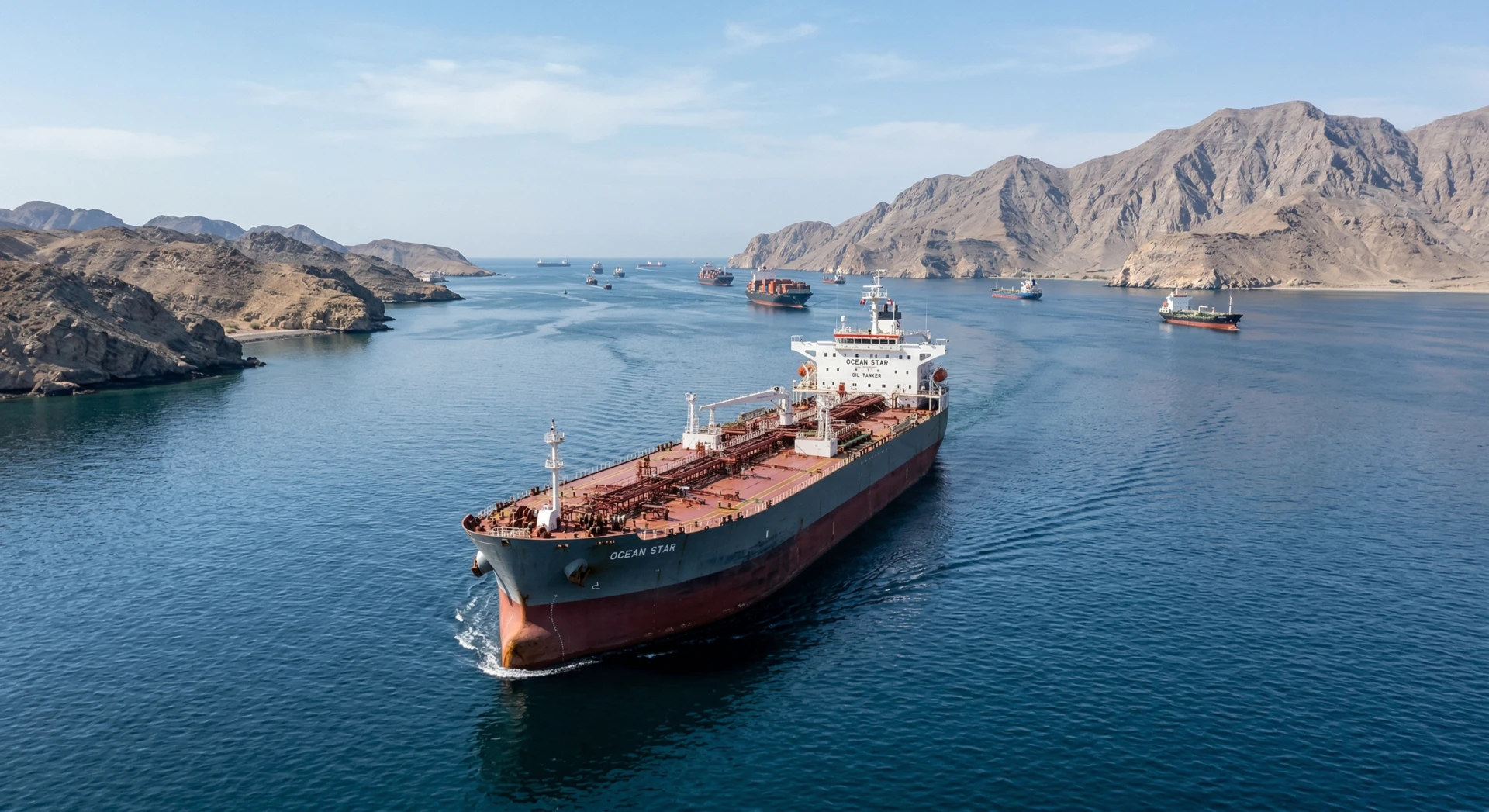
To understand where the margin actually moves, it helps to trace a single voyage. Consider a VLCC a Very Large Crude Carrier, a supertanker capable of carrying approximately 2 million barrels of crude loading at Ruwais, Abu Dhabi's principal export terminal on the Persian Gulf coast, bound for a Japanese refinery at Chiba. The vessel transits the Strait of Hormuz, a 33 kilometre wide chokepoint between Oman and Iran through which roughly 20% of world traded oil passes every day, then crosses the Arabian Sea, rounds the southern tip of India, and arrives approximately 20–25 days later. The base freight rate on this route, at current market levels, is approximately $14–16 per metric tonne. War-risk premium the additional insurance loading applied because the vessel entered a designated war-risk zone is charged separately and has, in comparable Gulf escalation episodes, ranged between $0.50 and $2.00 per barrel, or approximately $3.50 to $14.00 per metric tonne on a full VLCC cargo. At the midpoint say $1.25/bbl, adding roughly $8.75/MT that war-risk loading represents more than half the base freight margin on the voyage. It is not a footnote. It is the margin.
The mechanics of how that premium compounds matters for operators trying to model exposure. War-risk loadings in Gulf zones are typically assessed on a per-voyage basis, applied at the time of entry into the designated area, and recalculated by underwriters at intervals that have shortened considerably since 2019. When incident frequency rises whether through actual strikes or credible alerts underwriters narrow their recalibration windows. Before the Dubai alert, the Gulf zone loading had been tracking toward the lower end of the $0.50–$2.00/bbl range, reflecting the partial de-escalation signalled by the US-Iran interim deal. After it, operators querying their war-risk brokers for updated terms are receiving quotes that reflect a zone rerating upward. Sources indicate that UAE Foreign Minister Sheikh Abdullah bin Zayed Al Nahyan spoke with his Iranian counterpart following the incident, stressing the importance of the interim deal but diplomatic calls and underwriting cycles move at different speeds. The premium revision is already in place. The diplomatic reassurance is still in progress.
On the buy side, the operators most immediately exposed are Asian crude importers Japanese, South Korean, and Indian refineries who have embedded voyage cost assumptions in term supply contracts priced on a delivered basis. If war-risk premiums have risen by, say, $0.75/bbl since contracts were negotiated, and a VLCC carries 2 million barrels, that is $1.5 million in unrecovered cost per voyage. On a monthly import programme of eight VLCCs, the annual exposure runs to approximately $144 million before accounting for any further premium escalation. On the sell side, Gulf NOC trading arms and major integrated traders Vitol, Trafigura, ADNOC's trading division selling on a CFR (cost and freight meaning the seller bears freight and insurance to destination) basis face the same arithmetic in reverse: their delivered margin compresses by exactly the amount the war-risk loading has risen, unless they can renegotiate terms to FOB (free on board buyer assumes freight and insurance from the load port). The pressure to push contracts from CFR to FOB is already a visible commercial trend in Gulf crude markets, and the Dubai alert adds momentum.
For large integrated tanker operators and trading houses with access to the derivatives and insurance markets those managing fleets of ten vessels or more, with dedicated war-risk coverage programmes negotiated annually with Lloyd's syndicates the response is relatively structured. They can hedge freight exposure through Forward Freight Agreements (FFAs financial contracts that lock in a future freight rate, allowing operators to fix voyage economics ahead of execution), and their scale allows them to negotiate war-risk premium caps or corridor structures that limit single voyage upside exposure. The practical consequence for them is not existential it is a margin reduction of known magnitude, managed within an existing risk framework. The Dubai alert moves their quarterly P&L by a calculable amount. They do not like it, but they can model it.
For smaller regional tanker operators independent owners running three to five vessels, regional fuel importers chartering tonnage on the spot market for Gulf-origin refined products, smaller South Asian oil companies managing their own freight the picture is materially harder. They typically buy war-risk insurance voyage by voyage, at spot rates, with no ability to hedge freight through FFAs at sufficient scale to make the instrument economic. When underwriters raise Gulf zone premiums following an incident like the Dubai alert, smaller operators face the full spot rate immediately. There is no portfolio to absorb the shock. The practical equivalents available to them fixing voyage terms bilaterally with charterers at a fixed all-in delivered price before entering the zone, seeking term supply agreements that transfer freight risk to the counterparty, or building a war-risk contingency line into their working capital are imperfect substitutes, and most require counterparty cooperation that is increasingly difficult to obtain when the market is moving against you.
The structural question that this episode surfaces and that the swift all-clear obscures is whether the Gulf has entered a regime where alert frequency itself is the operative risk variable, independent of alert accuracy. The Iran-Iraq tanker war of the 1980s provides the last comparable structural anchor: during that conflict, Lloyd's of London repriced Gulf war-risk premiums multiple times in the same quarter, not because every attack succeeded, but because the frequency of attempts demonstrated that the threat was persistent and serious. The current environment, with Bahrain, Qatar, Saudi Arabia, Kuwait, Oman, and Jordan all reportedly activating regional security coordination in response to the Dubai alert, suggests that Gulf states themselves are treating incident frequency not incident outcome as the relevant signal. Insurance underwriters read the same signal and reach the same conclusion. A rerouting via the Cape of Good Hope adding approximately 3,500 nautical miles and 8–12 extra steaming days to an Abu Dhabi–Japan voyage, at a daily operating cost of roughly $35,000–$45,000 per vessel is not yet economically justified relative to elevated but manageable war-risk premiums. But operators with flexible routing provisions in their charters are beginning to model the crossover point.
The actionable signal for tanker operators and their procurement counterparts is the Lloyd's Joint War Committee (JWC) Listed Areas designation. The JWC the underwriting committee that maintains the official list of high-risk maritime zones for war-risk insurance purposes updates its Gulf zone assessments periodically, and a formal uplift in the UAE coastal zone rating would serve as the definitive market signal that war-risk premiums have structurally reset upward, not merely spiked. Operators should monitor the JWC listed areas bulletin over the next 30 days. If the UAE zone rating is upgraded, expect war-risk loadings to move toward the upper end of the $1.50–$2.00/bbl range immediately, and expect FOB versus CFR contract renegotiations to accelerate across Gulf crude and products markets. If the JWC holds its current rating reading the diplomatic outreach and the false alarm attribution as sufficient reassurance the premium spike should partially reverse within two to three weeks, and spot charter economics normalise. The difference between those two outcomes is approximately $10–15 per metric tonne on every Gulf-origin cargo. That is a number worth watching precisely.
.jpg)




'%3e%3cg id='Final-Copy-2_2_' transform='translate(1275.000000, 200.000000)'%3e%3cpath class='st0' d='M7.4,12.8h6.8l3.1-11.6H7.4C4.2,1.2,1.6,3.8,1.6,7S4.2,12.8,7.4,12.8z'/%3e%3c/g%3e%3c/g%3e%3c/g%3e%3cg id='final---dec.11-2020'%3e%3cg id='_x30_208-our-toggle' transform='translate(-1275.000000, -200.000000)'%3e%3cg id='Final-Copy-2' transform='translate(1275.000000, 200.000000)'%3e%3cpath class='st1' d='M22.6,0H7.4c-3.9,0-7,3.1-7,7s3.1,7,7,7h15.2c3.9,0,7-3.1,7-7S26.4,0,22.6,0z M1.6,7c0-3.2,2.6-5.8,5.8-5.8 h9.9l-3.1,11.6H7.4C4.2,12.8,1.6,10.2,1.6,7z'/%3e%3cpath id='x' class='st2' d='M24.6,4c0.2,0.2,0.2,0.6,0,0.8l0,0L22.5,7l2.2,2.2c0.2,0.2,0.2,0.6,0,0.8c-0.2,0.2-0.6,0.2-0.8,0 l0,0l-2.2-2.2L19.5,10c-0.2,0.2-0.6,0.2-0.8,0c-0.2-0.2-0.2-0.6,0-0.8l0,0L20.8,7l-2.2-2.2c-0.2-0.2-0.2-0.6,0-0.8 c0.2-0.2,0.6-0.2,0.8,0l0,0l2.2,2.2L23.8,4C24,3.8,24.4,3.8,24.6,4z'/%3e%3cpath id='y' class='st3' d='M12.7,4.1c0.2,0.2,0.3,0.6,0.1,0.8l0,0L8.6,9.8C8.5,9.9,8.4,10,8.3,10c-0.2,0.1-0.5,0.1-0.7-0.1l0,0 L5.4,7.7c-0.2-0.2-0.2-0.6,0-0.8c0.2-0.2,0.6-0.2,0.8,0l0,0L8,8.6l3.8-4.5C12,3.9,12.4,3.9,12.7,4.1z'/%3e%3c/g%3e%3c/g%3e%3c/g%3e%3c/g%3e%3c/svg%3e) Privacy Choices
Privacy Choices