.avif)
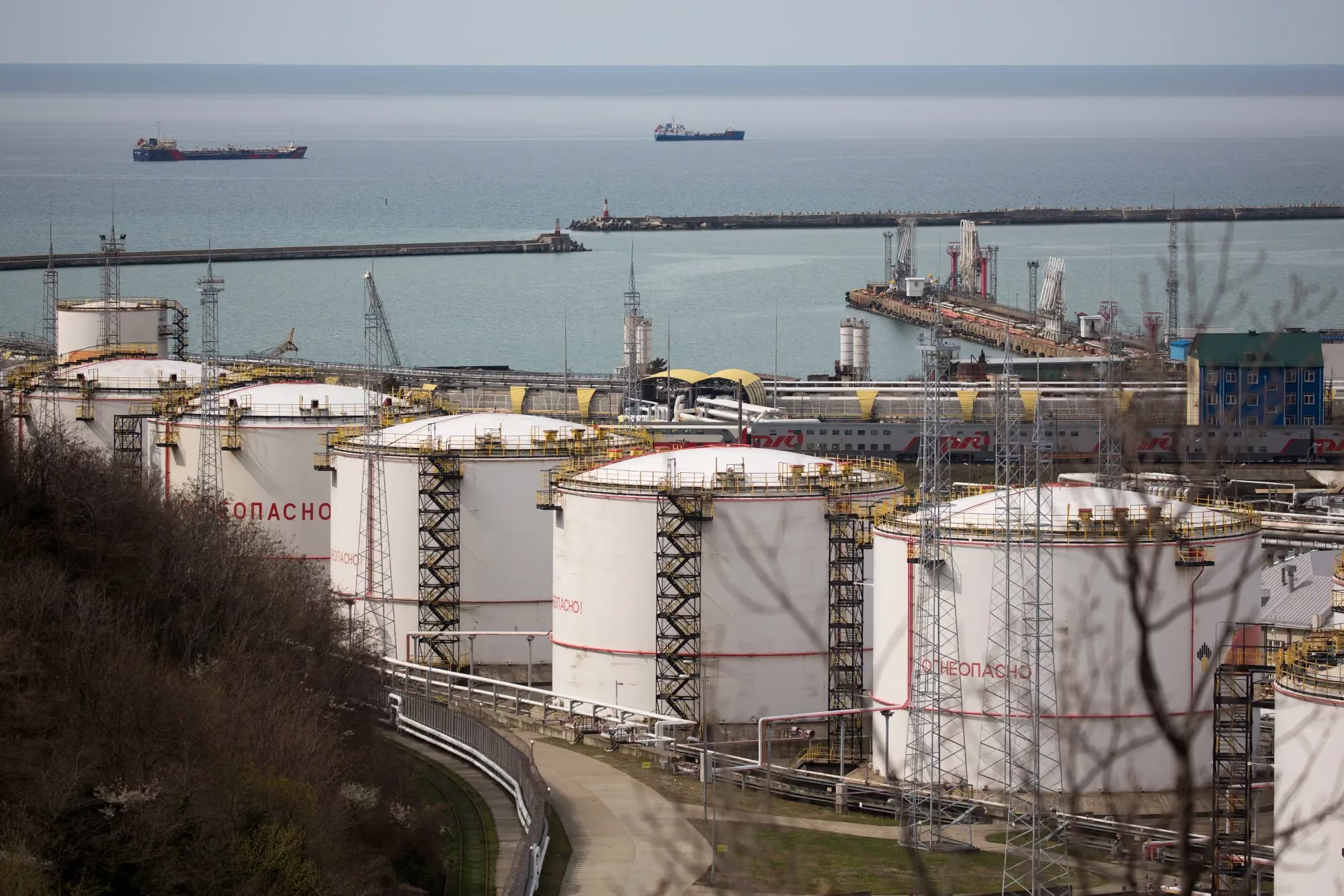
Russian crude exporters face a potential margin compression worth $20-25 per barrel if the EU freezes its price cap at $44.10 instead of allowing the automatic July reset to approximately $65. Under the current dynamic mechanism, adopted last year, the cap automatically adjusts every six months to remain 15% below the average market price of Russian Urals crude. With Urals market price floating around $86 per barrel, the freeze would widen the gap between shadow fleet pricing and EU sanctioned flows to more than $40 per barrel.
The price cap mechanism prohibits European companies from providing insurance and transportation services for Russian oil sold above the threshold. For Russian exporters operating through EU maritime services a shrinking but still significant channel this means choosing between accepting the capped price or finding alternative logistics. Western entities are barred from handling Russian oil above the mandated threshold, creating a binary choice: comply with the cap or exit the EU financed system entirely. The current $44.10 threshold represents roughly half the market price, making EU serviced flows economically unviable for most Russian producers.
On the buy side, major integrated refiners in India and China Russia's largest crude customers face minimal direct impact since they predominantly use shadow fleet networks outside EU jurisdiction. Indian refiners started buying petroleum from Russia as the war disrupted supplies from the Middle East. These buyers typically pay market rates ($85-90/barrel for Urals) regardless of EU cap levels. However, smaller regional buyers dependent on traditional financing face increased costs as they must either pay premiums for non-EU maritime services or accept supply disruptions.
On the sell side, state-controlled Russian exporters like Rosneft and Gazprom Neft operate extensive shadow fleet operations that bypass EU maritime services entirely. These operators can capture the full market premium currently $40+ above the capped rate. Russian firms have relied on intermediaries and digital-asset settlement to work around sanctions pressure. For smaller Russian producers lacking shadow fleet access, the cap freeze forces a stark choice: accept significantly below-market pricing through EU channels or invest in alternative logistics infrastructure.
For large integrated traders Vitol, Trafigura, major national oil companies with derivatives access the margin opportunity concentrates in the price differential arbitrage between capped and uncapped flows. Consider a mid-sized vessel carrying 100,000 tonnes of Urals crude: at current market prices of $86/barrel versus the capped rate of $44.10, each cargo represents a potential $42/barrel price spread worth approximately $31 million per voyage. Traders with access to both EU compliant and shadow fleet logistics can arbitrage this differential, though regulatory and reputational risks limit participation.
For regional operators independent fuel importers, smaller refinery operators, regional distribution cooperatives without derivatives access or shadow fleet connections, the cap freeze creates operational complexity without hedging instruments. These operators must either accept supply uncertainty as EU compliant Russian flows become scarce, diversify to alternative suppliers at premium pricing, or develop bilateral financing arrangements outside traditional banking channels. The practical equivalent involves pre-financing inventory through non-EU sources or accepting shorter-term supply contracts with higher counterparty risk.
TTF natural gas futures have risen by up to 60% since the closure of the Strait of Hormuz, creating broader energy market stress that compounds the oil pricing dynamics. Brent crude futures rose toward $98 per barrel as of June 3, while the Strait closure took 14 million b/d off the market. This supply shock makes alternative crude sources more expensive, indirectly supporting demand for discounted Russian barrels even at capped prices. The insurance and maritime services supply chain Lloyd's of London syndicates, Protection & Indemnity clubs, specialized commodity finance banks loses financing fees worth an estimated $200 million annually on Russian crude flows that migrate to shadow networks.
The proposed measure is part of the EU's 21st sanctions package against Russia, alongside targeting around 20 more vessels linked to Russia's shadow fleet. The enforcement challenge intensifies as the US issued a Russian oil sanctions waiver to alleviate pressure on the markets, allowing vulnerable countries to buy Russian oil already at sea. This creates a regulatory arbitrage where US licensed flows compete with EU restricted volumes, potentially undermining the cap's effectiveness while creating compliance complexity for international traders.
For market observers, the key indicator is the Urals-Brent spread currently trading at approximately $12-15/barrel discount to Brent versus the historical $2-5 range. Any new sanctions package will require unanimous approval from all EU member states, with final decisions expected by mid-June. Several countries remain cautious about measures that could further disrupt energy markets amid ongoing volatility in the Middle East. Watch for the actual July cap reset announcement if the freeze proceeds, expect Urals price volatility as markets test the shadow fleet's capacity to absorb additional volume at full market pricing.


.jpg)
.jpg)

'%3e%3cg id='Final-Copy-2_2_' transform='translate(1275.000000, 200.000000)'%3e%3cpath class='st0' d='M7.4,12.8h6.8l3.1-11.6H7.4C4.2,1.2,1.6,3.8,1.6,7S4.2,12.8,7.4,12.8z'/%3e%3c/g%3e%3c/g%3e%3c/g%3e%3cg id='final---dec.11-2020'%3e%3cg id='_x30_208-our-toggle' transform='translate(-1275.000000, -200.000000)'%3e%3cg id='Final-Copy-2' transform='translate(1275.000000, 200.000000)'%3e%3cpath class='st1' d='M22.6,0H7.4c-3.9,0-7,3.1-7,7s3.1,7,7,7h15.2c3.9,0,7-3.1,7-7S26.4,0,22.6,0z M1.6,7c0-3.2,2.6-5.8,5.8-5.8 h9.9l-3.1,11.6H7.4C4.2,12.8,1.6,10.2,1.6,7z'/%3e%3cpath id='x' class='st2' d='M24.6,4c0.2,0.2,0.2,0.6,0,0.8l0,0L22.5,7l2.2,2.2c0.2,0.2,0.2,0.6,0,0.8c-0.2,0.2-0.6,0.2-0.8,0 l0,0l-2.2-2.2L19.5,10c-0.2,0.2-0.6,0.2-0.8,0c-0.2-0.2-0.2-0.6,0-0.8l0,0L20.8,7l-2.2-2.2c-0.2-0.2-0.2-0.6,0-0.8 c0.2-0.2,0.6-0.2,0.8,0l0,0l2.2,2.2L23.8,4C24,3.8,24.4,3.8,24.6,4z'/%3e%3cpath id='y' class='st3' d='M12.7,4.1c0.2,0.2,0.3,0.6,0.1,0.8l0,0L8.6,9.8C8.5,9.9,8.4,10,8.3,10c-0.2,0.1-0.5,0.1-0.7-0.1l0,0 L5.4,7.7c-0.2-0.2-0.2-0.6,0-0.8c0.2-0.2,0.6-0.2,0.8,0l0,0L8,8.6l3.8-4.5C12,3.9,12.4,3.9,12.7,4.1z'/%3e%3c/g%3e%3c/g%3e%3c/g%3e%3c/g%3e%3c/svg%3e) Privacy Choices
Privacy Choices