.avif)
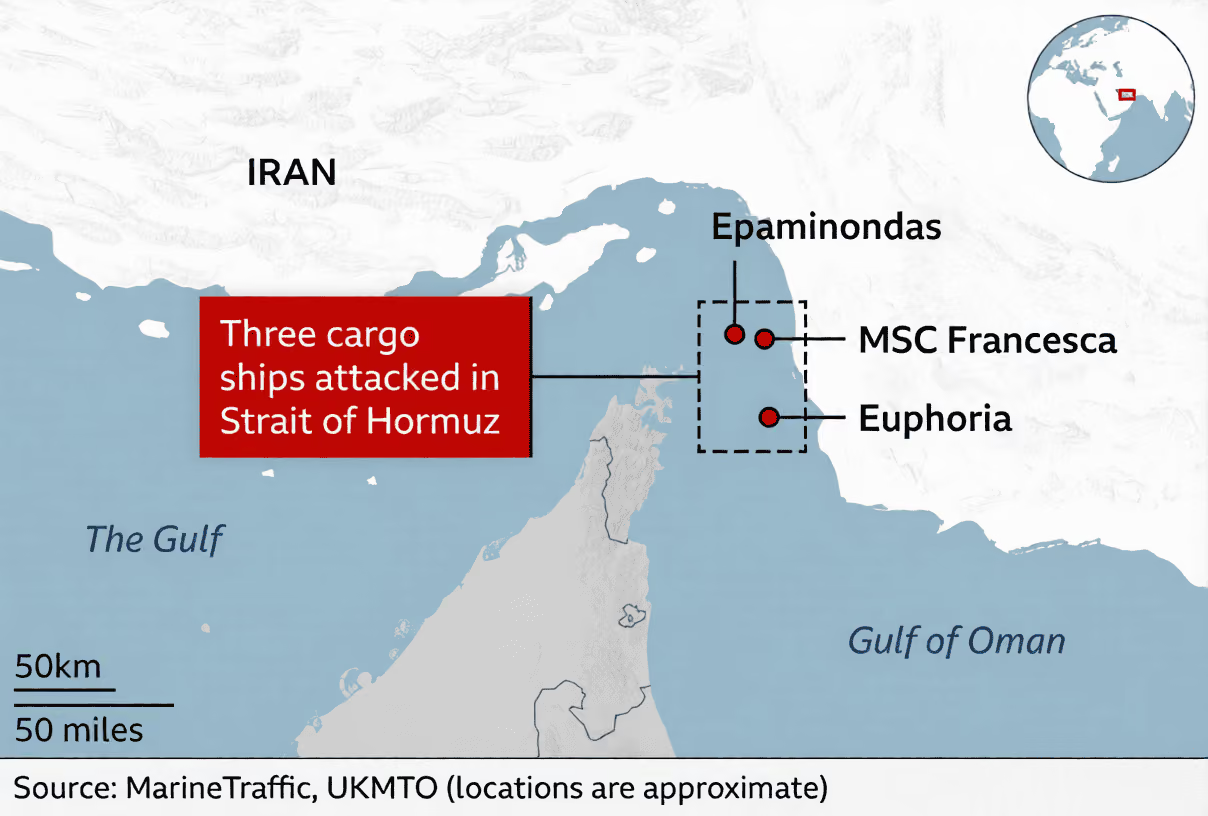
Charterers holding firm Hormuz-transit fixtures woke on 25 June 2026 to war-risk surcharges repricing in real time with preliminary indications pointing to increases of $0.50 to $2.00 per barrel equivalent on Gulf-loading programs, effective immediately. A cargo vessel transiting the Strait of Hormuz on the newly established Oman coordinated alternative route was struck by an unknown projectile southeast of Dahit, Oman. UKMTO the United Kingdom Maritime Trade Operations, the Royal Navy advisory body that serves as the primary commercial shipping alert network in the region confirmed bridge damage with no casualties and no environmental spill. The vessel's identity remains unconfirmed in the latest reports. What is confirmed is the commercial consequence: a route designed to restart Gulf crude flows under international auspices has been hit on its first weeks of operation, and every cargo owner with a GCC loading program must now price that risk.
The physical geography matters here. The Strait of Hormuz is a 33 kilometre wide navigational chokepoint between Oman and Iran through which approximately 20% of globally traded oil passes daily roughly 17–18 million barrels. The new Oman coordinated route, announced in partnership with the International Maritime Organization (IMO the UN body that governs international shipping standards and safety), was designed to provide a sanctioned corridor as commercial traffic attempted recovery from prewar lows. Convoys had begun moving with greater cadence, including operations led by the Stoic Warrior. The strike southeast of Dahit places the incident directly on that corridor. Iran had explicitly warned vessels against using routes not authorised by Tehran, though no confirmed link between that warning and the strike has been established. The gap between a diplomatic warning and an unattributed projectile is precisely where this intelligence lives.
The margin anatomy is stark. Before this incident, a charterer fixing a VLCC a Very Large Crude Carrier, capable of carrying approximately 2 million barrels on a UAE to Japan voyage faced war-risk insurance premiums that had already risen with the broader regional disruption. A representative pre-incident war-risk add-on of $0.40 per barrel on a 2 million barrel cargo costs the charterer $800,000 per voyage. If surcharges reprice to $1.50 per barrel within the $0.50–$2.00 range now in play that same voyage carries an additional insurance cost of $3 million, before any freight movement. Freight itself is not static: comparable tanker earnings on alternative routing spiked in prior Hormuz disruption cycles, and war-risk underwriters will not be slow to respond to a confirmed projectile strike on a UN-backed route. The cargo owner absorbs this. The refinery at the other end sees its netback the effective price it receives after subtracting all delivery costs compress immediately.
The MOU signed last week between the United States and Iran creates a 60 day window to finalise an interim peace arrangement governing Hormuz transit. That window is now structurally compromised by a reality the MOU cannot paper over: Iran may not control all actors with the capability and intent to strike vessels in the strait. The IRGC Iran's Islamic Revolutionary Guard Corps, which has historically commanded maritime interdiction capabilities in the Gulf and various Iranian aligned proxy networks do not necessarily operate on the same diplomatic timeline as Tehran's negotiating delegation. If enforcement authority over the strait is fragmented between the Iranian state, its military arms, and affiliated regional actors, then a signed agreement between Washington and Tehran guarantees corridor legality on paper but not physical safety on the water. Charterers and their insurers cannot underwrite the difference. This is the core intelligence problem: the MOU assumes a unitary counterparty, and the strike suggests that assumption may not hold.
On the buy side, Asian refinery procurement teams Japanese, South Korean, and Indian buyers running on contracted GCC crude programs face an immediate squeeze. Consider a mid-sized Indian refiner taking 1 million barrels per month of Abu Dhabi crude under a term contract. At a $1.50/bbl war-risk surcharge, that buyer absorbs an additional $1.5 million per monthly cargo. Annualised, that is $18 million in additional cost against a margin structure that was already thin after crude prices fluctuated around the pre-war reference of approximately $73 per barrel. Oil briefly dipped below that $73/bbl level on 25 June a moment that technically opened a buy-side arbitrage opportunity for paper traders if physical normalization resumes within the MOU window. Whether that dip holds or reverses depends entirely on convoy continuity and Iranian signalling in the next 10–14 days. On the sell side, GCC national oil companies loading at Abu Dhabi, Ras Tanura, and Fujairah face a different pressure: buyers requesting destination flexibility clauses and spot-price reopeners in term contracts they signed assuming normalised Hormuz access.
For large integrated trading houses a Trafigura, Vitol, or a national oil company's trading arm with full derivatives access the primary instrument is the freight forward agreement (FFA), which allows operators to lock in freight rates for future voyages independently of the spot market. A trader currently long physical Gulf crude and short FFAs on the relevant VLCC routes can partially hedge the freight spike. War-risk insurance can also be placed in the London market on a voyage-by-voyage basis, though premiums will reprice upward within 24–48 hours of a confirmed incident of this nature. The Cape of Good Hope re-route sending Gulf crude the long way around Africa rather than through Hormuz becomes commercially viable once war-risk surcharges on the Hormuz route exceed approximately $1.50/bbl equivalent, adding roughly 12–15 additional sailing days and $3–5/MT in additional voyage costs depending on current VLCC spot rates for the Cape route.
For smaller regional operators an independent fuel importer in South or Southeast Asia, a regional trading cooperative without derivatives desk access the options are narrower but not absent. The practical equivalent of an FFA hedge is fixing freight terms bilaterally on a time-charter basis (paying a fixed daily rate for a vessel rather than spot voyage rates, removing freight volatility from the equation for the charter period). On the cargo side, regional buyers should be actively canvassing Atlantic Basin crude availability: when Hormuz risk spikes, the Brent-Dubai spread the price difference between North Sea Brent crude and Middle Eastern Dubai crude widens as Dubai crude is discounted to compete with rerouted volumes. A regional buyer with port flexibility can exploit that spread. The practical signal: if the Brent-Dubai spread widens beyond $3/bbl on a sustained basis, Atlantic Basin crude arbitrage to Asia is open and regional buyers should be pricing it.
The broader regional context is not incidental. Clashes in Lebanon involving Israeli forces and Iranian-backed factions, reported in parallel with the Hormuz incident, indicate that any de-escalation scenario involving Iran's maritime posture exists within a wider theatre of competing pressures on Iranian decision making. War-risk underwriters price cumulative regional risk, not individual incidents in isolation. The last comparable sustained disruption of the Hormuz chokepoint was the Iran-Iraq tanker war of the 1980s, when freight rates tripled within weeks of concentrated attacks. The current situation is structurally different there is an active diplomatic track, and the strike caused no casualties but the precedent for rapid freight repricing is well-established and should inform any assumption that insurance markets will move slowly.
The time-bound signal observers should track is the Baltic Dirty Tanker Index (BDTI) specifically the TD3C route, which benchmarks VLCC freight from Ras Tanura, Saudi Arabia to Chiba, Japan. A move above 75 on TD3C within the next seven trading days signals that the freight market is pricing sustained Hormuz disruption rather than a single incident. Simultaneously, watch UKMTO advisory bulletins for any second incident on the Oman coordinated corridor within the 60 day MOU negotiation window: a second strike would effectively close the diplomatic track and force a structural rerouting decision across the Gulf crude trade. The 60 day window expires around late August 2026. Every cargo program loading after that date should carry scenario pricing for both a normalised Hormuz transit and a full Cape reroute until the MOU either produces enforceable terms or collapses under the weight of incidents its signatories cannot control.
'%3e%3cg id='Final-Copy-2_2_' transform='translate(1275.000000, 200.000000)'%3e%3cpath class='st0' d='M7.4,12.8h6.8l3.1-11.6H7.4C4.2,1.2,1.6,3.8,1.6,7S4.2,12.8,7.4,12.8z'/%3e%3c/g%3e%3c/g%3e%3c/g%3e%3cg id='final---dec.11-2020'%3e%3cg id='_x30_208-our-toggle' transform='translate(-1275.000000, -200.000000)'%3e%3cg id='Final-Copy-2' transform='translate(1275.000000, 200.000000)'%3e%3cpath class='st1' d='M22.6,0H7.4c-3.9,0-7,3.1-7,7s3.1,7,7,7h15.2c3.9,0,7-3.1,7-7S26.4,0,22.6,0z M1.6,7c0-3.2,2.6-5.8,5.8-5.8 h9.9l-3.1,11.6H7.4C4.2,12.8,1.6,10.2,1.6,7z'/%3e%3cpath id='x' class='st2' d='M24.6,4c0.2,0.2,0.2,0.6,0,0.8l0,0L22.5,7l2.2,2.2c0.2,0.2,0.2,0.6,0,0.8c-0.2,0.2-0.6,0.2-0.8,0 l0,0l-2.2-2.2L19.5,10c-0.2,0.2-0.6,0.2-0.8,0c-0.2-0.2-0.2-0.6,0-0.8l0,0L20.8,7l-2.2-2.2c-0.2-0.2-0.2-0.6,0-0.8 c0.2-0.2,0.6-0.2,0.8,0l0,0l2.2,2.2L23.8,4C24,3.8,24.4,3.8,24.6,4z'/%3e%3cpath id='y' class='st3' d='M12.7,4.1c0.2,0.2,0.3,0.6,0.1,0.8l0,0L8.6,9.8C8.5,9.9,8.4,10,8.3,10c-0.2,0.1-0.5,0.1-0.7-0.1l0,0 L5.4,7.7c-0.2-0.2-0.2-0.6,0-0.8c0.2-0.2,0.6-0.2,0.8,0l0,0L8,8.6l3.8-4.5C12,3.9,12.4,3.9,12.7,4.1z'/%3e%3c/g%3e%3c/g%3e%3c/g%3e%3c/g%3e%3c/svg%3e) Privacy Choices
Privacy Choices