.avif)
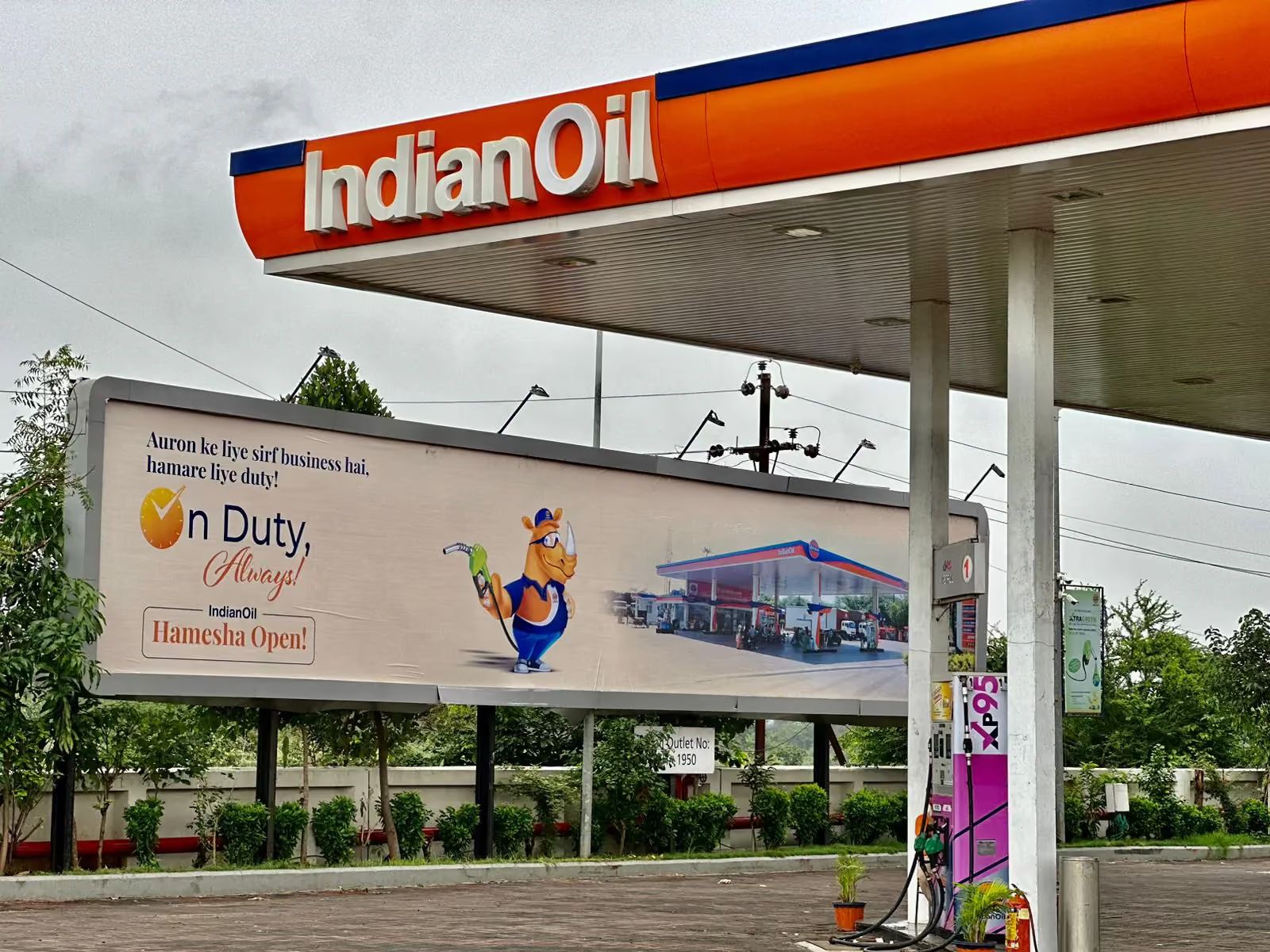
Indian Oil Marketing Companies are absorbing an effective margin erosion of $0.50–1.50 per barrel on every Hormuz routed crude cargo as of the week of 22 June 2026 a cost that has not been reflected in retail fuel pricing or downstream guidance, and one that compounds daily while US-Iran nuclear talks remain unresolved.
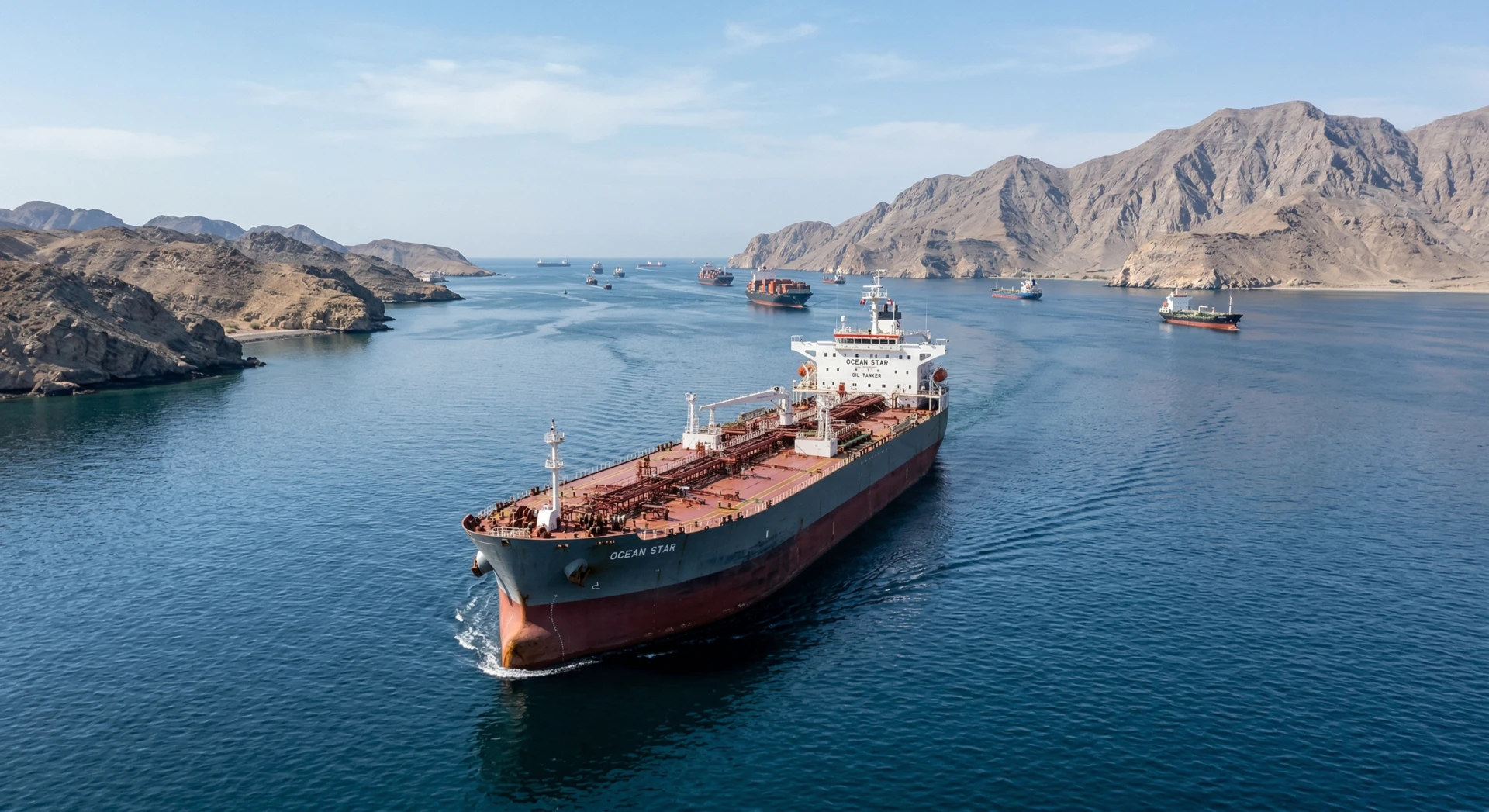
The mechanism is the Strait of Hormuz, a 33 kilometre wide waterway connecting the Persian Gulf to the Gulf of Oman through which roughly 17–21 million barrels of crude oil and condensate liquid hydrocarbons produced alongside natural gas transit each day. According to shipping data cited in reports from the period, vessel transits through the Strait fell from 32 ships on Friday to 26 on Saturday, a single-day decline of nearly 19%. This covers all vessel types, not crude tankers alone, but even a sustained 15–20% reduction in Very Large Crude Carrier (VLCC) transits supertankers each carrying approximately 2 million barrels would immediately tighten the supply of Gulf crude arriving at Indian refineries. The Strait is not a theoretical chokepoint; it is the physical pipe through which approximately 85–90% of India's crude imports flow. There is no domestic alternative and no rerouting that does not cost time and money.
The cost mechanism works through two compounding channels. First, War Risk Insurance a voyage specific premium charged by marine underwriters when a vessel transits a declared conflict zone is currently running at 0.50–1.00% of vessel value per Hormuz voyage. A standard VLCC valued at approximately $120 million incurs a War Risk premium of $600,000 to $1.2 million per transit. Spread across a 2 million barrel cargo, that is $0.30–0.60 per barrel of additional cost, borne ultimately by the cargo owner. Second, if Indian OMCs redirect purchases to alternative origins West Africa or the US Gulf Coast the Cape of Good Hope rerouting adds 7–10 sailing days and an estimated $1.50–2.50 per barrel in incremental freight. Neither cost sits in current OMC margin models, which were built around stable Gulf supply at normalised freight rates.
To make this concrete: consider Indian Oil Corporation, India's largest refiner, running a standard 2 million barrel VLCC cargo from Basra, Iraq, through Hormuz to its Paradip refinery on the Odisha coast a voyage of roughly 20–22 days under normal conditions. At pre-disruption freight rates of approximately $8–10 per metric tonne, the all-in delivered cost per barrel was manageable within the OMC's regulated and semi-regulated pricing structure. Add a $0.50/bbl War Risk premium and freight rate increases pushing toward $12–14/MT as vessel operators price in Hormuz risk a voyage cost increment of $1.20–1.80/bbl and the delivered margin on every cargo narrows or inverts. Multiply across Indian Oil's refining throughput of roughly 1.5 million barrels per day, and the aggregate weekly exposure runs into hundreds of millions of dollars. This is not a rounding error. It is the margin.
On the buy side, Indian OMCs Indian Oil, Bharat Petroleum, Hindustan Petroleum face an acute timing problem. Their crude procurement cycles run on 30–60 day term contracts with Gulf producers, primarily through the Abu Dhabi National Oil Company (ADNOC) and Saudi Aramco's official selling prices (OSPs). These contracts do not automatically reprice when War Risk premiums spike mid-voyage. The OMCs absorb the difference unless they have explicit cost pass through clauses which most term contracts with government sellers do not include. Spot market alternatives exist, but spot crude from West Africa or the US Gulf Coast carries a structural $2–4 per barrel premium over committed Gulf-route purchases right now, because traders with optionality on non-Gulf supply are pricing that optionality explicitly. On the sell side, the same OMCs sell refined products petrol, diesel, LPG at prices that are politically managed in India. Retail fuel prices have not moved in response to this disruption. The margin compression is, for now, entirely internal.
For large integrated crude traders Vitol, Trafigura, or the trading arms of national oil companies with derivatives access the intraday spread movement on 22 June created a specific arbitrage window. WTI crude futures advanced 2.06% to $78.18 per barrel while Brent (August delivery) fell 0.83% to $81.24, widening the WTI-Brent discount to approximately $3/bbl. The WTI-Brent spread the price difference between US benchmark crude and the North Sea benchmark that anchors most international pricing normally runs $2–4/bbl, reflecting quality and logistics differences. When it widens sharply on geopolitical dislocation, traders able to originate US crude and freight it into Asian refining hubs can lock in delivered economics before the spread mean-reverts. The freight cost from the US Gulf Coast to India currently runs approximately $5–7/bbl on a standard Suezmax (a vessel sized for Suez Canal transit, carrying 800,000–1,000,000 barrels); at a $3/bbl WTI-Brent discount, the arb is not fully open, but it narrows the required freight advantage significantly. For smaller regional operators independent fuel importers or state-level distributors without derivatives desks no equivalent instrument is available. Their practical response is to extend payment terms on existing term supply contracts, build modest inventory buffers where storage exists, and request provisional price reopeners from their Gulf counterpart. Most will do none of these things in time.
The Iran nuclear talks add a second-order risk that equity markets have partially priced but commodity markets have not yet fully absorbed. According to reports, an Iranian delegation walked out of negotiations in Switzerland after renewed threats from US President Donald Trump, though talks reportedly continued through mediators. Qatar and Pakistan officials indicated headway toward a framework agreement within approximately 60 days. If confirmed, a 60 day negotiating horizon means the current disruption regime elevated War Risk premiums, reduced Hormuz transits, spot market tightness for Gulf crude remains the operating environment through at least late August 2026. That is two full crude procurement cycles for most Indian OMCs. The equity market's interpretation Sensex and Nifty opening modestly higher with OMC stocks among early movers reflects relief that Brent remained below $80, treating price stability as a proxy for geopolitical stability. It is not. A crude price held near $80 by demand-side softness coexisting with supply-route disruption is a structurally different risk environment from an $80 crude price in open-water, undisrupted conditions.
A secondary demand-side risk compounds the supply picture. India's cumulative June rainfall was reported as below normal under prevailing El Niño conditions the periodic warming of Pacific surface waters that suppresses Indian Ocean monsoon formation. A delayed or deficient monsoon affects kharif crop sowing (the summer harvest season covering rice, pulses, and oilseeds), rural household incomes, and downstream consumption of diesel the fuel that powers agricultural pumps and rural freight. Indian OMCs derive a meaningful portion of diesel volume growth from rural demand. A monsoon shortfall in 2026 does not show up in June procurement decisions, but it will appear in August–September demand data. For OMCs already compressing margins on the import cost side, a demand shortfall on the sales side creates a bilateral squeeze that neither equity valuations nor current procurement models have discounted.
The specific signal to watch is the Baltic Dirty Tanker Index (BDTI) the benchmark index tracking freight rates for crude oil tankers globally specifically the BDTI TD3C sub-route, which measures VLCC freight costs from the Middle East Gulf to Japan, the most direct proxy for Gulf to Asia crude economics. If the BDTI TD3C rises above 65 Worldscale points (a standardised freight pricing unit) from its current level near 40–50, that move will confirm that vessel operators are systematically pricing Hormuz transit risk into forward bookings, not just spot voyages. That inflection point, if it occurs within the next 30 days, will be the moment when OMC procurement desks can no longer absorb the cost differential quietly. Procurement officers should be monitoring this index weekly through the Lloyd's List Intelligence platform or the Baltic Exchange directly, setting internal alert thresholds now rather than reacting when the number is already in the headlines.

.jpg)
.jpg)

'%3e%3cg id='Final-Copy-2_2_' transform='translate(1275.000000, 200.000000)'%3e%3cpath class='st0' d='M7.4,12.8h6.8l3.1-11.6H7.4C4.2,1.2,1.6,3.8,1.6,7S4.2,12.8,7.4,12.8z'/%3e%3c/g%3e%3c/g%3e%3c/g%3e%3cg id='final---dec.11-2020'%3e%3cg id='_x30_208-our-toggle' transform='translate(-1275.000000, -200.000000)'%3e%3cg id='Final-Copy-2' transform='translate(1275.000000, 200.000000)'%3e%3cpath class='st1' d='M22.6,0H7.4c-3.9,0-7,3.1-7,7s3.1,7,7,7h15.2c3.9,0,7-3.1,7-7S26.4,0,22.6,0z M1.6,7c0-3.2,2.6-5.8,5.8-5.8 h9.9l-3.1,11.6H7.4C4.2,12.8,1.6,10.2,1.6,7z'/%3e%3cpath id='x' class='st2' d='M24.6,4c0.2,0.2,0.2,0.6,0,0.8l0,0L22.5,7l2.2,2.2c0.2,0.2,0.2,0.6,0,0.8c-0.2,0.2-0.6,0.2-0.8,0 l0,0l-2.2-2.2L19.5,10c-0.2,0.2-0.6,0.2-0.8,0c-0.2-0.2-0.2-0.6,0-0.8l0,0L20.8,7l-2.2-2.2c-0.2-0.2-0.2-0.6,0-0.8 c0.2-0.2,0.6-0.2,0.8,0l0,0l2.2,2.2L23.8,4C24,3.8,24.4,3.8,24.6,4z'/%3e%3cpath id='y' class='st3' d='M12.7,4.1c0.2,0.2,0.3,0.6,0.1,0.8l0,0L8.6,9.8C8.5,9.9,8.4,10,8.3,10c-0.2,0.1-0.5,0.1-0.7-0.1l0,0 L5.4,7.7c-0.2-0.2-0.2-0.6,0-0.8c0.2-0.2,0.6-0.2,0.8,0l0,0L8,8.6l3.8-4.5C12,3.9,12.4,3.9,12.7,4.1z'/%3e%3c/g%3e%3c/g%3e%3c/g%3e%3c/g%3e%3c/svg%3e) Privacy Choices
Privacy Choices