.avif)

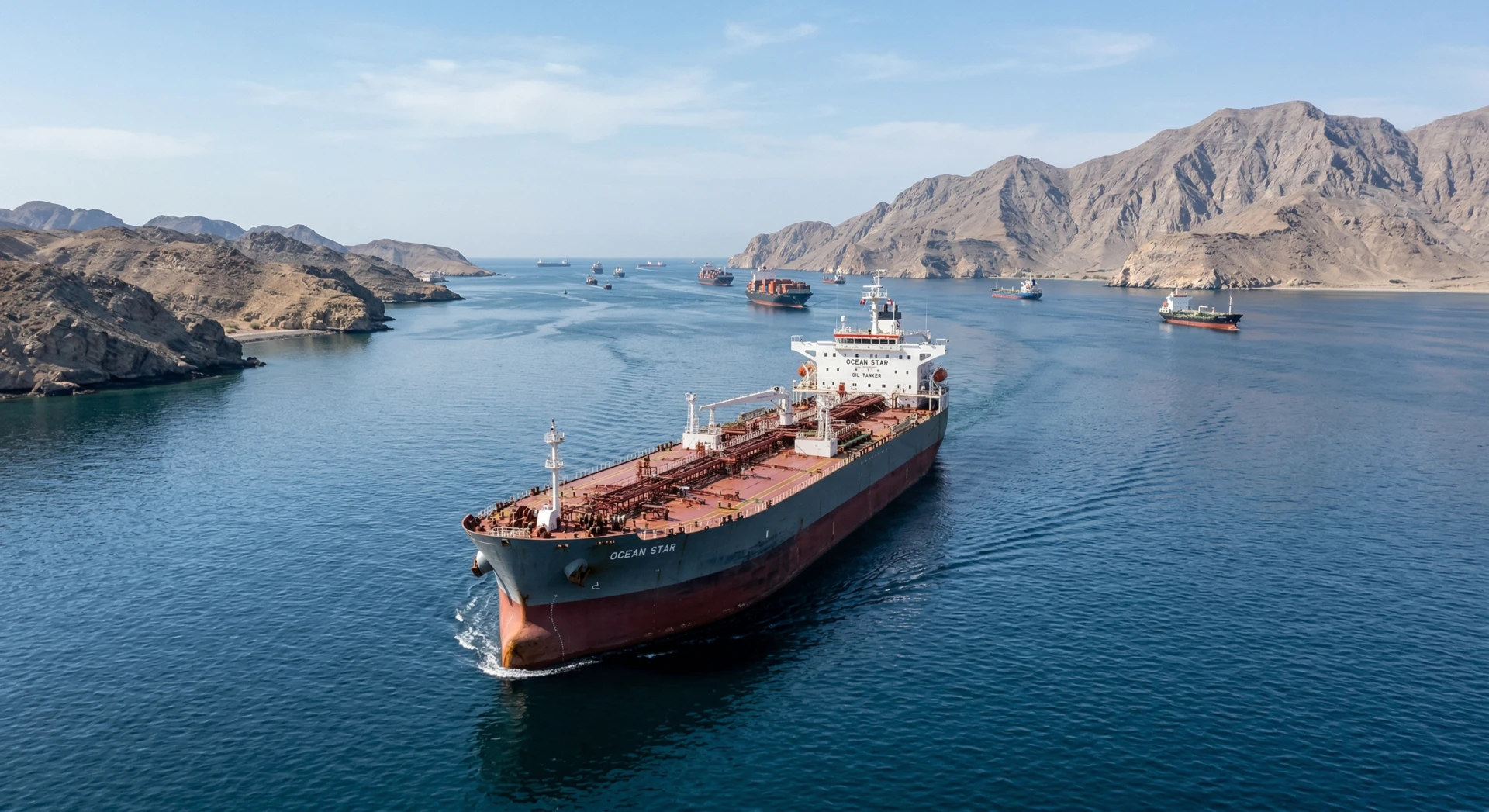
Persian Gulf crude exporters face margin compression of $10-15/bbl if Iranian transit fee demands materialise, as Brent trades at $108.76/bbl and draft ceasefire terms emerge. Iran's Persian Gulf Strait Authority reportedly demands fees up to $2 million per crossing, payable in yuan or bitcoin, fundamentally altering the economics of Middle East to Asia crude flows that normally handle 15 million bpd. For a VLCC (Very Large Crude Carrier) carrying 2 million barrels the standard vessel class for Saudi to China routes a $2 million transit fee adds $1/bbl to delivered cost. But smaller vessels face exponentially higher per-barrel impacts: an Aframax tanker carrying 700,000 barrels would absorb $2.85/bbl in transit fees alone.
The reported framework includes immediate Strait reopening, guaranteed freedom of navigation under joint monitoring, and phased sanctions relief tied to Iranian compliance. Pakistan-mediated talks have extended the April 8 ceasefire indefinitely as negotiators work through maritime security arrangements and permanent peace terms. The joint monitoring system undefined in operational detail represents the critical mechanism for enforcing any transit fee collection. Without clarity on enforcement authority, dispute resolution, or payment verification, the framework leaves Iranian fee demands as an unresolved commercial wildcard that could either collapse or reshape Persian Gulf trade entirely.
US Treasury has warned that paying Iran's transit fees may itself constitute a sanctions violation, creating a compliance nightmare for international shipowners. A letter of credit (LC) the bank guarantee that makes most commodity trade possible becomes unworkable when the payment itself triggers sanctions exposure. The fee structure lacks official schedules, with reports suggesting variable pricing and cryptocurrency payment options. This payment mechanism uncertainty forces operators to choose between sanctions compliance and physical transit access, eliminating the financing predictability that underpins crude oil trade.
Before the February 2026 conflict, roughly 25% of global seaborne oil and 15 million barrels per day transited Hormuz. April traffic dropped to 191 vessels less than 10% of pre-conflict levels, creating acute supply tightness that has supported oil prices despite demand destruction. The arithmetic is stark: Persian Gulf producers have lost 85-90% of their primary export corridor capacity. Even partial reopening under Iranian fee structures would restore physical volumes while destroying commercial margins a pyrrhic victory for exporters who need both access and profitability.
On the buy side, Asian refiners confront a binary choice: pay Iranian transit fees and absorb $10-15/bbl in additional costs, or continue sourcing Atlantic Basin alternatives at $20-25/bbl premium over pre-war Persian Gulf benchmarks. China imports 40% of its crude through Hormuz, while Japan routes 70% of its Middle Eastern supplies via the strait. Japan expects its first Hormuz transit since the war began the Idemitsu Maru VLCC carrying 2 million barrels of Saudi crude to arrive Monday. This single cargo demonstrates the operational complexity: the vessel successfully navigated Iranian controls but carries no precedent for systematic fee collection.
On the sell side, Persian Gulf national oil companies (NOCs) and integrated producers face existential margin destruction if Iranian fees become permanent. Iran's expanded zone boundary now extends from Mount Mubarak to the UAE coast south of Fujairah, capturing the UAE's Hormuz bypass route designed precisely to avoid such chokepoint control. Saudi Aramco, ADNOC, and Qatar Energy the region's dominant exporters would see their primary competitive advantage (low-cost Persian Gulf crude) eroded by transit fees that cannot be hedged, financed, or passed through to buyers without contract renegotiation.
For large integrated traders with derivatives access Vitol, Trafigura, Glencore the fee structure creates arbitrage opportunities through Atlantic Basin-Persian Gulf spread trading, but eliminates the financing mechanisms that make physical Persian Gulf crude profitable. Brent-Dubai spreads the price difference between North Sea and Middle East crude have remained elevated throughout the crisis, but Iranian fees would institutionalise this dislocation rather than resolve it. The traders' margin concentrates in spread capture rather than physical crude handling, fundamentally altering their role in Persian Gulf markets.
For smaller regional operators without derivatives access independent fuel importers, regional distributors, national oil companies from importing countries the fee structure represents an impossible financing challenge. These operators typically use crude oil cargoes as collateral for letters of credit, but Iranian fee demands payable in yuan or cryptocurrency create settlement mechanisms incompatible with international banking. The practical equivalent becomes bilateral supply agreements with Persian Gulf producers that incorporate transit fees, eliminating spot market flexibility and concentrating margin with the handful of operators capable of managing yuan-denominated settlements.
Approximately 70% of recent Hormuz transits involved Iranian nexus cargo or ports, with shadow fleet vessels comprising 80% of traffic versus 10-15% pre-war. The shadow fleet internationally sanctioned vessels using deceptive practices has become the primary operator class willing to navigate Iranian controls. This creates a perverse market structure where legitimate operators are priced out by transit fees while sanctions evading vessels capture the remaining volumes. The shadow fleet's dominance suggests Iranian fee collection may already be occurring through informal mechanisms.
The freight dimension reveals where margin truly concentrates under Iranian control. War-risk insurance premiums increased from 0.125% to 0.4% of vessel value per transit adding $250,000 for VLCCs. Combined with $2 million transit fees, a single VLCC voyage faces $2.25 million in incremental costs before considering time charter rates, bunker fuel, or crew hazard pay. These costs accrue entirely to vessel operators, not cargo owners, concentrating value in the hands of shipowners willing to accept Iranian payment mechanisms and sanctions risk.
More than 1,550 vessels remain stranded with 22,500 mariners trapped, while daily transit counts remain in single digits with most vessels operating dark. The stranded fleet represents approximately $15-20 billion in vessel values and cargo, creating massive carrying costs for owners and charterers. UAE pipeline construction to bypass Hormuz is reportedly 50% complete, offering medium-term alternatives but no immediate relief for current cargo commitments. The pipeline, when operational, would restore UAE export capacity while leaving Saudi and Qatari crude exposed to Iranian fee demands.
Backwardation where near-term oil prices exceed forward prices signals acute physical supply tightness that Iranian fee structures would institutionalise rather than resolve. Oil prices remain nearly 50% above pre-war levels despite ongoing supply constraints. The market is rationing scarce supply through price rather than availability, but Iranian fees would create artificial scarcity even after physical reopening. This represents a fundamental shift from temporary crisis pricing to permanent structural costs embedded in Persian Gulf crude.
The financing structure becomes the critical constraint under Iranian fee demands. Traditional commodity financing relies on LC mechanisms that require correspondent banking relationships with sanctions compliant institutions. Yuan or bitcoin payments circumvent traditional banking but create settlement risk and regulatory exposure. Chinese banks willing to process yuan payments for Iranian fees would face secondary sanctions risk, while cryptocurrency settlements lack the legal framework for commercial cargo financing. The result is a bifurcated market where Chinese and sanctions resistant operators capture Iranian controlled volumes while Western and sanctions compliant operators retreat to Atlantic Basin alternatives.
For observers monitoring market resolution, the critical signal becomes Iranian fee collection verification versus framework enforcement mechanisms. No official fee schedule has been released, while US Treasury warnings suggest payment enforcement conflicts. The Brent-Dubai spread normally $2-4/bbl should collapse toward historical ranges if genuine reopening occurs without fee structures. Sustained spreads above $8-10/bbl would indicate Iranian fee collection or continued operational restrictions. Monitor this spread daily through June 30: convergence signals genuine market reopening, while persistent elevation confirms Iranian fee institutionalisation.
The ultimate resolution depends on enforcement mechanisms within any joint monitoring system. Pakistan mediation continues with US acceptance of Iran's demand to settle Hormuz first, nuclear constraints later. If joint monitoring legitimises Iranian fee collection, Persian Gulf crude markets face permanent structural change with margin concentration in Iranian toll mechanisms rather than production efficiency. If joint monitoring enforces free navigation, current price distortions resolve rapidly. The next 30 days determine whether Persian Gulf crude returns to historical cost competitiveness or transitions to Iranian controlled toll collection that fundamentally alters global oil trade economics.

.jpg)
.jpg)

'%3e%3cg id='Final-Copy-2_2_' transform='translate(1275.000000, 200.000000)'%3e%3cpath class='st0' d='M7.4,12.8h6.8l3.1-11.6H7.4C4.2,1.2,1.6,3.8,1.6,7S4.2,12.8,7.4,12.8z'/%3e%3c/g%3e%3c/g%3e%3c/g%3e%3cg id='final---dec.11-2020'%3e%3cg id='_x30_208-our-toggle' transform='translate(-1275.000000, -200.000000)'%3e%3cg id='Final-Copy-2' transform='translate(1275.000000, 200.000000)'%3e%3cpath class='st1' d='M22.6,0H7.4c-3.9,0-7,3.1-7,7s3.1,7,7,7h15.2c3.9,0,7-3.1,7-7S26.4,0,22.6,0z M1.6,7c0-3.2,2.6-5.8,5.8-5.8 h9.9l-3.1,11.6H7.4C4.2,12.8,1.6,10.2,1.6,7z'/%3e%3cpath id='x' class='st2' d='M24.6,4c0.2,0.2,0.2,0.6,0,0.8l0,0L22.5,7l2.2,2.2c0.2,0.2,0.2,0.6,0,0.8c-0.2,0.2-0.6,0.2-0.8,0 l0,0l-2.2-2.2L19.5,10c-0.2,0.2-0.6,0.2-0.8,0c-0.2-0.2-0.2-0.6,0-0.8l0,0L20.8,7l-2.2-2.2c-0.2-0.2-0.2-0.6,0-0.8 c0.2-0.2,0.6-0.2,0.8,0l0,0l2.2,2.2L23.8,4C24,3.8,24.4,3.8,24.6,4z'/%3e%3cpath id='y' class='st3' d='M12.7,4.1c0.2,0.2,0.3,0.6,0.1,0.8l0,0L8.6,9.8C8.5,9.9,8.4,10,8.3,10c-0.2,0.1-0.5,0.1-0.7-0.1l0,0 L5.4,7.7c-0.2-0.2-0.2-0.6,0-0.8c0.2-0.2,0.6-0.2,0.8,0l0,0L8,8.6l3.8-4.5C12,3.9,12.4,3.9,12.7,4.1z'/%3e%3c/g%3e%3c/g%3e%3c/g%3e%3c/g%3e%3c/svg%3e) Privacy Choices
Privacy Choices