.avif)
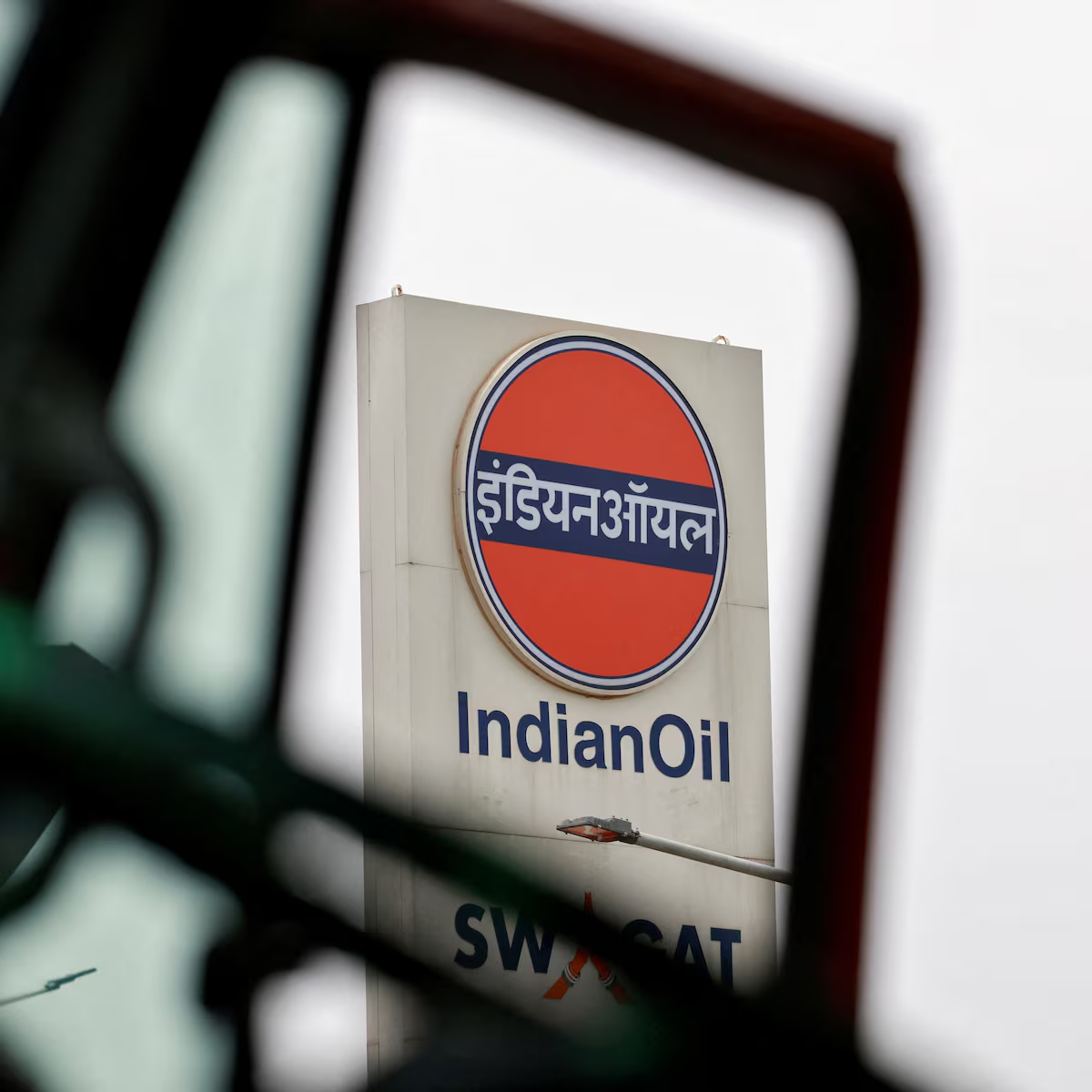
India's state oil marketing companies (OMCs) gained up to 3% on Tuesday morning following a second round of petrol and diesel price hikes and strong quarterly earnings. The 86-91 paise per litre fuel price increase brought temporary relief to companies absorbing losses estimated at over ₹1,000-1,200 crore per day across their retail operations. Indian Oil Corporation (IOC) led the move, surging 3% to an intraday high of ₹135.63 after reporting a 78% year on year surge in consolidated net profit to ₹14,458 crore for Q4 FY2026. The margin relief is marginal OMCs face structured political constraints on fuel pricing that prevent full cost pass-through, even as Brent crude trades at $110.30 per barrel and markets remain highly volatile with the Strait of Hormuz largely shut.
Oil marketing companies state controlled retailers of refined petroleum products who buy crude oil internationally and sell petrol, diesel, and LPG domestically operate under a dual mandate that creates chronic margin pressure. The companies must balance commercial viability with political price sensitivity, particularly during inflationary periods. Reports indicate under-recoveries of around ₹26 per litre for petrol and up to ₹82 per litre for diesel before Tuesday's adjustment. The latest revision pushed Delhi retail prices to ₹98.64 for petrol and ₹91.58 for diesel, representing the second increase within seven days. Even with these adjustments, the pricing gap remains substantial. Consider a mid-sized fuel distributor serving Delhi: at current retail margins, the company earns approximately ₹2-3 per litre on petrol before accounting for distribution costs. The ₹26 per litre under-recovery means the company effectively subsidises every transaction by nearly ten times its gross margin.
On the buy side, large integrated refiners with international trading arms can partially hedge crude exposure through derivative markets, but these instruments become expensive when volatility persists. A company like IOC, processing roughly 1.4 million barrels per day across its refinery network, faces daily crude costs exceeding $150 million at current Brent levels. Despite price hikes, fuel retailers like IOC, BPCL, HPCL continue to lose ₹15-17 per litre. For smaller regional distributors without derivatives access, the equivalent protection comes from inventory management reducing stock levels to 10-15 days from the typical 30-45 days, accepting supply risk to limit price exposure.
On the sell side, Indian state refiners benefit from strong refining margins the crack spread between crude oil input costs and refined product prices even as marketing losses mount. IOC's strong refining margins and steady revenues from core petroleum business drove performance despite the retail price freeze earlier in the year. The Singapore complex refining margin averaged $8-12 per barrel in Q1 2026, well above the $4-6 per barrel long-term average. This margin cushions some losses, but cannot offset the magnitude of marketing under-recoveries when crude oil rises $40 per barrel in three months. For equity investors, Tuesday's relief rally reflects temporary margin improvement rather than structural solution. The companies remain exposed to the next crude oil spike.
Watch Brent crude at $110.30 per barrel for directional signals on OMC financial pressure by June 30, 2026. Any sustained move above $115 per barrel will require additional retail price adjustments within 30 days, based on historical government response patterns. Markets remain highly volatile with oil prices elevated as the Strait of Hormuz stays largely shut and attacks on key infrastructure disrupt production. Monitor the Indian crude basket a weighted average of imported crude grades for more precise cost pressure indicators than international benchmarks alone.
.jpg)

'%3e%3cg id='Final-Copy-2_2_' transform='translate(1275.000000, 200.000000)'%3e%3cpath class='st0' d='M7.4,12.8h6.8l3.1-11.6H7.4C4.2,1.2,1.6,3.8,1.6,7S4.2,12.8,7.4,12.8z'/%3e%3c/g%3e%3c/g%3e%3c/g%3e%3cg id='final---dec.11-2020'%3e%3cg id='_x30_208-our-toggle' transform='translate(-1275.000000, -200.000000)'%3e%3cg id='Final-Copy-2' transform='translate(1275.000000, 200.000000)'%3e%3cpath class='st1' d='M22.6,0H7.4c-3.9,0-7,3.1-7,7s3.1,7,7,7h15.2c3.9,0,7-3.1,7-7S26.4,0,22.6,0z M1.6,7c0-3.2,2.6-5.8,5.8-5.8 h9.9l-3.1,11.6H7.4C4.2,12.8,1.6,10.2,1.6,7z'/%3e%3cpath id='x' class='st2' d='M24.6,4c0.2,0.2,0.2,0.6,0,0.8l0,0L22.5,7l2.2,2.2c0.2,0.2,0.2,0.6,0,0.8c-0.2,0.2-0.6,0.2-0.8,0 l0,0l-2.2-2.2L19.5,10c-0.2,0.2-0.6,0.2-0.8,0c-0.2-0.2-0.2-0.6,0-0.8l0,0L20.8,7l-2.2-2.2c-0.2-0.2-0.2-0.6,0-0.8 c0.2-0.2,0.6-0.2,0.8,0l0,0l2.2,2.2L23.8,4C24,3.8,24.4,3.8,24.6,4z'/%3e%3cpath id='y' class='st3' d='M12.7,4.1c0.2,0.2,0.3,0.6,0.1,0.8l0,0L8.6,9.8C8.5,9.9,8.4,10,8.3,10c-0.2,0.1-0.5,0.1-0.7-0.1l0,0 L5.4,7.7c-0.2-0.2-0.2-0.6,0-0.8c0.2-0.2,0.6-0.2,0.8,0l0,0L8,8.6l3.8-4.5C12,3.9,12.4,3.9,12.7,4.1z'/%3e%3c/g%3e%3c/g%3e%3c/g%3e%3c/g%3e%3c/svg%3e) Privacy Choices
Privacy Choices