.avif)
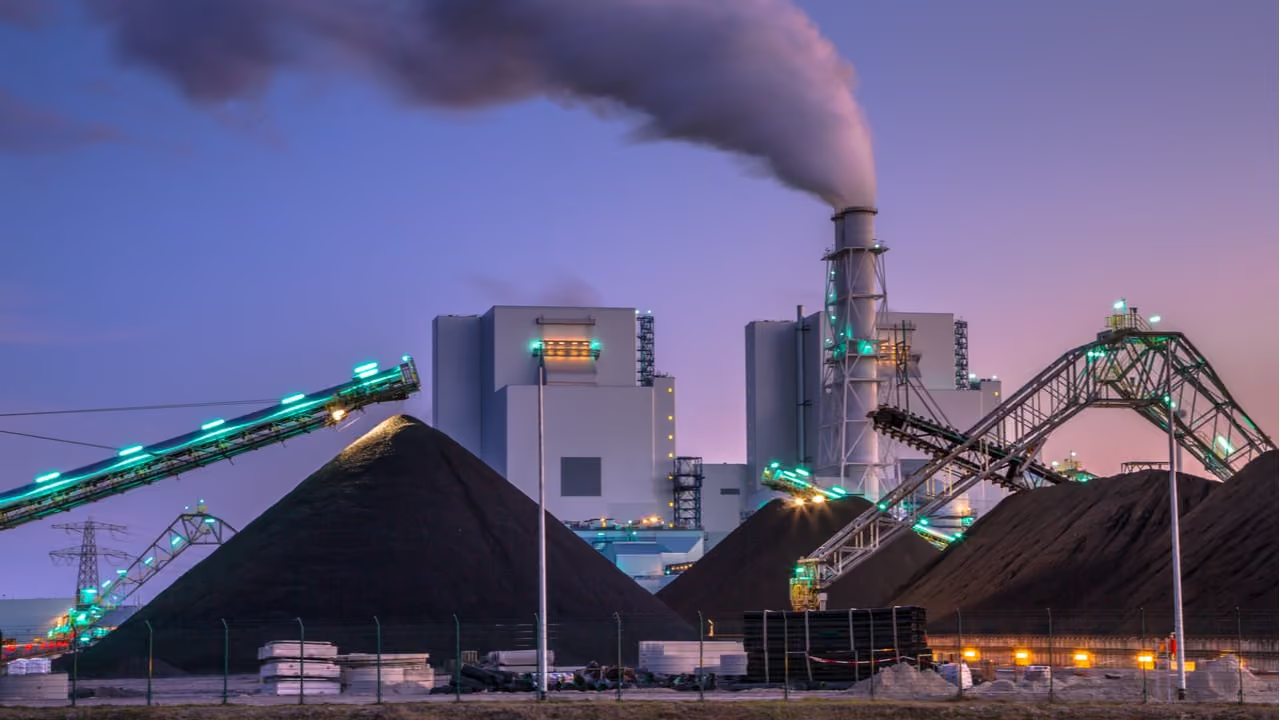
Indian fertilizer manufacturers face margin compression of $400-500/MT as the government commits ₹46,000 crore to coal gasification a thermo chemical process converting coal into synthesis gas (syngas), primarily carbon monoxide and hydrogen for industrial feedstock production. The scheme targets reducing imports of LNG (over 50% imported), urea (~20% imported), ammonia (~100% imported), and methanol (~80-90% imported). The combined ₹46,000 crore includes a ₹37,500 crore incentive scheme approved May 13 targeting 75 million tonnes gasification, contributing to India's 100 million tonnes target by 2030. Consider current economics: India recently paid $959/tonne for imported urea nearly double the price two months earlier. Coal gasification offers domestic feedstock security but at environmental cost: it emits roughly 3.8 tonnes CO2 per tonne ammonia versus 1.8 tonnes for natural gas.
On the buy side: Companies like Chambal Fertilisers, Coromandel International, GSFC and RCF that depend heavily on imported urea, ammonia and LNG for manufacturing stand to benefit enormously if coal gasification successfully substitutes expensive imported feedstocks. The government provides financial support up to 20% of plant and machinery costs, capped at ₹5,000 crore per project. The Talcher Fertilizers plant in Odisha India's flagship coal gasification based urea project expected to produce 1.27 million tonnes annually is targeted for commissioning by December 2027. On the sell side: Coal India stands to gain most directly as the scheme creates large new demand for domestic coal beyond the power sector. Coal India's three planned gasification projects could require cumulative investments of ₹50,000-60,000 crore, with each remaining project costing around ₹20,000 crore.
For large integrated traders with derivatives access: The 30 year coal linkage contracts provide revenue visibility and pricing stability that few other coal demand segments offer. The government promises tax and import duty incentives worth ₹46,500 crore plus a 50% rebate in revenue share for commercial coal block bidders using 10% of coal for gasification. For smaller regional coal miners without scale: the gasification premium requires minimum investment thresholds and technical partnerships. Financial incentives cap at ₹12,000 crore per entity group across all projects, with minimum synthetic gas production of 1,500 Nm3/hr. Coal India evaluates domestic and overseas technologies, including from Chinese firms with extensive gasification experience. The arbitrage spreads domestic coal pricing versus imported gas/naphtha, with gasification creating feedstock at fixed rupee costs rather than volatile dollar denominated imports.
The program could substitute imports worth ₹3 lakh crore over five years while targeting 100 million tonnes coal gasification by 2030. Coal utilization generates expected annual revenue of ₹6,300 crore from 75 million tonnes gasification plus downstream GST and levies. Rising geopolitical tensions in West Asia and volatile LNG prices expose India's vulnerability to global energy supply disruptions, making coal gasification both energy security strategy and industrial policy. Currently, 85% of India's crude oil, 50% of natural gas, and over 90% of methanol and fertilizers come from overseas. The physical constraint: India holds nearly 400 billion tonnes coal reserves among the world's largest, but gasification requires 2-3x more capital than conventional gas based chemical plants. Success depends on sustaining coal quality specifications and managing higher CO2 emissions per output unit.
For traders and intermediaries: The scheme's timing coincides with Middle East crisis keeping Strait of Hormuz disrupted and impacting gas imports across Asia. Ripple effects spread across coal mining, energy, industrial gases, EPC contractors, and infrastructure sectors. Two gasification projects out of seven will start soon, producing urea and chemicals at affordable rates to help farmers. For observers: monitor Talcher Fertilizers completion by December 2027 as the key proof of concept. Watch Coal India's quarterly coal offtake figures for gasification versus thermal power demand through Q4 2026. The coal ministry organizes investor roadshows in Hyderabad, Mumbai, and New Delhi in June's second week participation levels indicate private sector confidence in gasification economics versus continued import dependence.

.jpg)




'%3e%3cg id='Final-Copy-2_2_' transform='translate(1275.000000, 200.000000)'%3e%3cpath class='st0' d='M7.4,12.8h6.8l3.1-11.6H7.4C4.2,1.2,1.6,3.8,1.6,7S4.2,12.8,7.4,12.8z'/%3e%3c/g%3e%3c/g%3e%3c/g%3e%3cg id='final---dec.11-2020'%3e%3cg id='_x30_208-our-toggle' transform='translate(-1275.000000, -200.000000)'%3e%3cg id='Final-Copy-2' transform='translate(1275.000000, 200.000000)'%3e%3cpath class='st1' d='M22.6,0H7.4c-3.9,0-7,3.1-7,7s3.1,7,7,7h15.2c3.9,0,7-3.1,7-7S26.4,0,22.6,0z M1.6,7c0-3.2,2.6-5.8,5.8-5.8 h9.9l-3.1,11.6H7.4C4.2,12.8,1.6,10.2,1.6,7z'/%3e%3cpath id='x' class='st2' d='M24.6,4c0.2,0.2,0.2,0.6,0,0.8l0,0L22.5,7l2.2,2.2c0.2,0.2,0.2,0.6,0,0.8c-0.2,0.2-0.6,0.2-0.8,0 l0,0l-2.2-2.2L19.5,10c-0.2,0.2-0.6,0.2-0.8,0c-0.2-0.2-0.2-0.6,0-0.8l0,0L20.8,7l-2.2-2.2c-0.2-0.2-0.2-0.6,0-0.8 c0.2-0.2,0.6-0.2,0.8,0l0,0l2.2,2.2L23.8,4C24,3.8,24.4,3.8,24.6,4z'/%3e%3cpath id='y' class='st3' d='M12.7,4.1c0.2,0.2,0.3,0.6,0.1,0.8l0,0L8.6,9.8C8.5,9.9,8.4,10,8.3,10c-0.2,0.1-0.5,0.1-0.7-0.1l0,0 L5.4,7.7c-0.2-0.2-0.2-0.6,0-0.8c0.2-0.2,0.6-0.2,0.8,0l0,0L8,8.6l3.8-4.5C12,3.9,12.4,3.9,12.7,4.1z'/%3e%3c/g%3e%3c/g%3e%3c/g%3e%3c/g%3e%3c/svg%3e) Privacy Choices
Privacy Choices