.avif)
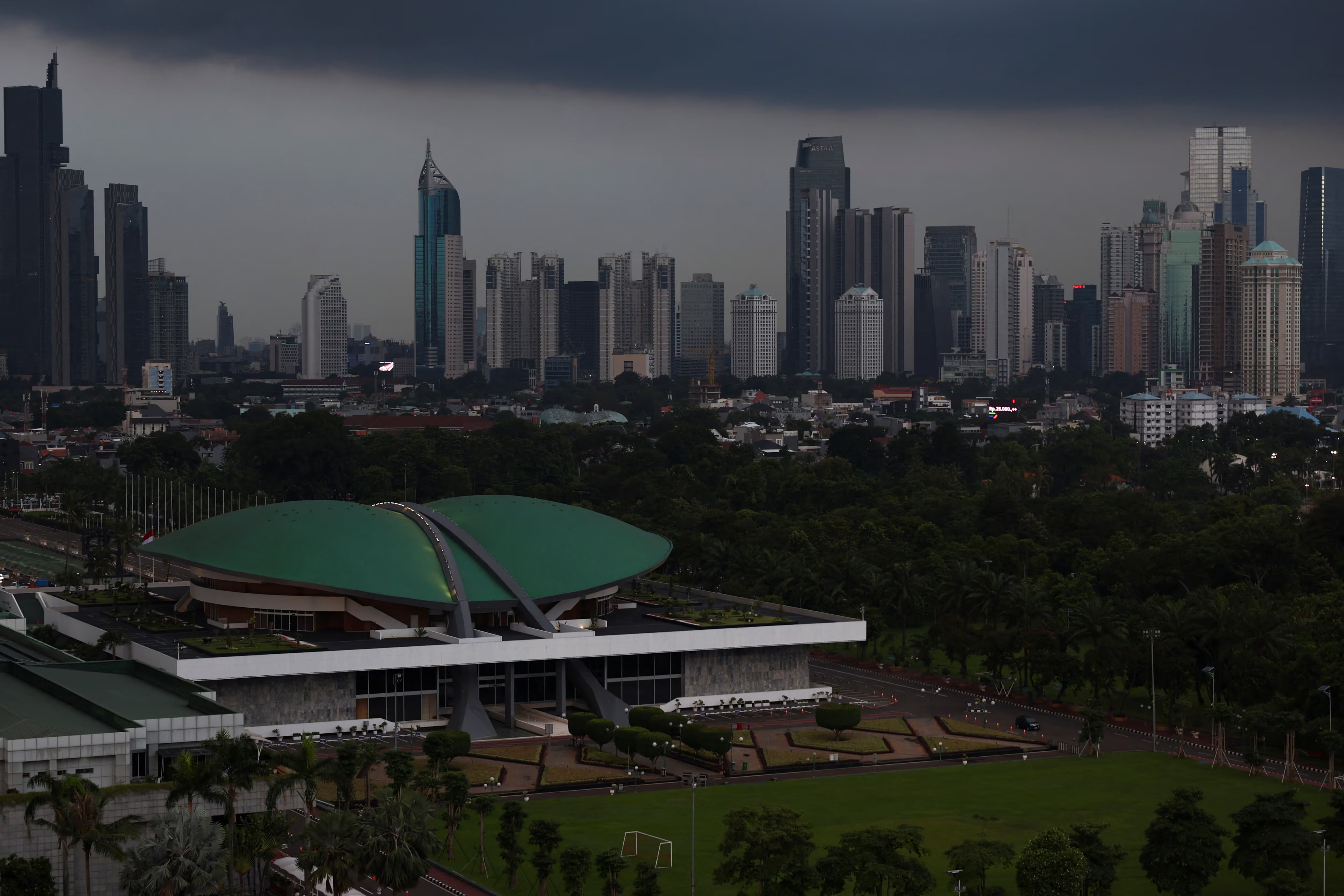
Indonesian petroleum product importers face meaningfully higher financing costs and currency driven landed price inflation beginning Q2 2026, with ANZ projecting two 25 basis point rate hikes from Bank Indonesia that would lift benchmark borrowing rates by 50 basis points and compress already thin import margins across the fuel and petrochemical supply chain.
Indonesia's Q1 2026 GDP print of 5.61% year on year the fastest pace in more than three years is being read by many trade counterparties as confirmation of robust demand. It is not. The number is accurate; its forward implication is not. Ramadan fell mid-February this year, injecting a concentrated burst of household spending which rose 5.52% year on year and accounts for more than half of GDP into the January–March window. Government bonus payments were front-loaded and President Prabowo Subianto's free-meal school program added a one-off fiscal impulse in the same quarter. These are non-recurring accelerants. The S&P Global Purchasing Managers' Index (PMI) a monthly survey of manufacturing conditions where a reading above 50 signals expansion and below 50 contraction published the same week as the GDP release, showed Indonesian factory output contracting at its fastest pace since May 2025 in April, with input cost inflation at a four-year high. Commodity buyers pricing Indonesia as a strong demand counterparty based on the headline GDP figure are reading a rearview mirror.
The mechanism connecting Middle East instability to an Indonesian petroleum importer's landed cost is worth tracing precisely. Petroleum product cargoes diesel, jet fuel, petrochemical feedstocks destined for Indonesia typically load at ports in the Arabian Gulf: Jubail, Ruwais, or Sohar. They transit the Strait of Hormuz, a 33 kilometre wide chokepoint through which roughly 20% of world traded oil flows daily, and arrive at Indonesian terminals primarily Tanjung Priok in Jakarta or Balongan on Java's north coast approximately 18–22 days later aboard MR tankers (Medium Range vessels, carrying around 40,000–45,000 tonnes of refined products). Middle East supply chain disruption, according to reports, is already adding 2–5 days to transit planning and elevating war-risk insurance premiums. On a 40,000 tonne diesel cargo, a $3/MT increase in freight and insurance conservative given current market conditions adds $120,000 to a single voyage. That is before currency effects are applied.
The rupiah dimension is where the margin anatomy becomes severe. The Indonesian rupiah (IDR) has come under sustained pressure in 2026, prompting Bank Indonesia the central bank to intervene directly in foreign exchange markets, selling USD reserves to support the currency. Consider a regional Indonesian fuel distributor importing a 40,000 tonne diesel cargo priced in US dollars at $750/MT CFR (Cost and Freight meaning the seller pays ocean freight but the buyer bears risk from the point of loading). At an exchange rate of IDR 16,500 to the dollar, that cargo costs approximately IDR 495 billion to settle. If the rupiah weakens a further 3% a plausible scenario under the ANZ rate hike trajectory the same cargo costs IDR 509.8 billion: an additional IDR 14.8 billion on a single parcel, with no change in the underlying product price. Domestic fuel pricing, constrained by Pertamina's (the state oil company) subsidised retail structure, does not automatically pass through that cost. The importer absorbs it.
On the buy side, the pressure falls unevenly by operator scale. A large integrated trader a Vitol, Trafigura, or the trading arm of a national oil company can hedge IDR exposure using non-deliverable forwards (NDFs currency contracts settled in USD rather than the local currency, used where direct IDR hedging is illiquid), typically at a cost of 80–120 basis points annualised on the hedged notional, and can use commodity derivatives on the ICE gasoil benchmark to lock in product cost weeks ahead of cargo arrival. The hedge cost is real but manageable against the scale of the position. For a smaller regional operator a mid-sized Java-based fuel importer or an independent industrial feedstock buyer without derivatives desk access the practical equivalent is accelerating procurement timing: buying forward from Pertamina's term allocation, fixing bilateral price terms with Middle East suppliers in IDR where counterparties will accept it (rare but negotiable on long-standing relationships), and reducing spot cargo exposure to the minimum operationally required. The asymmetry is significant: the large operator hedges the risk; the regional operator avoids the exposure by accepting supply inflexibility.
On the sell side, the picture diverges sharply by commodity. Indonesian palm oil and coal exporters whose revenues are USD denominated while their cost bases are largely IDR are the direct beneficiaries of rupiah weakness. Each 1% IDR depreciation adds approximately 1% to their USD equivalent export margin, all else equal. A coal exporter running a $15/MT operating margin on a USD contract sees that margin expand in IDR terms as the currency softens. This is the arbitrage window: operators holding USD export receivables against IDR cost bases should be capturing that carry aggressively now, before Bank Indonesia tightens and the IDR partially recovers. For petroleum product importers observing this dynamic, it explains why Indonesian export commodity counterparties may be slow to renegotiate USD contract terms the currency effect is currently working in their favour. The structural imbalance between export oriented commodities and import dependent manufacturing is one of the defining fault lines of the Indonesian economy in 2026.
The signal to watch is not the next GDP release that will confirm what happened in Q2, not what is happening now. The actionable intelligence comes from three specific, time bound sources. First, Bank Indonesia's monthly foreign exchange intervention disclosure, published approximately three weeks after month end: sustained or accelerating intervention signals that the rate hike may come sooner than ANZ's two-step timeline implies, which directly affects the cost of trade finance letters of credit (LCs bank guarantees of payment against shipping documents, the instrument that makes most international commodity trade possible). Second, the S&P Global Indonesia PMI for May 2026, due in the first week of June: if output and new orders remain below 50 and input costs hold at four year highs, demand destruction in the industrial feedstock segment is not a risk it is already underway. Third, Singapore's HSFO and gasoil barge market the regional spot clearing point for any evidence that cargoes originally destined for Indonesian buyers are being rerouted or deferred, which would confirm that rupiah-driven affordability deterioration is already reshaping cargo flow at the physical level.


.jpg)
.jpg)

'%3e%3cg id='Final-Copy-2_2_' transform='translate(1275.000000, 200.000000)'%3e%3cpath class='st0' d='M7.4,12.8h6.8l3.1-11.6H7.4C4.2,1.2,1.6,3.8,1.6,7S4.2,12.8,7.4,12.8z'/%3e%3c/g%3e%3c/g%3e%3c/g%3e%3cg id='final---dec.11-2020'%3e%3cg id='_x30_208-our-toggle' transform='translate(-1275.000000, -200.000000)'%3e%3cg id='Final-Copy-2' transform='translate(1275.000000, 200.000000)'%3e%3cpath class='st1' d='M22.6,0H7.4c-3.9,0-7,3.1-7,7s3.1,7,7,7h15.2c3.9,0,7-3.1,7-7S26.4,0,22.6,0z M1.6,7c0-3.2,2.6-5.8,5.8-5.8 h9.9l-3.1,11.6H7.4C4.2,12.8,1.6,10.2,1.6,7z'/%3e%3cpath id='x' class='st2' d='M24.6,4c0.2,0.2,0.2,0.6,0,0.8l0,0L22.5,7l2.2,2.2c0.2,0.2,0.2,0.6,0,0.8c-0.2,0.2-0.6,0.2-0.8,0 l0,0l-2.2-2.2L19.5,10c-0.2,0.2-0.6,0.2-0.8,0c-0.2-0.2-0.2-0.6,0-0.8l0,0L20.8,7l-2.2-2.2c-0.2-0.2-0.2-0.6,0-0.8 c0.2-0.2,0.6-0.2,0.8,0l0,0l2.2,2.2L23.8,4C24,3.8,24.4,3.8,24.6,4z'/%3e%3cpath id='y' class='st3' d='M12.7,4.1c0.2,0.2,0.3,0.6,0.1,0.8l0,0L8.6,9.8C8.5,9.9,8.4,10,8.3,10c-0.2,0.1-0.5,0.1-0.7-0.1l0,0 L5.4,7.7c-0.2-0.2-0.2-0.6,0-0.8c0.2-0.2,0.6-0.2,0.8,0l0,0L8,8.6l3.8-4.5C12,3.9,12.4,3.9,12.7,4.1z'/%3e%3c/g%3e%3c/g%3e%3c/g%3e%3c/g%3e%3c/svg%3e) Privacy Choices
Privacy Choices