.avif)

Independent crude importers across Southeast Asia and South Asia absorbed a 6% margin compression across three trading days on contracts positioned for a Hormuz reopening that has not materialised. A mid-sized Indonesian refinery operator buying Brent linked cargoes at Friday's settlement of $86.80 down from $95.06 at Monday's open on June 9 is now holding inventory priced against diplomatic optimism. The physical crude those contracts reference still cannot transit the chokepoint. The gap between what paper markets priced and what the physical market delivered is the entire story of the week ending June 13.
Brent crude fell more than 4% on Friday to close at $86.80 per barrel, its lowest settlement since early March. WTI settled at $84.88. Both benchmarks shed approximately 6% across the week the steepest weekly decline since the conflict began on February 28. The 30 day rolling average across May 13 to June 13 was $97.60, with the period high at $109.75 and low at $85.80. The market moved 22% from its monthly peak to Friday's close on diplomatic signal alone. The physical market changed not at all.
The catalyst was a Truth Social post from President Trump on Saturday June 13: "The Deal is scheduled to get signed tomorrow, and immediately after it is signed, the Hormuz Strait is OPEN TO ALL."
It is Sunday June 14. The Strait remains closed. No signature exists.
The Document Conflict Is the Operative Risk
Iran's foreign ministry spokesman Esmaeil Baqaei stated publicly on June 13 less than two hours after Pakistani Prime Minister Shehbaz Sharif announced finalisation was "likely within the next 24 hours" that the June 14 signing was "unlikely." His attribution: "hesitancy of the other side." President Trump subsequently posted Sunday that negotiations were proceeding in an "orderly and constructive manner" but had instructed officials "not to rush into a deal." The two posts are structurally contradictory. Both moved markets. Neither reflected physical reality.
Two competing official documents now exist with material differences on the terms that matter most to oil markets. Iranian state news agency Mehr published a 14 point draft on June 13 specifying: Hormuz reopening in 30 days under arrangements set by Tehran, US force withdrawal from the region, and $300 billion in reconstruction funding. The Trump administration categorically denied the document represented agreed terms. Vice President Vance stated that fake information was circulating and that Tehran would receive no upfront cash. A senior administration official simultaneously placed 80% probability on a deal being signed "in the coming days."
Two competing official texts. Two contradictory timelines on the single term the reopening date that crude markets are actually pricing. The 80% deal probability is embedded in Brent at $86.80. The remaining 20% keeps Hormuz closed, which puts crude back above $100 where it was trading as recently as May 12 when both benchmarks were averaging $109 at their 30 day peak.
The arithmetic is specific. Brent has traded in a 52 week range of $58.72 to $126.41. The pre-conflict level on February 27 was approximately $70. The war premium at peak was $56 per barrel above that baseline. The current $86.80 embeds a residual war premium of approximately $17 per barrel on the assumption that normalisation is imminent. If the MOU is not signed this week, that premium has no mechanism to compress further. If the MOU is signed but Iranian terms prevail on the 30 day reopening timeline, the market reprices to reflect a month of continued shut-in before a single additional barrel transits the strait. Neither scenario supports the current price.
The Physical Market Has Not Moved
As of June 14, approximately 10-11 million barrels per day of crude remain shut in for every day the Strait stays blocked. The pre-war run rate through Hormuz was approximately 20% of global seaborne crude exports.
Since March 1, global seaborne crude and condensate exports averaged 36.3 million barrels per day through the eight weeks ending May 3, according to Vortexa down 6.8 million bpd, or 16%, versus the pre-war average from January 2025 through February 2026. The VLCC segment absorbed the sharpest impact: global crude exports on VLCCs fell 8.1 million bpd or 36% versus pre-war levels over the same period, as Kpler confirmed in March. The VLCC share of seaborne crude exports fell to 40% from 52% pre-conflict.
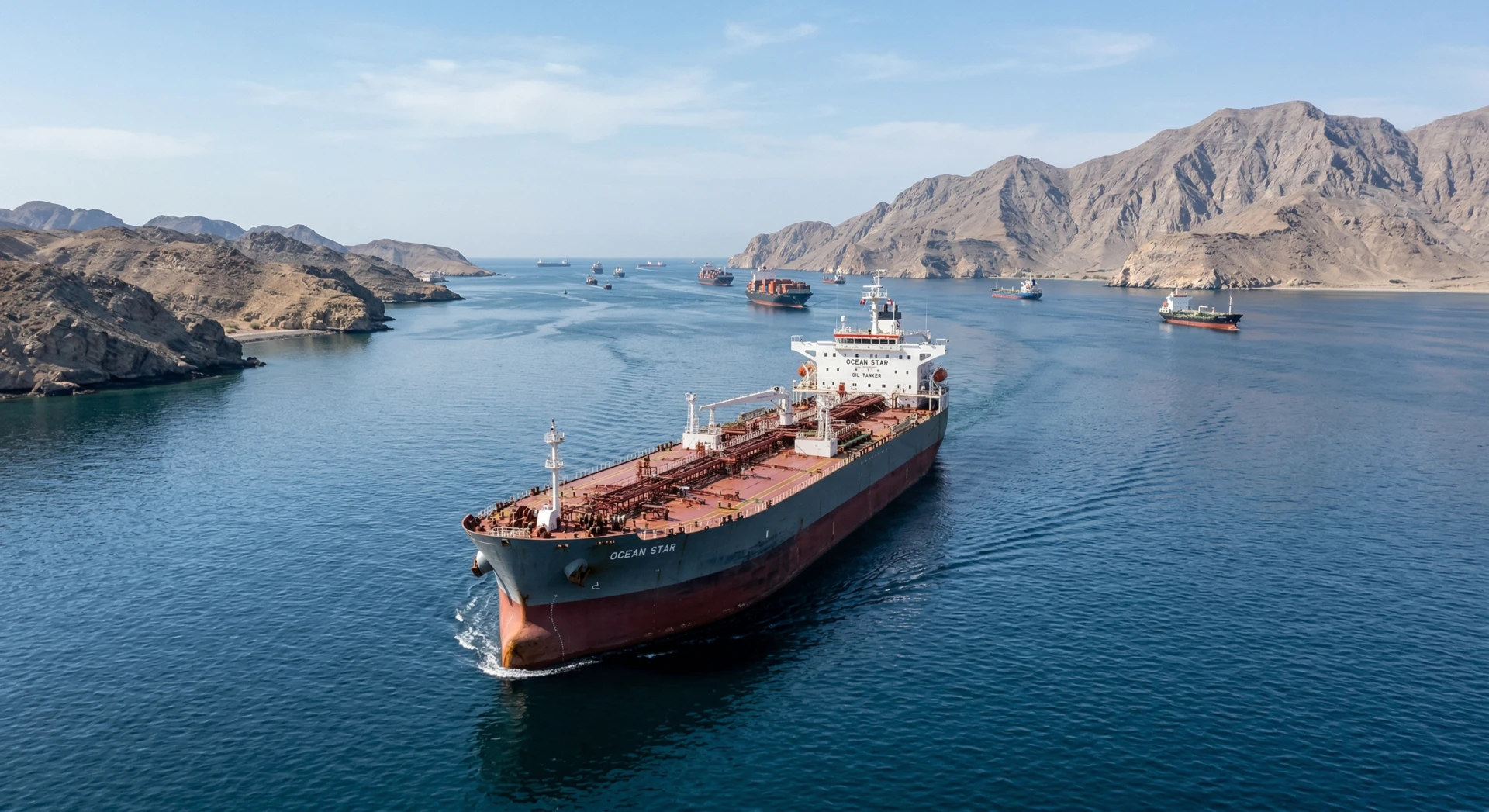
Tanker transit data confirms what the futures curve obscures. Kpler documented a 92% collapse in Strait of Hormuz tanker transits compared to the week before the conflict began, with normal daily transits of approximately 138 vessels collapsing to near-zero in March. The International Maritime Organization reported in April that approximately 20,000 mariners and 2,000 ships were stranded in the Persian Gulf. Lloyd's List Intelligence, drawing on vessel tracking data, confirmed approximately 60 VLCCs inside the Middle East Gulf in the early weeks of the closure representing roughly 8% of the entire compliant VLCC fleet with 33 at anchor and 14 slow steaming. A further 23 Suezmax vessels remained trapped.
AIS data from Starboard Maritime Intelligence, analysed by CSIS, showed that after Iran's foreign minister announced a reopening in April, dozens of vessels surged toward Hormuz and most reversed course back into the Gulf. Only 13 made it through. As of June, commercial traffic through the strait remains at a fraction of pre-war levels despite the April ceasefire. The ceasefire did not reopen the waterway. The MOU, if signed, will not reopen it either at least not on the timeline the futures market priced last week.
Saudi Arabia diverted crude loadings from Ras Tanura to Yanbu on the Red Sea, partially compensating. Yanbu's annual capacity of 210 million metric tonnes cannot absorb what Ras Tanura, Kuwait's Mina al-Ahmadi and the UAE's Ruwais terminals normally handle. Pipeline bypass helps at the margins. It does not offset the 10-11 million bpd shut-in.
The Freight Market Tells the Unedited Story
The VLCC rate trajectory is the most honest instrument in this market. It cannot be moved by Truth Social posts.
Before the conflict, VLCC time charter equivalents on the Middle East Gulf to China route (TD3C) were running in the low to mid five digit range in normal operating conditions approximately $40,000 to $80,000 per day. The pre-conflict surge to six year highs in late January and February 2026 had already pushed the Baltic Exchange's TD3C index to $112,394 per day as tensions mounted. On February 27, the night before the US-Israeli strikes on Iran, some hulls had already cleared $200,000 per day, with one fixture (the DHT Jaguar to Bahri) reported at $208,000 per day.
When the conflict began, rates shattered every historical record. On March 3, VLCC spot rates on the MEG-China route hit $423,736 per day a level without precedent in Baltic Exchange data going back to 2005. By mid-March, the MEG-Singapore VLCC TCE index reached $484,890 per day, with individual fixtures reported at $554,771 per day for vessels loading from Oman to South Korea. War-risk insurance cancellation by four major marine insurers in early March, followed by seven P&I clubs cancelling war-risk extensions on March 5, removed entire layers of insurable capacity and drove the rate spiral.
The BDTI Baltic Dirty Tanker Index, the composite measure of crude tanker transportation costs across all vessel sizes reached 2,068 points on May 29, against a pre-conflict normal range of approximately 1,200 to 1,400 points. That is a sustained 50-60% structural premium on dirty tanker rates that has not normalised four months after the conflict began.
Current VLCC rates on the MEG-China route remain in the $150,000 to $200,000 per day range as of early June, per market commentary from MEES and consistent with Maritime Hub assessments. That is three to five times pre-conflict normal operating cost.
The freight market did not sell off 6% last week. The crude futures market did. The physical cost of moving a barrel of Gulf crude to Asia has not collapsed. Only the paper price of the crude itself moved. When freight and crude diverge this sharply on diplomatic headlines, the freight market is pricing what the futures market refuses to: the waterway is still closed.
Worked Numerical Example: The VLCC Voyage Cost Stack
The freight reality, in operator terms. The cost stack on a standard 22 day Middle East Gulf to Shanghai voyage for a VLCC carrying 2 million barrels:
Pre-conflict (February 2026):
- VLCC TCE: $80,000 per day x 22 days = $1.76 million
- Hull war-risk premium: 0.125% of $100m hull value, one-time = $125,000
- P&I, fuel surcharges, port costs, demurrage allowance: approximately $400,000
- Total voyage cost: approximately $2.3 million
- Per barrel transportation cost: $1.15
Current conditions (June 2026):
- VLCC TCE: $175,000 per day x 22 days = $3.85 million
- Hull war-risk premium: 1.0% of $100m hull value, renewable every 7 days = approximately $400,000 across voyage duration
- P&I (where available), war risk top-ups, security escort surcharges: approximately $800,000
- Demurrage exposure on Gulf anchorage delays (factoring in typical 4-7 day wait): approximately $1.0 million
- Total voyage cost: approximately $6.05 million
- Per barrel transportation cost: $3.03
The transportation cost differential is $1.88 per barrel above pre-conflict normal. Per Argus, the Mideast Gulf to China VLCC rate on Basrah Medium reached $15.32 per barrel at the March peak, which was 20% of FOB cargo value. Current $3.03 per barrel transportation is still nearly three times the pre-conflict ratio to FOB value.
When Brent fell $5.60 per barrel on the week, the embedded transportation cost did not fall. A buyer paying for delivered Asian crude saw the all in delivered cost compress by approximately $4.00 per barrel, not $5.60. The freight premium absorbs roughly a quarter of the apparent diplomatic discount before it ever reaches the refinery gate.
The Operator Margin Anatomy
The Institute's framework reads markets through three operator perspectives: buyer, seller, intermediary. Last week's 6% crude decline distributed across each in distinct ways.
For Buyers: The Unhedged Refinery and Independent Importer
Regional refineries and fuel distributors without futures market access took the week's price movement as a direct balance sheet event.
Worked example: A mid-sized Indonesian importer holding 1 million barrels of Brent-linked forward purchase commitments at Monday's $95.06 open is now sitting on approximately $8.26 million in unrealised paper losses against Friday's $86.80 settlement. The physical crude is still coming. It still costs more to transport than pre-conflict. Only the futures-linked purchase price moved, and it moved against them.
For Asian refineries paying delivered cost on Hormuz transit crude, the margin compression is compounded by the freight premium. The refinery sees $86.80 on the screen and books inventory at that price, but the all-in delivered cost runs $3.00 per barrel above pre-conflict levels because of the freight stack. When refined product prices have already adjusted to a $90+ crude environment, the gross margin per barrel processed has compressed by $3-4 on every barrel that arrives over the next 30 days.
Japanese and Korean refiners face the most acute exposure: Japan imports approximately 70% of its crude from the Middle East with most transiting Hormuz, while Korean refiners similarly depend on the corridor. Indian refiners (Reliance, IOC, BPCL) have partially diversified to Russian and African crude but retain meaningful Hormuz exposure.
For Sellers: The NOC Trading Arm and Integrated Producer
National oil company trading arms (Saudi Aramco Trading, ADNOC, KPC, Sonangol) and integrated majors with upstream Gulf production occupied a structurally protected position through the week.
Their crude was already priced at the elevated war premium. Shut-in volumes accrue lost revenue but do not generate mark-to-market losses on cargo in transit. Their downstream refining margins benefit from input costs that have not actually fallen at the burner tip despite the futures decline. They can selectively defer production decisions while monitoring whether the futures move forces a structural break or proves transient.
The risk for sellers is dual: prolonged shut-in eventually destroys demand for their crude as Asian refineries reconfigure for alternative grades, and a confirmed deal triggers an immediate 100 million barrel inventory flush from stranded vessels into the same market they sell into. Saudi Aramco's diversion to Yanbu and ADNOC's pipeline routing through Fujairah are not just operational measures they are structural positioning for a market where Asian buyers may not return to pre-war reliance on Hormuz transit cargo even after reopening.
For Intermediaries: The Integrated Trading House
Vitol, Trafigura, Mercuria, Gunvor and the major NOC trading arms operating across both physical and paper markets occupied the most actively profitable position through the week.
Our analysts work three arbitrage forms in physical commodity markets: space (geographic), time (temporal), form (quality). The Hormuz crisis has activated all three simultaneously, and last week's diplomatic optimism opened a new layer of basis arbitrage between physical Gulf crude and paper Brent.
Geographic arbitrage: Physical crude loading at Yanbu, Fujairah and alternative Gulf ports trades at differentials to Brent that widened sharply through March-May. A house buying physical Gulf crude at WTI linked differentials and selling Brent linked exposure into Asian refineries captures the spread compression as diplomatic optimism narrows the Brent-Dubai gap.
Time arbitrage: The forward curve moved into deeper backwardation through Friday as near-term prices fell faster than distant months. A house long physical crude at $86.80 spot and short December futures at the forward curve premium captures the carry compression approximately $0.50 per barrel for every $1 the curve flattens.
Basis arbitrage: The freight forward agreement (FFA) market on TD3C MEG-China VLCC routes has not collapsed as the crude futures market has. A house long crude futures (positioned for reopening) and short FFAs (positioned for continued disruption) captures both directional moves. When crude futures fall on diplomatic optimism but freight rates hold on operational reality, the house extracts margin from both legs.
Regional importers without derivatives access cannot execute any of these. They bear the full directional exposure to diplomatic volatility while integrated houses systematically extract margin from the same volatility.
The China Demand Dimension
The single largest factor preventing crude prices from sustaining above $120 through this conflict has been the Chinese demand response. Without it, the war premium would have persisted at March-April levels and Brent would still be above $100.
China cut crude imports from 11.7 million barrels per day in February to under 9 million barrels per day by late May a 2.7 million bpd reduction. Per JPMorgan analysis, that single cut represented approximately 74% of the global decline in crude imports during the disruption period. SocGen identified Chinese demand suppression as the second largest offsetting force in the market, behind only Saudi rerouting through Yanbu and larger than the coordinated SPR releases by the US, Europe and Japan combined.
The mechanism was deliberate. China authorised state-owned refiners (Sinopec, CNPC) to draw from commercial reserves in April. US Energy Secretary Wright publicly confirmed around May 15 that the drawdown had extended to strategic petroleum reserves. China's total crude reserves were estimated at 1.2 to 1.47 billion barrels at the end of 2025 nominally 110 to 180 days of cover, practically 60 to 90 days of working inventory before refiners would cut runs to protect minimum stocks, per Baker Institute analysis.
The relevant point for the current price environment: that reserve buffer is now structurally depleted. Baker Institute estimated the runway extending to mid-July before Chinese refiners face hard run-rate cuts. Tanker transit from the Gulf to East Asia takes approximately three weeks. Decisions on how to manage the next phase of import volume will need to be made well before the inventory cushion runs dry.
If the deal signs and Hormuz reopens on the US timeline, China rebuilds reserves aggressively through Q3-Q4, providing structural floor support for crude prices. If the deal signs on Iranian 30 day terms, China extends drawdown for another month while Asian refineries source from Atlantic Basin at elevated cost. If no deal signs, China faces the binary choice of accepting refinery run cuts (destroying refined product margins) or accepting elevated crude prices to maintain throughput.
China's diversification posture matters here too. PetroChina Chairman Dai Houliang stated in early 2026 that Hormuz imports represent only about 10% of the company's total operating volume the result of an aggressive multi-year strategy to diversify across 49 country sources with no single source exceeding 20% of supply. Three overland pipeline corridors (northeastern from Russia, northwestern from Kazakhstan, southwestern from Myanmar) provided 38% of Chinese crude transport in 2025. The Chinese demand suppression that has cushioned global oil prices through this conflict was made possible by infrastructure investment that long preceded it.
The current $86.80 Brent price embeds an assumption that Chinese demand recovers to pre-conflict 11.7 million bpd within weeks of any reopening. If China instead uses the disruption as a structural opportunity to accelerate de-oiling and diversification which Baker Institute identifies as Beijing's most strategically rational path the demand recovery may be partial. That outcome is not currently priced.
The Trade Finance Dimension
The competing documents problem is not just a diplomatic headline. It is an operational block on trade finance for Hormuz transit crude.
Standard crude trade operates on 30 to 90 day payment terms backed by confirmed letters of credit. As the Institute's analysts have laid out in past work, documentary trade finance forms the backbone of bilateral physical commodity flows: the seller's bank issues the LC to the buyer's bank, the bill of lading transfers cargo title, payment releases against document presentation. This system is centuries old and operates on a fundamental requirement that the terms of the underlying contract are defined and not subject to material dispute.
Hormuz transit crude cannot currently meet that requirement. Two competing official documents exist with material differences on routing, timing and risk allocation. A bank asked to issue an LC against a cargo whose Strait transit is governed by terms that two governments dispute cannot underwrite the document presentation. The bank does not know which set of compliance obligations to verify against.
This effect compounds through the war-risk insurance dimension. Lloyd's of London hull war-risk premiums on Persian Gulf transits rose from approximately 0.125% of hull value pre-conflict to 1% of hull value renewable on 7 day terms equivalent to approximately $1 million per 7 day coverage window for a VLCC with $100 million insured hull value. Seven P&I clubs cancelled war-risk extensions on March 5, removing protection and indemnity coverage from a tranche of the global fleet. Without P&I and hull war-risk in place, banks cannot issue trade finance against cargo. Without trade finance, the cargo does not move regardless of crude price.
The cascading effect was visible in the March 9 Asian equity collapse, when seven P&I clubs cancelled war-risk extensions and Asian markets shed $1.3 trillion in a single session. South Korea's KOSPI fell 7.62% its worst single day decline in market history. The collapse was not primarily about oil prices. It was about the recognition that without insurable transit, Asian industrial supply chains face a structural disruption that no amount of inventory cushioning can fully absorb.
The Friday close at $86.80 implicitly assumes that trade finance will be restored within days of any MOU signature. That assumption ignores the document conflict. Banks cannot underwrite against text both governments dispute. War-risk insurers cannot price coverage against terms that may be reversed within a week. Until the documents converge, the trade finance infrastructure that physical crude flows depend on remains structurally impaired even if a deal signs.
The integrated trading houses that maintain captive insurance vehicles (Trafigura, Vitol) can self-insure against the gap. The regional importers and independent traders that rely entirely on bank issued LCs cannot. The trade finance dimension is another structural advantage flowing to integrated capital and another structural drag on smaller operators.
The Operational Timeline That Markets Cannot Wish Away
Even if the MOU were signed today, Sunday June 14, the Strait of Hormuz would not physically reopen for commercial traffic at pre-conflict volumes for a minimum of four to six weeks. This is not a political assessment. It is operational reality.
Iran deployed mines in the strait. Mine clearing operations require specialised vessels and systematic sweeping of a 39 kilometre wide chokepoint, with directional traffic lanes of only 3.2 kilometres each. Historical precedents for mine clearance in confined waterways suggest two to four weeks of continuous operations under favourable conditions. The Strait of Hormuz is not favourable conditions. It carries approximately 138 vessels per day in normal operations. The realistic lower bound for clearance to commercial grade safety is four weeks.
War-risk insurance restoration follows mine clearance. Lloyd's syndicates require syndicate review of confirmed clearance, cessation of hostilities across all Iran-related fronts (including Lebanon, where Israeli operations continued into June 13), and actuarial reassessment of transit risk. Historically a one to two week process after physical conditions warrant it.
Pilot services and port logistics require reconstruction. Commercial traffic through the strait ran at 135 vessels per day before the conflict. Since May 6, open transits fell to near-zero per UANI tracking. Even under US "Project Freedom" escort arrangements launched May 4, compliant traffic was not fully normalised. Rebuilding pilot rosters, restoring coordination with Fujairah and Khor Fakkan transshipment hubs, and clearing port congestion at Jebel Ali which reached 300-400% above normal capacity at peak crisis will require weeks of restoration after physical transit resumes.
Sparta's Singapore desk estimated three to six months to return to pre-war status quo, accounting for time to bring production back online, repair damaged facilities and restore refinery input supply chains. Fitch Ratings, assessing the situation in early June, placed potential full reopening around end of July 2026, with Brent crude averaging $87 per barrel for full-year 2026 if that timeline holds. That assessment was made before this weekend's failed signing.
The Dallas Fed quarterly model assigned a 35% probability that the Strait remains closed through Q4 2026 even under conditions of moderate diplomatic progress. That probability rises if signing slips beyond June.
The market priced last week as though the timeline between MOU signature and fully normalised Strait transit was measured in hours. The operational reality is measured in months.
What the Prediction Market Already Knew
The divergence between presidential announcements and sophisticated capital positioning is the most telling signal of the weekend.
Polymarket the largest prediction market with over $300 million in volume traded on the US-Iran permanent peace deal question was pricing a permanent deal by June 30 at single-digit probability as of June 13, even as President Trump was posting that Sunday's signing was imminent. This is not an anomaly. It reflects the pattern that has repeated throughout the conflict: the White House announces imminence, Iran's hardliners push back, the June 30 probability dips, and oil futures whipsaw between the two signals.
The divergence between the 80% deal probability asserted by the administration official to CNBC and the sub-10% implied by Polymarket's June 30 contract captures exactly the uncertainty that Brent at $86.80 cannot properly price. The futures selloff last week was retail and systematic momentum, not informed physical positioning. Informed positioning is in the freight market, where rates have not collapsed.
The Brent-Dubai Spread as the Operative Diagnostic
For operators monitoring this situation across the coming weeks, the Brent-Dubai Exchange of Futures for Swaps (EFS) differential is the real-time barometer of Persian Gulf crude integration into global supply chains. It is more reliable than any diplomatic announcement.
In peacetime, the Brent-Dubai EFS spread historically runs $2 to $4 per barrel. When the Hormuz crisis erupted on March 3, the spread blew out above $6 per barrel the widest level since 2022. Brent absorbed the geopolitical premium while Dubai, priced against physically unavailable Gulf crude, sat near $68 as Brent surged toward $84. The widening was diagnostic: it confirmed the market had stopped treating Dubai linked Gulf crude as physically deliverable at posted prices.
A Brent Dubai EFS spread above $6 per barrel signals the market does not believe Persian Gulf crude is accessible regardless of what any press office says. Convergence below $3 per barrel is the signal that normalisation has physically begun that ships are actually loading, actually transiting, and actually delivering Gulf crude to Asian refineries at near-normal cost.
Monitor this weekly. Track it alongside the BDTI. Watch the Baltic Exchange's TD3C index, which prices the MEG-China VLCC route that carries the largest single volume of Gulf crude to its primary market. When TD3C and front month Brent converge in their directional movement both falling together as physical reopening validates diplomatic announcements the normalisation trade is real. Until they converge, they are pricing different things: the paper market is pricing diplomacy, and the freight market is pricing physics.
Procurement Watch
For Buyer-Side Operators: Asian Refineries, Independent Importers, Regional Distributors
Monitor: Brent Dubai EFS spread daily. Trigger level for confirmed normalisation: sustained convergence below $3 per barrel for five consecutive trading days. Trigger level for failed normalisation: re-widening above $6 per barrel.
Decision branch: Do not lock in post-announcement spot supply at sub $85 Brent assuming immediate delivery. The carrying cost and operational delay between MOU signature and physical Gulf crude arrival will erode the apparent discount. Lock in 30 day forward delivery only if the freight component (TD3C VLCC index) confirms directional alignment with the crude move.
Hedge construct for non-derivatives operators: Negotiate with primary suppliers for delayed pricing optionality the right to fix price at delivery rather than at contract date for the next 30 days of cargo. The optionality cost will be approximately $1-2 per barrel. The protection against a sustained reversal in crude prices is significantly greater than that cost.
For Seller-Side Operators: Atlantic Basin and West African Producers
Monitor: Nigerian Bonny Light, Angolan Girassol, Brazilian Tupi differentials to Brent daily. Asian premium tracking weekly.
Decision branch: Do not unwind Atlantic Basin supply contracts to Asian refineries on Friday's price action alone. The premium that Asian refineries paid through March-May was structural compensation for Gulf inaccessibility. If reopening is delayed or partial, that premium should sustain through Q3.
Hedge construct: For producers with elevated Atlantic Basin contract premiums, consider locking forward sales through Q3 at current differentials. Spot market exposure beyond September carries significant downside risk if Hormuz normalises and Asian refineries return to Gulf sourcing at scale.
For Intermediary Operators: Integrated Trading Houses, FFA Capable Desks
Monitor: Brent-Dubai EFS, TD3C VLCC index, BDTI, forward curve structure. Watch for divergence between paper and physical signals.
Decision branch: Maintain split positioning: long crude futures positioned for eventual reopening, short TD3C FFAs positioned for continued elevated freight. Unwind one leg when convergence between paper and physical markets accelerates beyond 5% in either direction within 48 hours.
Captive insurance: Houses with internal insurance capacity can selectively underwrite physical cargo movement that bank mediated LCs cannot finance. The trade finance gap created by competing documents is itself the arbitrage.
For All Operators: Universal Watch Points
Monitor daily: Brent close, Brent-Dubai EFS, TD3C MEG-China VLCC rate, BDTI level.
Monitor weekly: Lloyd's of London war-risk premium quotes for Gulf transit (track via insurance market bulletins), Vortexa or Kpler Strait of Hormuz transit count, IMO/UANI stranded vessel count, Iranian and US official statements on document text.
Trigger events:
- MOU signed with confirmed Iranian acceptance of immediate Hormuz reopening: expect 5-8% crude drop within 24 hours, sustained.
- MOU signed with 30 day Iranian timeline prevailing: expect 3-5% drop on signature, partial reversal within 10-14 days.
- No signing by June 21: expect Brent drift back toward $92-95 as residual war premium reasserts.
- Active hostilities resume on any front: expect immediate $10-15 spike.
PI Commentary
The market is currently long a peace that both sides are actively negotiating.
The 6% weekly decline in crude futures reflects diplomatic momentum that the physical market has not validated and operational reality cannot accommodate on the timeline implied. The Brent at $86.80 settlement on Friday assumes 80% probability of imminent signing on terms that two governments publicly dispute, against a waterway that physically cannot reopen for commercial traffic for at least four to six weeks after any signature, with mine clearance, war-risk insurance restoration, and pilot service reconstruction still entirely ahead.
The desk assesses the freight market as the more reliable indicator through the next 30 days. VLCC TD3C rates remain three to five times pre-conflict normal. The BDTI sits 50-60% above pre-war baseline. The Brent-Dubai EFS spread, while compressed from March wides, has not converged to peacetime levels. None of these markets have priced what crude futures priced last week. They are pricing the physical reality that the diplomatic narrative has temporarily obscured.
For operators across every archetype, the Institute's operational guidance is the same: do not commit forward physical positions on the assumption that Friday's price action reflects sustainable structural change. The deal may sign this week. It may sign on terms that reopen Hormuz immediately. Neither outcome if it occurs eliminates the 4-6 week operational gap between signature and full normalisation. The trading houses with FFA access and captive insurance will harvest that gap. The regional importers without those tools will pay for it.
The competing documents problem is the underrated risk through the coming days. Banks cannot issue LCs against text that two governments dispute. War-risk insurers cannot price coverage against terms that may be reversed within a week. Until the document conflict resolves into a single agreed text not just an announcement that an agreement exists trade finance infrastructure for Hormuz-transit crude remains structurally impaired regardless of what the futures market does.
The 80% deal probability and the sub 10% Polymarket pricing cannot both be correct. Our senior analysts view the prediction market as the better calibrated signal given its $300 million in transaction volume from operators with direct exposure to outcomes. The 6% weekly decline in Brent priced toward the 80% probability. The freight market priced toward the sub 10%. Operators positioning physical inventory should weight their decisions accordingly.
Brent at $86.80 is pricing an 80% probability of a deal signed this weekend, on terms that both parties have publicly disputed, for a waterway that will not physically reopen for weeks after any signature, with 10-11 million barrels per day still shut in and 2,000 vessels still stranded.
The deal that does not exist cannot reopen the strait that remains closed.

.jpg)
.jpg)

'%3e%3cg id='Final-Copy-2_2_' transform='translate(1275.000000, 200.000000)'%3e%3cpath class='st0' d='M7.4,12.8h6.8l3.1-11.6H7.4C4.2,1.2,1.6,3.8,1.6,7S4.2,12.8,7.4,12.8z'/%3e%3c/g%3e%3c/g%3e%3c/g%3e%3cg id='final---dec.11-2020'%3e%3cg id='_x30_208-our-toggle' transform='translate(-1275.000000, -200.000000)'%3e%3cg id='Final-Copy-2' transform='translate(1275.000000, 200.000000)'%3e%3cpath class='st1' d='M22.6,0H7.4c-3.9,0-7,3.1-7,7s3.1,7,7,7h15.2c3.9,0,7-3.1,7-7S26.4,0,22.6,0z M1.6,7c0-3.2,2.6-5.8,5.8-5.8 h9.9l-3.1,11.6H7.4C4.2,12.8,1.6,10.2,1.6,7z'/%3e%3cpath id='x' class='st2' d='M24.6,4c0.2,0.2,0.2,0.6,0,0.8l0,0L22.5,7l2.2,2.2c0.2,0.2,0.2,0.6,0,0.8c-0.2,0.2-0.6,0.2-0.8,0 l0,0l-2.2-2.2L19.5,10c-0.2,0.2-0.6,0.2-0.8,0c-0.2-0.2-0.2-0.6,0-0.8l0,0L20.8,7l-2.2-2.2c-0.2-0.2-0.2-0.6,0-0.8 c0.2-0.2,0.6-0.2,0.8,0l0,0l2.2,2.2L23.8,4C24,3.8,24.4,3.8,24.6,4z'/%3e%3cpath id='y' class='st3' d='M12.7,4.1c0.2,0.2,0.3,0.6,0.1,0.8l0,0L8.6,9.8C8.5,9.9,8.4,10,8.3,10c-0.2,0.1-0.5,0.1-0.7-0.1l0,0 L5.4,7.7c-0.2-0.2-0.2-0.6,0-0.8c0.2-0.2,0.6-0.2,0.8,0l0,0L8,8.6l3.8-4.5C12,3.9,12.4,3.9,12.7,4.1z'/%3e%3c/g%3e%3c/g%3e%3c/g%3e%3c/g%3e%3c/svg%3e) Privacy Choices
Privacy Choices