.avif)
Iraq's crude oil traders face a structural margin crisis beginning now: the country's 3.4 million barrels per day of Hormuz exposed exports cannot be rerouted through any combination of overland corridors or alternative pipelines without absorbing losses that compound with every week of disruption.
Iraq's exposure to the Strait of Hormuz the 33 kilometre wide chokepoint between Oman and Iran through which roughly 20% of the world's seaborne oil passes daily is among the most extreme of any major producer. Of Iraq's approximately 3.6 million barrels per day (bpd) of total crude exports, roughly 3.4 million bpd flow through southern Gulf terminals at Basrah and Khor al-Amaya, loaded onto VLCCs (Very Large Crude Carriers supertankers capable of carrying around 2 million barrels each) and transiting Hormuz before reaching customers in Asia and Europe. There is no existing infrastructure capable of redirecting that volume overland or by alternative maritime route on any commercially meaningful timeline. Iraq's State Oil Marketing Organisation (SOMO the government body that contracts and prices all Iraqi crude exports) and its buyers are both facing that arithmetic simultaneously, and neither side has a clean answer.
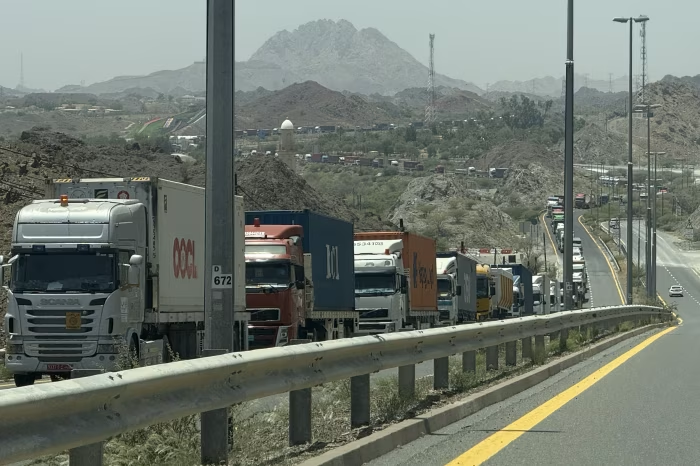
Baghdad's response has been to accelerate an overland pivot through Syria to the Mediterranean port of Baniyas. The mechanics are as follows: Iraqi fuel oil and crude travel by truck from southern Iraq, cross the al-Tanf/al-Waleed border into Syrian territory, and are offloaded at Baniyas a refinery and export terminal on Syria's northwest coast. Truck volumes according to reports have reached 500–700 per day on the Iraqi side of the crossing, with Baniyas reportedly expanding from an initial handling capacity of around 300 trucks per day to approximately 900 trucks per day as port infrastructure upgrades progress. SOMO has contracted for 650,000 metric tons per month of fuel oil via this route for the April–June 2026 period, with initial crude exports by truck targeted at approximately 50,000 bpd from early July 2026.
The numbers, however, expose the ceiling rather than the solution. At 900 trucks per day each carrying roughly 30–35 tonnes of crude Baniyas can process approximately 27,000–31,500 tonnes per day, or roughly 180,000–210,000 barrels per day in equivalent liquid volume. Even if every truck arrived full, every discharge operation ran without incident, and no transit delays occurred across contested Syrian territory, that theoretical maximum covers roughly 5–6% of Iraq's normal Hormuz-exposed export base. The Kirkuk–Baniyas pipeline a war-damaged infrastructure asset that Iraq and Syria are working to restore has a historical design capacity of up to 300,000 bpd. Even fully restored, a process that would take years and cost billions, the pipeline and truck corridor combined would protect fewer than 15% of Iraq's export volumes. The remaining 85–88% remains structurally exposed to any Hormuz closure.
The margin anatomy of any prolonged disruption is severe on the sovereign side and complicated on the commercial side. Iraq's federal budget derives more than 90% of its revenues from crude oil sales a degree of fiscal dependence that S&P Global has warned could translate into a 15% real GDP contraction under sustained export disruption, with the budget deficit widening well beyond the baseline 7.5% of GDP projection. For every 100,000 bpd of sustained Basrah export shortfall, Iraq's sovereign revenue loss runs approximately $1–2 billion per month at current prices. At 3.4 million bpd offline, the arithmetic becomes an existential fiscal emergency: delayed public-sector salaries, acute pressure on Iraqi dinar (IQD) stability, and the kind of forced austerity that historically triggers civil unrest in a country with a large state payroll. This is the counterparty risk that any buyer or financier of Iraqi crude must now model explicitly.
On the buy side, the immediate impact falls on Asian refiners particularly in China, India, South Korea, and Japan who together absorb the majority of Basrah Light and Basrah Heavy crude under term contracts. A Chinese teapot refinery (an independent, smaller-scale refining operation outside the state system) holding a 12 month SOMO term contract for, say, 3 million barrels per month of Basrah Heavy has no simple substitute of equivalent grade and price point. Iraqi Basrah Heavy a high-sulphur, heavy crude requires refineries configured with hydrocracking and coking units (processing equipment designed to handle dense, sulphur-rich feedstock). Switching to alternative supply means either paying a premium for scarcer comparable grades such as Kuwaiti Export Crude or Kuwait Blend, or running incompatible feedstock through units not optimised for it, reducing yield and increasing operating cost. On the sell side, SOMO faces the inverse problem: Baniyas routed barrels arriving in the Mediterranean command a discount. Kirkuk-blend crude at Baniyas, priced at an estimated $4–6 per barrel below Dated Brent (the North Sea benchmark price used as the global crude pricing reference), reflects delivery uncertainty, war-risk freight premiums, and the absence of creditworthy off-take commitments from major end-buyers none of which has yet been publicly confirmed for this route.
Freight is where another layer of margin concentration occurs. VLCC operators on the Basrah–Asia route vessels that might earn $14–16 per metric tonne in freight under normal market conditions face time charter equivalent (TCE) compression (TCE: the daily earnings of a vessel after voyage costs, the standard measure of vessel profitability) of $5,000–15,000 per day depending on the scale of volume reduction from southern Iraqi terminals. A VLCC that might earn $28 million on a Basrah–Qingdao round voyage at full market rates earns proportionally less as cargo availability at Basrah drops. For large integrated traders a Trafigura, a Vitol, or a national oil company trading arm with access to freight derivatives and swap markets the tool is an FFA (Forward Freight Agreement: a financial contract that locks in a future freight rate), allowing them to hedge freight exposure on both the upside and downside of this disruption. For a smaller regional operator a mid-sized Mediterranean independent buying Baniyas barrels on spot there is no FFA market for that obscure route, and the practical equivalent is fixing a freight rate bilaterally with a vessel operator willing to load at Baniyas, accepting the war-risk insurance premium (currently estimated at an additional $0.50–1.50 per barrel for eastern Mediterranean cargoes in the current environment) as a sunk cost in the deal structure.
The Syrian transit dependency is the risk beneath the risk. The al-Tanf/al-Waleed corridor crosses territory where armed non-state actors retain operational presence. A single interdiction event a roadblock, a pipeline sabotage, or a breakdown in Syrian government cooperation could shut the corridor faster than it was opened. Unlike the Strait of Hormuz, which has established international legal frameworks for freedom of navigation, an overland route through Syria has no comparable protection mechanism. There is also no publicly confirmed indication that major European or Asian refinery buyers are committing to long-term off-take agreements for Baniyas-routed Iraqi crude, which means the commercial liquidity of this route depends on opportunistic spot buying exactly the buyer category that extracts the largest discounts and withdraws first when conditions deteriorate. Mediterranean refiners in Italy and Spain with medium sour crude processing capacity (the technical configuration needed for Kirkuk-blend crude) represent the most credible near-term buyer base, but only if war-risk premiums are priced into the cargo discount rather than absorbed by the refiner.
For observers tracking this situation, the signal to watch is not Iraq's political announcements about pipeline revival timelines those are measured in years but the Baniyas truck throughput figure reported weekly by Syrian port authorities, cross-referenced against the Argus Basrah Sour differential (the published price marker for Basrah crude relative to Dated Brent) and Baltic Dirty Tanker Index Route TD3C (the benchmark freight rate for VLCC cargoes from the Middle East Gulf to China). If TD3C rates fall sharply while Basrah differentials widen simultaneously meaning buyers are being paid more to take Iraqi crude while vessel operators earn less that combination signals a buyers' market for Iraqi oil only available to those willing to absorb the geopolitical premium elsewhere in the cost stack. Watch for any confirmed off-take contract from a named European refiner for Baniyas crude: that would be the first genuine signal that the Mediterranean route has moved from political project to commercial reality.


.jpg)
.jpg)
'%3e%3cg id='Final-Copy-2_2_' transform='translate(1275.000000, 200.000000)'%3e%3cpath class='st0' d='M7.4,12.8h6.8l3.1-11.6H7.4C4.2,1.2,1.6,3.8,1.6,7S4.2,12.8,7.4,12.8z'/%3e%3c/g%3e%3c/g%3e%3c/g%3e%3cg id='final---dec.11-2020'%3e%3cg id='_x30_208-our-toggle' transform='translate(-1275.000000, -200.000000)'%3e%3cg id='Final-Copy-2' transform='translate(1275.000000, 200.000000)'%3e%3cpath class='st1' d='M22.6,0H7.4c-3.9,0-7,3.1-7,7s3.1,7,7,7h15.2c3.9,0,7-3.1,7-7S26.4,0,22.6,0z M1.6,7c0-3.2,2.6-5.8,5.8-5.8 h9.9l-3.1,11.6H7.4C4.2,12.8,1.6,10.2,1.6,7z'/%3e%3cpath id='x' class='st2' d='M24.6,4c0.2,0.2,0.2,0.6,0,0.8l0,0L22.5,7l2.2,2.2c0.2,0.2,0.2,0.6,0,0.8c-0.2,0.2-0.6,0.2-0.8,0 l0,0l-2.2-2.2L19.5,10c-0.2,0.2-0.6,0.2-0.8,0c-0.2-0.2-0.2-0.6,0-0.8l0,0L20.8,7l-2.2-2.2c-0.2-0.2-0.2-0.6,0-0.8 c0.2-0.2,0.6-0.2,0.8,0l0,0l2.2,2.2L23.8,4C24,3.8,24.4,3.8,24.6,4z'/%3e%3cpath id='y' class='st3' d='M12.7,4.1c0.2,0.2,0.3,0.6,0.1,0.8l0,0L8.6,9.8C8.5,9.9,8.4,10,8.3,10c-0.2,0.1-0.5,0.1-0.7-0.1l0,0 L5.4,7.7c-0.2-0.2-0.2-0.6,0-0.8c0.2-0.2,0.6-0.2,0.8,0l0,0L8,8.6l3.8-4.5C12,3.9,12.4,3.9,12.7,4.1z'/%3e%3c/g%3e%3c/g%3e%3c/g%3e%3c/g%3e%3c/svg%3e) Privacy Choices
Privacy Choices