.avif)
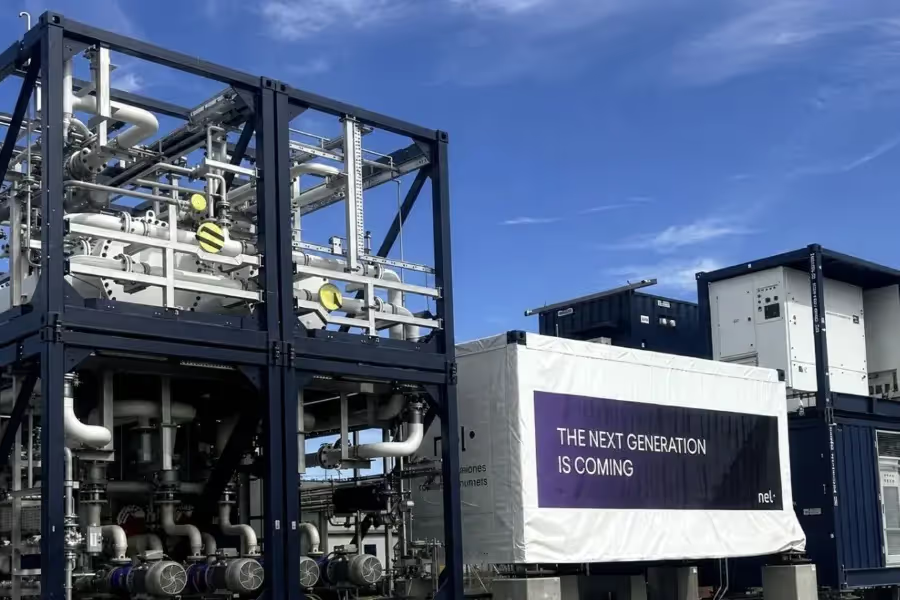
Green hydrogen project developers targeting large-scale deployment face immediate cost relief as Nel ASA's next-generation pressurized alkaline electrolyser system promises to cut turnkey hydrogen production costs by 40-60% delivering complete 25 megawatt installations for under $1,450 per kilowatt. This represents a substantial reduction from current industrial hydrogen projects that typically reach total system costs approaching or exceeding $3,000 per kilowatt. The commercial launch, announced May 6, arrives as electrolyser manufacturers outside China face sharp reductions in revenue and increased financial losses, making Nel's cost breakthrough particularly significant for project economics that have stalled hydrogen deployment.
An electrolyser the technology that splits water into hydrogen and oxygen using electricity is the foundational equipment for green hydrogen production. Nel's system delivers hydrogen at 30 bar pressure with 99.99% purity, which matters because high-pressure delivery eliminates the need for downstream compression equipment that typically adds $100-200 per kilowatt to project costs. The modular, factory built design reduces complexity and improves efficiency, with these features expected to reduce system CAPEX by 40-60% compared to solutions available today. Consider the arithmetic: a 25 megawatt green hydrogen facility using Nel's system would cost approximately $36 million for electrolyser equipment alone, compared to $50-75 million for competing technologies a savings that often determines project viability.
On the buy side, green hydrogen project developers gain access to standardized, bankable technology that simplifies financing and accelerates deployment timelines. Large integrated developers like renewable energy majors and national oil companies with captive power can leverage Nel's modular approach to scale projects systematically Nel is industrializing at Herøya with production capacity of up to 1 GW per year, with a roadmap to scale to 4 GW annually. For smaller regional developers without access to long-term power purchase agreements, the 40-60% cost reduction creates margin for higher electricity costs while maintaining competitive hydrogen pricing. On the sell side, existing electrolyser suppliers face margin compression as Nel's cost structure forces industry repricing. Chinese manufacturers, who have dominated through low-cost equipment, now confront Western technology that approaches their price points while delivering higher operational reliability.
The platform's industrialization is supported by a grant of up to €135 million from the EU Innovation Fund, covering up to 60% of eligible costs, which accelerates time to market and provides cost validation for potential buyers. However, Nel's cost reduction claims focus on turnkey project delivery, not just equipment pricing and Nel doesn't control site preparation, grid connection, or permitting costs that often comprise 50% or more of total project expenditure. Chinese competitors control 65% of global installed electrolyser capacity and 60% of manufacturing capacity, with Chinese alkaline electrolyser costs estimated at approximately $1.0 million per megawatt, roughly 50-60% lower than Western counterparts. The reality: Nel's pricing advantage exists primarily against Western competitors, not against Chinese systems that remain significantly cheaper on equipment alone.
Nel CEO Håkon Volldal notes that the first quarter was quiet on order intake, but momentum continues for the PEM division with high expectations for orders in the first half, while discussions around energy security and decentralized applications including defense-related uses are emerging as new market drivers. For observers monitoring hydrogen market development, watch Nel's order book through Q2 2026 for validation that the 40-60% cost reduction translates to actual project commitments. The company's ability to secure multi hundred megawatt orders by year end will signal whether this pricing breakthrough can overcome the broader challenges facing green hydrogen economics outside subsidized markets.
'%3e%3cg id='Final-Copy-2_2_' transform='translate(1275.000000, 200.000000)'%3e%3cpath class='st0' d='M7.4,12.8h6.8l3.1-11.6H7.4C4.2,1.2,1.6,3.8,1.6,7S4.2,12.8,7.4,12.8z'/%3e%3c/g%3e%3c/g%3e%3c/g%3e%3cg id='final---dec.11-2020'%3e%3cg id='_x30_208-our-toggle' transform='translate(-1275.000000, -200.000000)'%3e%3cg id='Final-Copy-2' transform='translate(1275.000000, 200.000000)'%3e%3cpath class='st1' d='M22.6,0H7.4c-3.9,0-7,3.1-7,7s3.1,7,7,7h15.2c3.9,0,7-3.1,7-7S26.4,0,22.6,0z M1.6,7c0-3.2,2.6-5.8,5.8-5.8 h9.9l-3.1,11.6H7.4C4.2,12.8,1.6,10.2,1.6,7z'/%3e%3cpath id='x' class='st2' d='M24.6,4c0.2,0.2,0.2,0.6,0,0.8l0,0L22.5,7l2.2,2.2c0.2,0.2,0.2,0.6,0,0.8c-0.2,0.2-0.6,0.2-0.8,0 l0,0l-2.2-2.2L19.5,10c-0.2,0.2-0.6,0.2-0.8,0c-0.2-0.2-0.2-0.6,0-0.8l0,0L20.8,7l-2.2-2.2c-0.2-0.2-0.2-0.6,0-0.8 c0.2-0.2,0.6-0.2,0.8,0l0,0l2.2,2.2L23.8,4C24,3.8,24.4,3.8,24.6,4z'/%3e%3cpath id='y' class='st3' d='M12.7,4.1c0.2,0.2,0.3,0.6,0.1,0.8l0,0L8.6,9.8C8.5,9.9,8.4,10,8.3,10c-0.2,0.1-0.5,0.1-0.7-0.1l0,0 L5.4,7.7c-0.2-0.2-0.2-0.6,0-0.8c0.2-0.2,0.6-0.2,0.8,0l0,0L8,8.6l3.8-4.5C12,3.9,12.4,3.9,12.7,4.1z'/%3e%3c/g%3e%3c/g%3e%3c/g%3e%3c/g%3e%3c/svg%3e) Privacy Choices
Privacy Choices