.avif)
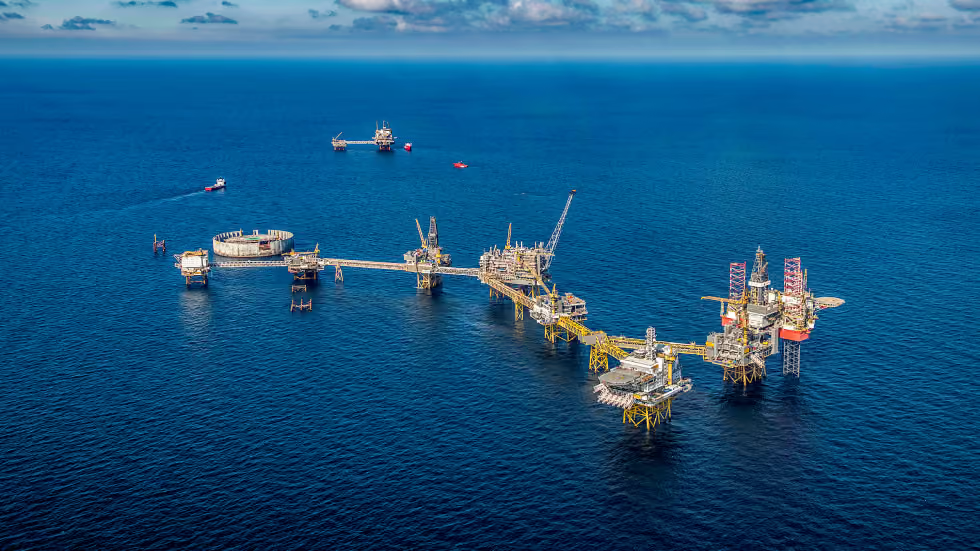
Norwegian oil and gas companies are confronting the infrastructure ceiling of global offshore development at NOK 266 billion in projected 2026 investment an 11 billion kroner increase from the previous quarter's estimate. The revision, driven primarily by a NOK 20 billion redevelopment project spearheaded by ConocoPhillips to restart production across three previously closed fields in the Greater Ekofisk Area, signals a fundamental constraint: significant activity and scarce capacity in parts of the supplier industry is forcing every project to compete for the same finite pool of subsea engineering talent, heavy-lift vessels, and fabrication yards. Despite the upward revision, the 2026 estimate shows a decline of 1.1 percent from 2025, confirming that Norway has reached peak investment capacity rather than peak opportunity.
Field development the construction of subsea infrastructure, pipelines, and processing facilities accounts for the dominant share of cost inflation. Since the autumn of 2024, the total costs of the ongoing projects have increased by about $6 billion (60 billion crowns), or by 17%, according to Statistics Norway. This inflation is not currency driven or commodity driven it reflects the finite supply of specialized marine contractors capable of installing subsea Christmas trees (the valve assemblies controlling individual wells) at 300-meter depths in the North Sea. Consider a mid-sized field development requiring 15 subsea wells: the specialized vessels needed for installation dynamically positioned heavy-lift ships with 2,000 tonne crane capacity now command day rates exceeding $500,000, up from $350,000 eighteen months ago. That additional $150,000 per day compounds across 60 day installation campaigns, adding $9 million per project before accounting for engineering delays.
On the buy side, Norwegian independents and smaller consortium partners face margin compression at every project stage. Vaar Energi, targeting 400 kboepd production maintenance through 2026, must now budget 20-30% higher development costs for the same subsea infrastructure. For a typical 50,000 boe/day development requiring NOK 15 billion capital expenditure, the recent cost inflation adds NOK 3 billion equivalent to reducing project returns by 200 basis points at $85 Brent. Smaller operators without existing fabrication contracts are discovering that lead times for critical subsea equipment have extended from 24 months to 36 months, forcing either project delays or premium pricing for expedited delivery. On the sell side, subsea technology specialists notably Aker Solutions, Subsea 7, and OneSubsea are capturing extraordinary margins from capacity constraints. Day rates for specialized installation vessels have risen 40% since early 2025, while subsea equipment manufacturers are reporting order backlogs extending through 2028.
For large integrated Norwegian majors Equinor, Aker BP, and international operators with established supplier relationships the constraint represents manageable cost inflation rather than project cancellation risk. These operators maintain long-term framework agreements with fabrication contractors and can absorb 15-20% cost increases across multi-billion NOK portfolios without fundamental project economics changing. Equinor's current development portfolio, anchored by projects approved under the 2020 tax incentive package, benefits from locked-in fabrication contracts negotiated before the capacity crunch intensified. For smaller regional operators mid-sized E&P companies and private equity-backed developers without framework agreements the fabrication constraint has become project-killing. A regional operator planning a NOK 8 billion field development now faces NOK 10-12 billion costs, pushing break-even prices from $65 Brent to $80+ Brent. Many are deferring final investment decisions until 2027, hoping capacity additions will moderate costs.
For observers tracking global offshore development capacity, monitor fabrication contract awards through Rystad Energy's offshore project database by Q3 2026. If Norwegian field developments begin securing fabrication slots extending beyond 2029, it confirms structural under-investment in global subsea capacity. The constraint is not limited to Norway Brazilian pre-salt, Guyana deepwater, and North Sea UK projects compete for identical specialized resources. Watch Aker Solutions' order intake figures quarterly: sustained backlog growth above NOK 45 billion indicates the capacity ceiling persists, while declining backlogs signal capacity additions are relieving the bottleneck. In practical terms, Norway can stabilize supply-but it can no longer respond when the market tightens, making infrastructure capacity the binding constraint on North Sea oil supply growth.
'%3e%3cg id='Final-Copy-2_2_' transform='translate(1275.000000, 200.000000)'%3e%3cpath class='st0' d='M7.4,12.8h6.8l3.1-11.6H7.4C4.2,1.2,1.6,3.8,1.6,7S4.2,12.8,7.4,12.8z'/%3e%3c/g%3e%3c/g%3e%3c/g%3e%3cg id='final---dec.11-2020'%3e%3cg id='_x30_208-our-toggle' transform='translate(-1275.000000, -200.000000)'%3e%3cg id='Final-Copy-2' transform='translate(1275.000000, 200.000000)'%3e%3cpath class='st1' d='M22.6,0H7.4c-3.9,0-7,3.1-7,7s3.1,7,7,7h15.2c3.9,0,7-3.1,7-7S26.4,0,22.6,0z M1.6,7c0-3.2,2.6-5.8,5.8-5.8 h9.9l-3.1,11.6H7.4C4.2,12.8,1.6,10.2,1.6,7z'/%3e%3cpath id='x' class='st2' d='M24.6,4c0.2,0.2,0.2,0.6,0,0.8l0,0L22.5,7l2.2,2.2c0.2,0.2,0.2,0.6,0,0.8c-0.2,0.2-0.6,0.2-0.8,0 l0,0l-2.2-2.2L19.5,10c-0.2,0.2-0.6,0.2-0.8,0c-0.2-0.2-0.2-0.6,0-0.8l0,0L20.8,7l-2.2-2.2c-0.2-0.2-0.2-0.6,0-0.8 c0.2-0.2,0.6-0.2,0.8,0l0,0l2.2,2.2L23.8,4C24,3.8,24.4,3.8,24.6,4z'/%3e%3cpath id='y' class='st3' d='M12.7,4.1c0.2,0.2,0.3,0.6,0.1,0.8l0,0L8.6,9.8C8.5,9.9,8.4,10,8.3,10c-0.2,0.1-0.5,0.1-0.7-0.1l0,0 L5.4,7.7c-0.2-0.2-0.2-0.6,0-0.8c0.2-0.2,0.6-0.2,0.8,0l0,0L8,8.6l3.8-4.5C12,3.9,12.4,3.9,12.7,4.1z'/%3e%3c/g%3e%3c/g%3e%3c/g%3e%3c/g%3e%3c/svg%3e) Privacy Choices
Privacy Choices