.avif)

Tanker owners and operators on Middle East Gulf routes are facing a freight and insurance environment that may remain structurally elevated for months with war-risk premiums on Persian Gulf voyages running an estimated $3–8 per barrel above pre-conflict baselines and no credible government timeline for de-escalation.
The Pentagon, according to reports first published by The Wall Street Journal and subsequently briefed to lawmakers by Deputy Defense Secretary Stephen Feinberg, is seeking approximately $80 billion in supplemental wartime funding to cover costs from the US-Iran conflict and a range of other military operations. The figure if confirmed would dwarf the Pentagon's own earlier estimate of $25 billion spent on the Iran war specifically. The gap between those numbers matters for tanker operators not because military accounting is their business, but because the size and duration of the supplemental request is the clearest available signal of how long intensive US naval presence in the Persian Gulf and surrounding waters is expected to continue. Supplemental categories explicitly include ship operations and munitions replenishment, indicating sustained, not winding-down, naval engagement. What Washington spends on keeping warships at sea in the Gulf is, in practice, the underwriting mechanism for a threat environment that vessel owners and their insurers are pricing every day.
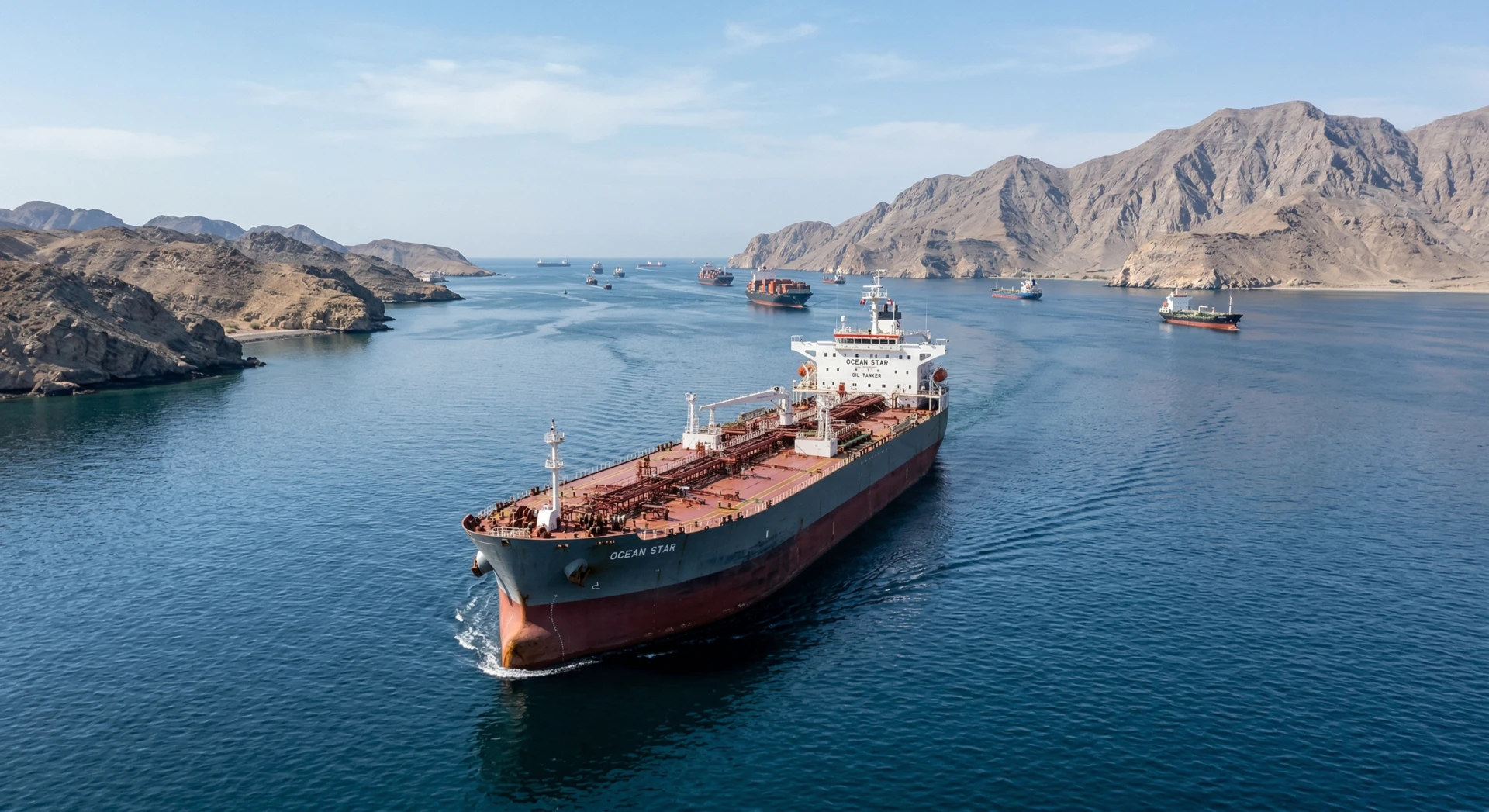
The physical geography here is not abstract. Crude oil, LPG, and refined products loaded at Ras Tanura, Kharg Island, and Jebel Ali transit the Strait of Hormuz a navigable channel roughly 33 kilometres wide at its narrowest point, through which approximately 20 percent of all globally traded oil moves daily. A VLCC (Very Large Crude Carrier a supertanker capable of carrying around 2 million barrels, or roughly 270,000 metric tonnes of crude) that would ordinarily transit Hormuz, cross the Arabian Sea, and arrive at a South Korean or Japanese refinery in 18–20 days is now operating inside a corridor where insurance underwriters and vessel owners have repriced risk continuously since hostilities began. The war-risk insurance surcharge a daily or per-voyage additional premium layered on top of standard P&I and hull coverage has become the defining variable in whether a voyage clears a profitable margin or does not.
To make the margin anatomy concrete: consider a VLCC operator running a standard MEG-Japan (Middle East Gulf to Japan) voyage on a spot fixture. Pre-conflict, a representative all-in voyage cost bunkers, port dues, canal fees, crew, standard insurance might total approximately $4–5 million for a round voyage, with freight earnings at Worldscale 55–60 generating gross revenue of roughly $8–10 million. The war-risk surcharge, currently estimated in the range of $1–2 million per voyage depending on underwriter and route specifics, compresses net margin by 15–25 percent relative to that baseline. That is the same as losing $1–2 per barrel on a 2 million barrel cargo a number that sounds small until you consider that tanker spot market margins are themselves measured in single-digit dollars per metric tonne. The surcharge is not a rounding error. On many voyages right now, it is most of the margin.
The opacity of the fiscal debate in Washington compounds operational risk in ways that are specific and measurable. The $80 billion supplemental figure, according to reporting, conflates Iran war naval and air costs with National Guard border deployments, the Venezuela operation, and drug interdiction missions in the Caribbean and eastern Pacific. The actual Iran-specific burn rate the per day cost of maintaining carrier strike groups, mine countermeasure vessels, and escort operations in and around the Gulf has not been publicly confirmed. White House budget director Russell Vought told Congress he had "no estimate for the cost of the war." Without a credible Iran-specific operational cost rate, tanker owners and their insurers cannot triangulate how long the current threat posture will be sustained. Insurance pricing in war zones is partly actuarial and partly a function of perceived duration: a temporary flare-up is priced differently from an open ended deployment. The absence of a credible Pentagon timeline pushes underwriters toward the conservative end of their range which means higher premiums stay higher for longer.
The route shift economics are already visible in the fixture data. Cargoes that can bear additional transit time certain crude grades, some refined products are being rerouted via the Cape of Good Hope, adding 10–14 days to the voyage and approximately $1.5–3 million in incremental freight cost per voyage, depending on vessel class and bunker price. For a Suezmax (a vessel class of roughly 130,000–150,000 deadweight tonnes, sized for Suez Canal transit) carrying 750,000 barrels on a West Africa–India or Middle East–Europe route, the Cape diversion adds roughly $2–4 per barrel in freight cost alone. On the sell side, Gulf crude exporters Saudi Aramco, ADNOC, Kuwait Petroleum cannot force buyers to absorb that cost without widening their official selling price discounts, which they have begun to do selectively. On the buy side, Asian refiners particularly independent Chinese teapot refineries and South Korean majors are recalculating crack spread viability. A crack spread is the margin between the price of crude and the refined products derived from it; when freight and insurance add $3–8 per barrel to the landed cost of crude, that spread compresses by an equivalent amount unless product prices rise to compensate.
For large integrated trading houses Trafigura, Vitol, or a national oil company's trading arm with full derivatives access the tools for managing this environment exist, though they are costly. War-risk insurance can be placed in the specialist Lloyd's of London market on a per-voyage or time basis; freight derivatives (Forward Freight Agreements, or FFAs contracts that lock in a future freight rate so a shipowner or cargo owner can hedge against rate movements) are available on the Baltic Exchange for the key tanker routes including TD3C (the benchmark VLCC route from the Middle East Gulf to China). The Brent-Dubai spread the price differential between North Sea Brent crude and Middle East Dubai crude is also worth watching: if Hormuz-linked risk compresses demand for Dubai priced cargoes relative to Atlantic basin crude, the spread may widen, creating an arbitrage window for Atlantic basin crude into Asia that large traders are positioned to exploit.
For smaller regional operators an independent tanker owner running two or three VLCCs on period charter, or a mid-sized fuel importer in Southeast Asia without access to FFA markets the options are more constrained but not absent. Fixing period time-charters (long-term vessel hire contracts at a daily rate agreed in advance) rather than spot voyages through the Gulf gives owners revenue certainty and transfers voyage cost risk including war-risk surcharges to the charterer. Fuel importers without derivatives access should be negotiating delivered-price contracts with their suppliers rather than CFR (Cost and Freight where the seller pays freight to the destination port) terms, which embed the seller's freight cost into the price with limited transparency. Inventory build holding 20–30 days of additional stock rather than the standard 10–15 is a blunt but effective buffer against a sudden freight spike or supply disruption.
The single most time bound signal observers should track is the Baltic Dirty Tanker Index BDTI TD3C route (VLCC Middle East Gulf to China) published daily by the Baltic Exchange. If this route's Worldscale flat rate begins declining from current elevated levels back toward pre-conflict norms of Worldscale 45–55, it will indicate either that insurance surcharges are being absorbed into a lower base rate suggesting market normalisation or that voyage volumes through Hormuz are recovering. A sustained move below Worldscale 50 on TD3C within the next 30 days, combined with a narrowing of the Brent-Dubai spread to below $1.50 per barrel, would be a credible signal that the worst of the freight premium is priced in. Until both signals confirm simultaneously, tanker owners should treat current rate levels as a risk-adjusted operational floor, not a windfall because the fiscal fog in Washington means the threat environment that created them has no confirmed expiry date.

.jpg)
.jpg)

'%3e%3cg id='Final-Copy-2_2_' transform='translate(1275.000000, 200.000000)'%3e%3cpath class='st0' d='M7.4,12.8h6.8l3.1-11.6H7.4C4.2,1.2,1.6,3.8,1.6,7S4.2,12.8,7.4,12.8z'/%3e%3c/g%3e%3c/g%3e%3c/g%3e%3cg id='final---dec.11-2020'%3e%3cg id='_x30_208-our-toggle' transform='translate(-1275.000000, -200.000000)'%3e%3cg id='Final-Copy-2' transform='translate(1275.000000, 200.000000)'%3e%3cpath class='st1' d='M22.6,0H7.4c-3.9,0-7,3.1-7,7s3.1,7,7,7h15.2c3.9,0,7-3.1,7-7S26.4,0,22.6,0z M1.6,7c0-3.2,2.6-5.8,5.8-5.8 h9.9l-3.1,11.6H7.4C4.2,12.8,1.6,10.2,1.6,7z'/%3e%3cpath id='x' class='st2' d='M24.6,4c0.2,0.2,0.2,0.6,0,0.8l0,0L22.5,7l2.2,2.2c0.2,0.2,0.2,0.6,0,0.8c-0.2,0.2-0.6,0.2-0.8,0 l0,0l-2.2-2.2L19.5,10c-0.2,0.2-0.6,0.2-0.8,0c-0.2-0.2-0.2-0.6,0-0.8l0,0L20.8,7l-2.2-2.2c-0.2-0.2-0.2-0.6,0-0.8 c0.2-0.2,0.6-0.2,0.8,0l0,0l2.2,2.2L23.8,4C24,3.8,24.4,3.8,24.6,4z'/%3e%3cpath id='y' class='st3' d='M12.7,4.1c0.2,0.2,0.3,0.6,0.1,0.8l0,0L8.6,9.8C8.5,9.9,8.4,10,8.3,10c-0.2,0.1-0.5,0.1-0.7-0.1l0,0 L5.4,7.7c-0.2-0.2-0.2-0.6,0-0.8c0.2-0.2,0.6-0.2,0.8,0l0,0L8,8.6l3.8-4.5C12,3.9,12.4,3.9,12.7,4.1z'/%3e%3c/g%3e%3c/g%3e%3c/g%3e%3c/g%3e%3c/svg%3e) Privacy Choices
Privacy Choices