.avif)
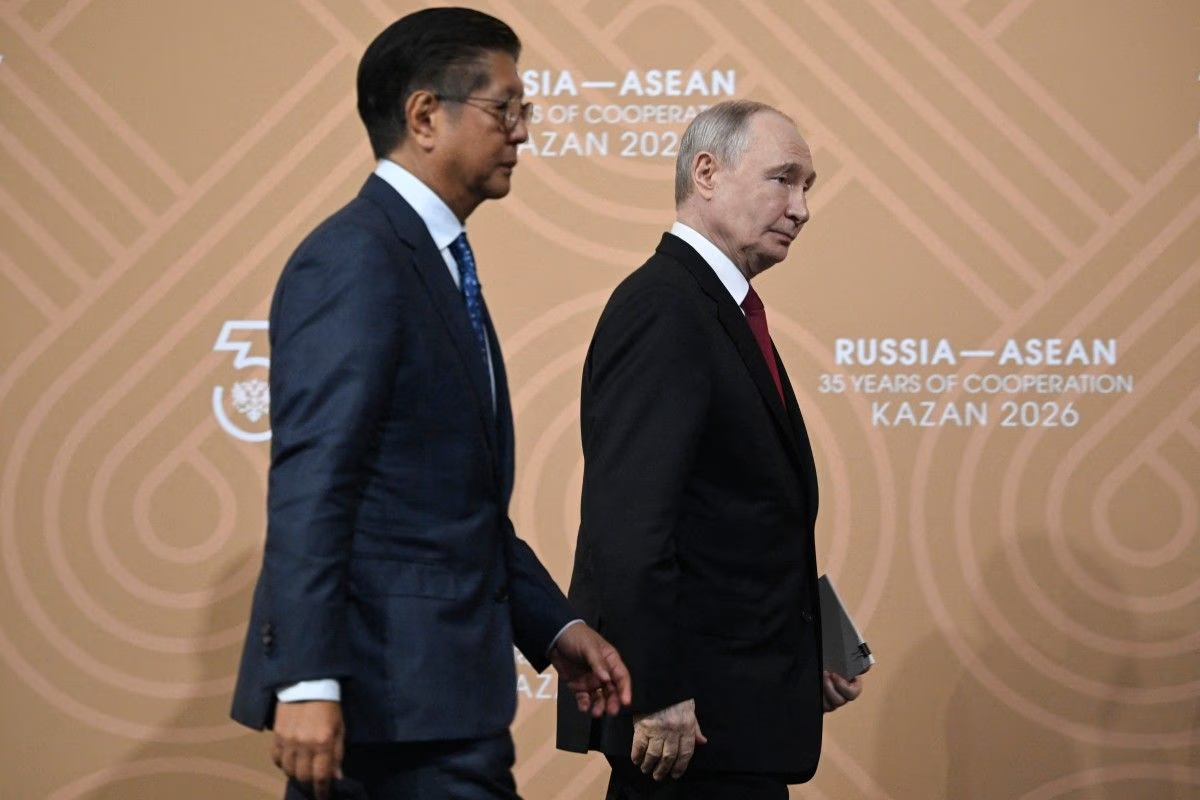
Philippine petroleum importers are paying elevated spot premiums for Hormuz routed product right now and a deal that might reduce that exposure is still months, possibly years, away from being operational.
President Ferdinand Marcos Jr. confirmed during a two day working visit to Kazan, Russia held in connection with the ASEAN-Russia Commemorative Summit that the Philippines has not finalised any structured petroleum supply agreement with Moscow. What exists instead is ad hoc purchasing: individual cargo deals with no contractual framework, no agreed volumes, and no settled payment mechanism. Marcos described Manila as "building a system" in response to the disruption of the Strait of Hormuz the 33 kilometre wide chokepoint between Oman and Iran through which roughly 20% of world traded oil and liquefied natural gas (LNG) passes daily following its closure in February 2026. Russia has signalled openness to expanded engagement, according to reports from the Kazan visit. But openness is not a contract, and a contract would still not be a workable trade.
The headline political question whether Philippine petroleum purchases fund Russia's war in Ukraine is the one Marcos addressed directly and the one that matters least commercially. He characterised the Philippines' total trade with Russia at approximately $5 billion as too small to represent meaningful war financing. That framing may be accurate geopolitically. It is also a deflection. The practical barriers to any structured Russian petroleum supply arrangement are not reputational. They are mechanical, and they are severe. Russian petroleum exporters face exclusion from SWIFT the global interbank messaging network that clears most international dollar payments and their cargoes are effectively uninsurable through the P&I clubs (Protection and Indemnity clubs mutual marine insurers operating under Western jurisdiction) that underwrite most seaborne cargo risk. Neither problem resolves because two governments express goodwill.
Consider what a structured Philippine import of Russian petroleum products would actually require. A mid-sized Philippine fuel importer bringing in a single 50,000 tonne cargo of diesel from a Russian Baltic port faces the following: the cargo cannot be settled in US dollars through a sanctioned Russian bank. The vessel carrying it cannot be insured through any major P&I club. If the importer uses a workaround routing payment through a third country intermediary in yuan or rupees, and sourcing tonnage from the so-called shadow fleet (older, sometimes poorly maintained tankers operating outside Western insurance and registry systems) the all-in landed cost rises materially. Freight on a shadow-fleet Aframax (a tanker class carrying 80,000–120,000 tonnes, the most common size for Russian refined product exports to Asia) runs $15–22/MT above standard market rates. Add re-insurance workarounds and intermediary margins, and the Russian product discount currently estimated at $10–18 per barrel on Urals and ESPO crude versus Brent-linked spot narrows to somewhere between $3 and $8/bbl. That is still an arbitrage. It is not, however, the transformative price relief Marcos's framing implies.
The margin anatomy here has three distinct layers. On the upstream side, Russian petroleum traders and their Asian intermediaries operating through Singapore, Dubai, or Hong Kong are capturing the bulk of the discount spread. They buy Russian product at Urals-linked prices, absorb the freight and insurance premium of shadow-fleet routing, and sell to end buyers in Asia at a discount to Brent-indexed spot. The margin to the intermediary on current numbers is approximately $5–10/bbl. On the buy side, Philippine downstream importers state-owned Philippine National Oil Company (PNOC) subsidiaries and private fuel distributors are currently paying Hormuz-disruption premiums on Middle East origin product and receiving no corresponding structural relief. The absence of a framework agreement means they cannot lock in forward supply at a negotiated discount; they remain exposed to the spot market on every cargo. On the sell side, Russian exporters benefit from any additional buyer entering the market, even informally, because it sustains demand for product that Europe no longer purchases.
The freight dimension deserves specific treatment because it is where the largest variable sits. A shift from Middle East-origin petroleum products currently routed through the Gulf of Oman and the South China Sea to Philippine ports at Batangas or Manila to Russian Far East or Baltic-origin cargoes changes the voyage geometry entirely. Russian Far East product (Sokol crude or ESPO blend) loaded at Kozmino port on the Pacific coast is actually the shortest route to the Philippines: approximately 3,500 nautical miles, compared to roughly 5,000 from the Arabian Gulf under normal Hormuz routing. Baltic origin product, by contrast, requires a Cape of Good Hope transit adding 12–15 days and $18–28/MT in freight versus the pre-Hormuz closure Middle East baseline. A large integrated trader a Vitol, Trafigura, or the trading arm of a national oil company can hedge freight exposure on the Baltic Dirty Tanker Index (BDTI) through Forward Freight Agreements (FFAs), financial instruments that lock in a freight rate for future voyages without requiring physical vessel control. A smaller regional fuel importer in the Philippines has no such tool available. Their practical equivalent is fixing a longer-term bilateral freight contract directly with a vessel operator a step that requires a structured cargo commitment they do not yet have.
For large integrated operators with derivatives access, the current situation presents a specific tactical opportunity. The Urals to Brent discount, tracked by Argus Media's Urals assessment, has been sustained above $12/bbl for the past two months. If a trader can establish non-sanctioned payment routing typically through an Asian intermediary bank operating under third-country jurisdiction and secure shadow-fleet tonnage with acceptable re-insurance coverage, the landed cost arbitrage on Philippine delivered refined product is real. The instrument is a physical offtake agreement with a Russian trader, hedged on the ICE Brent complex for price exposure and on BDTI for freight. Total hedge cost runs approximately $2–3/bbl, leaving a net arbitrage of $7–10/bbl at current spreads.
For smaller Philippine petroleum importers regional fuel distributors, island supply operators, provincial energy cooperatives the absence of a structured government to government framework is not merely inconvenient. It is prohibitive. These operators cannot self-navigate sanctions compliance, cannot source shadow-fleet tonnage independently, and cannot absorb the payment-routing complexity that a Russian cargo requires. Their practical options remain limited to: negotiating longer payment terms with existing Middle East suppliers to reduce cash-flow pressure from elevated spot prices; pooling volume through PNOC's procurement arm to access better spot pricing; or monitoring whether any ASEAN level intermediary mechanism a regional purchasing arrangement of the kind discussed but not agreed at the Kazan summit materialises. None of these options provides the supply-chain diversification Marcos is describing. They manage symptoms.
The specific signal to watch is the Argus Urals FOB Primorsk assessment published weekly against the ICE Brent prompt contract. If the Urals discount widens beyond $15/bbl and holds for more than three consecutive assessment weeks, it means Russian exporters are under increasing pressure to find new buyers, and the terms available to a structured Philippine importer improve materially. The second signal is whether PNOC announces a formal tender for Russian origin petroleum products any such tender would confirm that Manila has resolved, at minimum, the payment and insurance mechanism questions in practice, even if not in policy. Both signals have a meaningful reading window of 60–90 days. If neither appears by September 2026, the Kazan talks should be understood for what the evidence currently supports: diplomatic positioning, not supply chain transformation.
'%3e%3cg id='Final-Copy-2_2_' transform='translate(1275.000000, 200.000000)'%3e%3cpath class='st0' d='M7.4,12.8h6.8l3.1-11.6H7.4C4.2,1.2,1.6,3.8,1.6,7S4.2,12.8,7.4,12.8z'/%3e%3c/g%3e%3c/g%3e%3c/g%3e%3cg id='final---dec.11-2020'%3e%3cg id='_x30_208-our-toggle' transform='translate(-1275.000000, -200.000000)'%3e%3cg id='Final-Copy-2' transform='translate(1275.000000, 200.000000)'%3e%3cpath class='st1' d='M22.6,0H7.4c-3.9,0-7,3.1-7,7s3.1,7,7,7h15.2c3.9,0,7-3.1,7-7S26.4,0,22.6,0z M1.6,7c0-3.2,2.6-5.8,5.8-5.8 h9.9l-3.1,11.6H7.4C4.2,12.8,1.6,10.2,1.6,7z'/%3e%3cpath id='x' class='st2' d='M24.6,4c0.2,0.2,0.2,0.6,0,0.8l0,0L22.5,7l2.2,2.2c0.2,0.2,0.2,0.6,0,0.8c-0.2,0.2-0.6,0.2-0.8,0 l0,0l-2.2-2.2L19.5,10c-0.2,0.2-0.6,0.2-0.8,0c-0.2-0.2-0.2-0.6,0-0.8l0,0L20.8,7l-2.2-2.2c-0.2-0.2-0.2-0.6,0-0.8 c0.2-0.2,0.6-0.2,0.8,0l0,0l2.2,2.2L23.8,4C24,3.8,24.4,3.8,24.6,4z'/%3e%3cpath id='y' class='st3' d='M12.7,4.1c0.2,0.2,0.3,0.6,0.1,0.8l0,0L8.6,9.8C8.5,9.9,8.4,10,8.3,10c-0.2,0.1-0.5,0.1-0.7-0.1l0,0 L5.4,7.7c-0.2-0.2-0.2-0.6,0-0.8c0.2-0.2,0.6-0.2,0.8,0l0,0L8,8.6l3.8-4.5C12,3.9,12.4,3.9,12.7,4.1z'/%3e%3c/g%3e%3c/g%3e%3c/g%3e%3c/g%3e%3c/svg%3e) Privacy Choices
Privacy Choices