.avif)
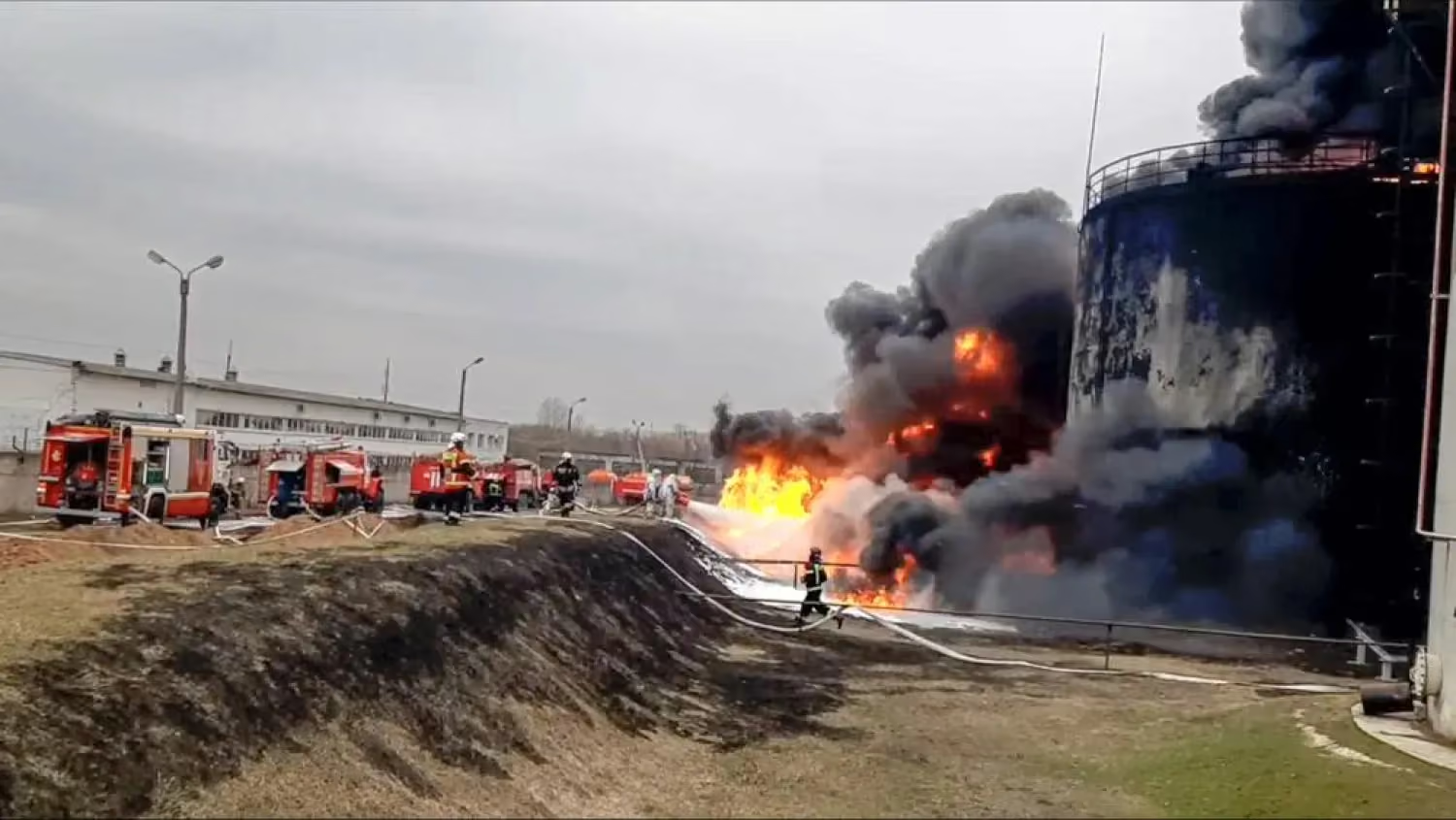
Fuel distributors serving Russia's Krasnodar Krai and the Republic of Adygea are facing a persistent throughput disruption at their primary regional storage hub for the second time in nine days with no backup facility of equivalent scale identified and no clear timeline for full restoration.
The Poltavskaya oil depot is not a refinery. That distinction matters commercially. A refinery converts crude oil into fuel products; a storage and distribution depot like Poltavskaya receives finished products diesel, gasoline, mazut (heavy fuel oil used for heating and power generation) and dispatches them to downstream distributors across two administrative regions. The facility holds approximately 15,000 cubic metres across 28 tanks, functioning as the logistics node that bridges upstream refining supply with the last-mile delivery networks serving Krasnodar Krai and Adygea. When a refinery burns, production is interrupted. When a depot of this type burns, distribution is interrupted and those are different problems with different recovery timescales. A refinery can throttle output while repairs proceed. A depot that cannot receive, store, or dispatch product simply stops the supply chain in place.
The first fire, according to reports, occurred on June 16 following a drone related incident and required the deployment of 32 personnel and seven pieces of equipment, with road access between Poltavskaya and Trudobelikovskoye temporarily closed. The second fire is reported to have occurred on June 25. Russian authorities attributed that blaze to falling UAV debris from an intercepted drone; Ukrainian and open-source accounts describe it as a direct strike. The Kyiv Independent noted it could not be independently verified, and Ukraine's military had not commented at the time of reporting. The attribution question, while relevant to the military and political narrative, is secondary to the commercial reality: whether the ignition source was a direct hit or falling debris, the facility burned twice within nine days, and the operational consequence for fuel distributors is identical either way.
The physical geography makes this a structural rather than episodic problem. Poltavskaya sits roughly 80 kilometres west of Krasnodar the regional capital and major fuel demand centre and approximately 385 kilometres from the active front line. That distance was once considered a comfortable operational buffer. It is no longer. Modern long-range drones have routinely demonstrated range well in excess of 400 kilometres in this conflict, meaning the southern Russian fuel logistics corridor including Krasnodar Krai's role as a supply route to Crimea and along the Black Sea coast is now within persistent threat range. Novorossiysk, Russia's principal Black Sea export terminal roughly 120 kilometres southeast of Poltavskaya, sits in the same threat envelope. The cumulative effect is that the entire southern supply corridor faces recurring disruption risk, not a one-off incident requiring a single emergency response.
The margin anatomy here falls on distributors, not refiners. Consider a mid-sized regional fuel distributor in Krasnodar Krai holding contracted supply commitments with a buyer at a fixed delivered price a common arrangement in Russian regional fuel markets. Under normal conditions, that distributor lifts product from Poltavskaya at a pre-agreed offtake rate, loads onto road tankers, and delivers within a predictable cost structure. With the depot partially or fully offline following two fires in nine days, that distributor faces three compounding cost pressures simultaneously: emergency spot procurement from alternative sources at a premium to contracted rates; extended haul distances if product must be sourced from secondary depots further north or east, adding fuel and time costs; and potential contractual penalties or volume shortfalls on committed deliveries. If the contracted supply price was set at, say, 55,000 roubles per tonne and emergency spot procurement in a supply constrained southern corridor adds even 3,000–5,000 roubles per tonne, a distributor moving 500 tonnes per week absorbs an unbudgeted cost of 1.5–2.5 million roubles weekly and that figure compounds with each week of disruption.
Kazakhstan's emergence as a supplementary gasoline supplier to Russia is the most commercially significant external signal in this story. Reports indicate Kazakhstan has been supplying gasoline into Russia amid energy-resource pressures attributed in part to infrastructure damage from Ukraine's strike campaign. For Kazakhstani exporters and the intermediary traders routing those volumes, the price differential between Kazakhstan domestic supply costs and the import demand price in supply-constrained southern Russia creates a short-window arbitrage that is, a temporary profit opportunity arising from the price gap between two markets. The overland route from Kazakhstan into southern Russia bypasses the Black Sea corridor entirely, moving by rail and road through the Volga region or directly across the Russia-Kazakhstan border. On the sell side, a Kazakhstani exporter able to confirm volumes and logistics at current differentials is capturing a genuine margin premium. The window is time-limited: it closes when Russian domestic supply restores, when Moscow imposes export restrictions on Kazakhstani volumes, or when competing suppliers enter the same arbitrage.
Operator scale determines the response options available. For a large integrated trading house a Litasco, a Trafigura operating in CIS markets, or a national oil company's trading arm with derivatives access the disruption is a positioning opportunity. They can use swaps on the Rotterdam diesel benchmark or CIS fuel oil markers as reference instruments while placing physical supply into the gap, earning the scarcity premium on delivered volumes. Their logistics infrastructure owned rail cars, multiple depot access agreements, pre-arranged shipping slots at Novorossiysk means they can reroute supply within days. For a smaller regional distributor without derivatives access and without alternative depot agreements already in place, the practical toolkit is narrower: renegotiate delivery schedules with buyers to create buffer time, contact secondary suppliers in Rostov on Don or Stavropol immediately before those volumes are absorbed by competing buyers facing the same constraint, and if possible fix forward offtake agreements at current prices before spot rates widen further. Waiting is the most expensive option available to a small operator in this environment.
The structural constraint that wartime reporting tends to understate is redundancy or its absence. No equivalent backup depot of comparable scale serving Krasnodar Krai and Adygea has been publicly identified. In standard supply chain risk frameworks, a single-node dependency of this kind one facility serving two regions, no documented alternative of equivalent throughput capacity is classified as a critical single point of failure. Two fires in nine days at that node is not a stress test. It is a stress test that has already failed twice. Fuel distributors operating in this region should treat supply availability from Poltavskaya as unreliable for the foreseeable planning horizon, not as a facility that will return to normal operations on a predictable schedule.
For observers tracking this situation, the most time-bound and actionable signal is Kazakhstan's gasoline export data to Russia, specifically volumes reported through the Eurasian Economic Union's monthly trade statistics, which typically become available with a four to six week lag. A sustained volume increase above the seasonal baseline established in the first quarter of 2026 confirms that the southern Russia supply gap is being partially filled through the Central Asian overland route and that the Kazakhstani export premium is real and persistent. Simultaneously, watch Novorossiysk port congestion data published through Lloyd's List Intelligence or similar vessel tracking services: any increase in inbound product tanker calls without corresponding outbound activity suggests that storage and distribution bottlenecks are widening downstream of the port, not just at Poltavskaya. If both signals move in the same direction within the next 30 days, the supply disruption has become systemic rather than localised, and distributor procurement strategies across the entire southern corridor require immediate revision.

.jpg)

'%3e%3cg id='Final-Copy-2_2_' transform='translate(1275.000000, 200.000000)'%3e%3cpath class='st0' d='M7.4,12.8h6.8l3.1-11.6H7.4C4.2,1.2,1.6,3.8,1.6,7S4.2,12.8,7.4,12.8z'/%3e%3c/g%3e%3c/g%3e%3c/g%3e%3cg id='final---dec.11-2020'%3e%3cg id='_x30_208-our-toggle' transform='translate(-1275.000000, -200.000000)'%3e%3cg id='Final-Copy-2' transform='translate(1275.000000, 200.000000)'%3e%3cpath class='st1' d='M22.6,0H7.4c-3.9,0-7,3.1-7,7s3.1,7,7,7h15.2c3.9,0,7-3.1,7-7S26.4,0,22.6,0z M1.6,7c0-3.2,2.6-5.8,5.8-5.8 h9.9l-3.1,11.6H7.4C4.2,12.8,1.6,10.2,1.6,7z'/%3e%3cpath id='x' class='st2' d='M24.6,4c0.2,0.2,0.2,0.6,0,0.8l0,0L22.5,7l2.2,2.2c0.2,0.2,0.2,0.6,0,0.8c-0.2,0.2-0.6,0.2-0.8,0 l0,0l-2.2-2.2L19.5,10c-0.2,0.2-0.6,0.2-0.8,0c-0.2-0.2-0.2-0.6,0-0.8l0,0L20.8,7l-2.2-2.2c-0.2-0.2-0.2-0.6,0-0.8 c0.2-0.2,0.6-0.2,0.8,0l0,0l2.2,2.2L23.8,4C24,3.8,24.4,3.8,24.6,4z'/%3e%3cpath id='y' class='st3' d='M12.7,4.1c0.2,0.2,0.3,0.6,0.1,0.8l0,0L8.6,9.8C8.5,9.9,8.4,10,8.3,10c-0.2,0.1-0.5,0.1-0.7-0.1l0,0 L5.4,7.7c-0.2-0.2-0.2-0.6,0-0.8c0.2-0.2,0.6-0.2,0.8,0l0,0L8,8.6l3.8-4.5C12,3.9,12.4,3.9,12.7,4.1z'/%3e%3c/g%3e%3c/g%3e%3c/g%3e%3c/g%3e%3c/svg%3e) Privacy Choices
Privacy Choices