.avif)
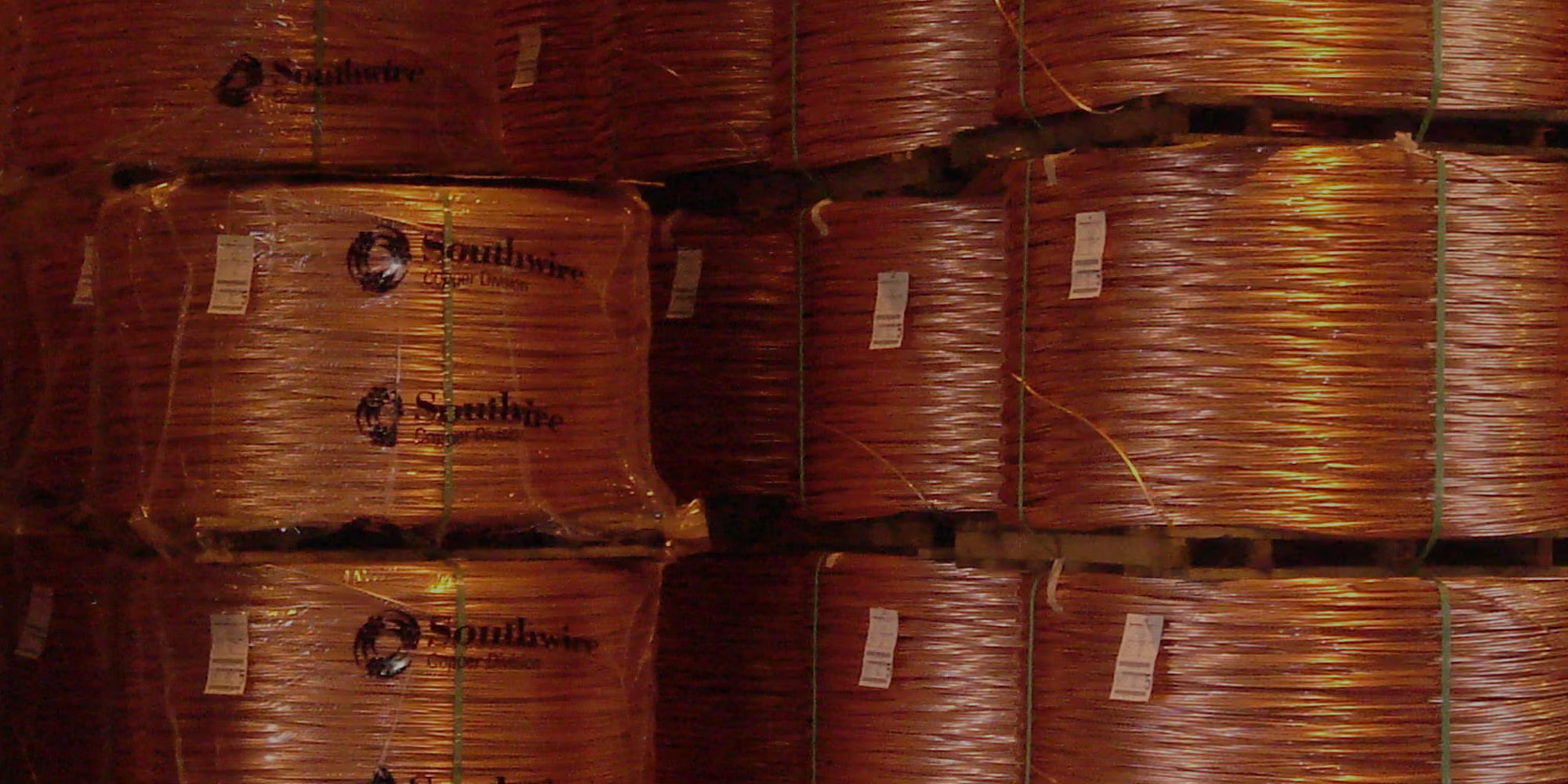
Copper concentrate buyers at wire rod mills and fabrication plants are paying record input costs right now embedded in Southern Copper's Q1 2026 results is a 63.8% adjusted EBITDA margin on $4.25 billion in revenue, meaning that for every dollar a downstream fabricator spends on copper, roughly 64 cents is producer profit. That transfer of value from buyer to seller is not abstract: adjusted EBITDA reached $2,712.8 million in a single quarter, up 55.4% year on year, and net income hit $1,576.9 million, a 66.7% surge. The mechanism is straightforward copper prices rose, operating leverage is extreme at these output scales, and the cost of ore extraction did not rise proportionally. The margin that Southern Copper is capturing is, in large part, the margin that copper fabricators and rod mills are no longer able to retain for themselves.
The production picture underneath those numbers is more complicated, and it is the detail that physical market participants those buying copper concentrate (the partially processed ore, containing roughly 25–30% copper, that flows from mine to smelter before refining) should treat as the operative signal. Southern Copper's Peruvian assets, principally Toquepala and Cuajone, are experiencing grade depletion a decline in the percentage of recoverable copper per tonne of rock mined. Lower grades mean more rock moved per tonne of metal produced, which raises unit costs and reduces output. The company confirmed that copper production fell year on year in Q1 2026, attributing this directly to lower ore grades and recoveries at Peruvian operations. Management's guidance is that grade recovery is expected 'by end of 2026' meaning two to three additional quarters of below-trend Peruvian output is effectively baked in. Peru is the world's second-largest copper producing country. When its largest single corporate producer signals sustained underperformance, physical availability tightens at the margin.
To understand what this means in cost terms, consider a mid-sized copper smelter in China purchasing 50,000 dry metric tonnes of concentrate per month from a Peruvian source. The treatment charge (TC) the fee the smelter charges to process raw concentrate into refined cathode has been falling in 2025 and into 2026 as concentrate supply tightened globally. At $30/tonne TC (a level seen in recent spot negotiations, versus $80/tonne two years ago), a smelter earning revenue from processing that monthly volume earns $1.5 million in TC income. At $80/tonne, the same volume generated $4 million. The $2.5 million monthly shortfall $30 million annually has to be recovered somewhere, and for smaller Chinese smelters without diversified concentrate offtake agreements, it often cannot be. Lower Peruvian grades now arriving at port mean reduced concentrate availability and no near-term prospect of TC recovery those charges will not normalise until supply visibly improves, and Southern Copper has not provided a tonnage target for the grade recovery it is guiding toward.
On the buy side, large integrated smelting and refining groups Codelco's downstream affiliates, Freeport's smelter operations, the major Chinese state-owned smelters such as Jiangxi Copper have the scale to negotiate long-term offtake agreements with fixed or floor TCs, partially insulating themselves from spot market volatility. For these operators, the practical tool is a multi-year concentrate supply agreement with a TC floor clause, ensuring a minimum processing fee regardless of spot market deterioration. The hedge is structural, not financial. On the sell side, Southern Copper itself is a direct beneficiary of the compressed TC environment: when smelters compete for scarce concentrate, the mine's negotiating position strengthens, and Southern Copper can allocate volumes to buyers offering the best net terms. Its 63.8% EBITDA margin reflects this leverage in full.
For smaller regional operators an independent rod mill in Southeast Asia, a mid-sized smelter in India without captive mine supply the practical options are narrower but not trivial. The first lever is supply diversification: sourcing concentrate from multiple geographies (Chilean, Australian, and Central African sources in addition to Peruvian) reduces single-source grade risk. The second lever is inventory building strategic stockpiles of cathode (refined copper, ready to process) when prices and premiums are relatively soft, rather than relying on just-in-time concentrate arrivals. The Shanghai Bonded Warehouse copper premium the additional cost of importing refined copper into China, quoted in dollars per tonne above LME is a practical indicator of immediate physical tightness. When that premium rises above $100/tonne, physical supply in the region is genuinely constrained, and smaller operators without stockpiles face spot acquisition at distressed prices.
The by-product story deserves a note. Southern Copper reported mined silver up 11.1% year on year with La Caridad mine alone contributing a 22.1% increase and mined zinc up 2.0%. These are not trivial revenues at scale: silver and zinc by product credits effectively reduce the net cash cost of copper production, which is part of why the company's margins remain so robust even as copper volumes fell. For a concentrate buyer, by-product content matters: a concentrate with high silver or gold content attracts a payable credit the portion of by-product value the smelter returns to the seller and that credit affects the effective price paid. Buyers negotiating new offtake deals with Southern Copper or similar diversified producers should model by-product payables explicitly: at current silver prices, a 1,000 gram per-tonne silver credit in concentrate is worth approximately $30–35/tonne of concentrate at the point of sale, a figure that can swing deal economics materially.
The specific signal to watch between now and Southern Copper's Q2 2026 results expected in late July is the LME copper cash to three month spread, known as the basis. When near-term copper prices exceed forward prices, the market is said to be in backwardation a condition signalling that buyers need metal now and physical inventory is tight. If Peruvian grades do not begin recovering in Q2, and if Southern Copper's output figures confirm continued underperformance when Q2 results are released, backwardation will deepen and TC spot offers will remain depressed. Conversely, if the company reports measurable grade improvement even partial it would signal the operational turnaround is ahead of guidance, and concentrate availability would begin normalising. The LME cash to three-month spread, published daily by the London Metal Exchange, is the single most efficient real-time indicator of whether the physical tightness implied by Southern Copper's Q1 narrative is intensifying or easing. Check it weekly through July.





'%3e%3cg id='Final-Copy-2_2_' transform='translate(1275.000000, 200.000000)'%3e%3cpath class='st0' d='M7.4,12.8h6.8l3.1-11.6H7.4C4.2,1.2,1.6,3.8,1.6,7S4.2,12.8,7.4,12.8z'/%3e%3c/g%3e%3c/g%3e%3c/g%3e%3cg id='final---dec.11-2020'%3e%3cg id='_x30_208-our-toggle' transform='translate(-1275.000000, -200.000000)'%3e%3cg id='Final-Copy-2' transform='translate(1275.000000, 200.000000)'%3e%3cpath class='st1' d='M22.6,0H7.4c-3.9,0-7,3.1-7,7s3.1,7,7,7h15.2c3.9,0,7-3.1,7-7S26.4,0,22.6,0z M1.6,7c0-3.2,2.6-5.8,5.8-5.8 h9.9l-3.1,11.6H7.4C4.2,12.8,1.6,10.2,1.6,7z'/%3e%3cpath id='x' class='st2' d='M24.6,4c0.2,0.2,0.2,0.6,0,0.8l0,0L22.5,7l2.2,2.2c0.2,0.2,0.2,0.6,0,0.8c-0.2,0.2-0.6,0.2-0.8,0 l0,0l-2.2-2.2L19.5,10c-0.2,0.2-0.6,0.2-0.8,0c-0.2-0.2-0.2-0.6,0-0.8l0,0L20.8,7l-2.2-2.2c-0.2-0.2-0.2-0.6,0-0.8 c0.2-0.2,0.6-0.2,0.8,0l0,0l2.2,2.2L23.8,4C24,3.8,24.4,3.8,24.6,4z'/%3e%3cpath id='y' class='st3' d='M12.7,4.1c0.2,0.2,0.3,0.6,0.1,0.8l0,0L8.6,9.8C8.5,9.9,8.4,10,8.3,10c-0.2,0.1-0.5,0.1-0.7-0.1l0,0 L5.4,7.7c-0.2-0.2-0.2-0.6,0-0.8c0.2-0.2,0.6-0.2,0.8,0l0,0L8,8.6l3.8-4.5C12,3.9,12.4,3.9,12.7,4.1z'/%3e%3c/g%3e%3c/g%3e%3c/g%3e%3c/g%3e%3c/svg%3e) Privacy Choices
Privacy Choices