.avif)
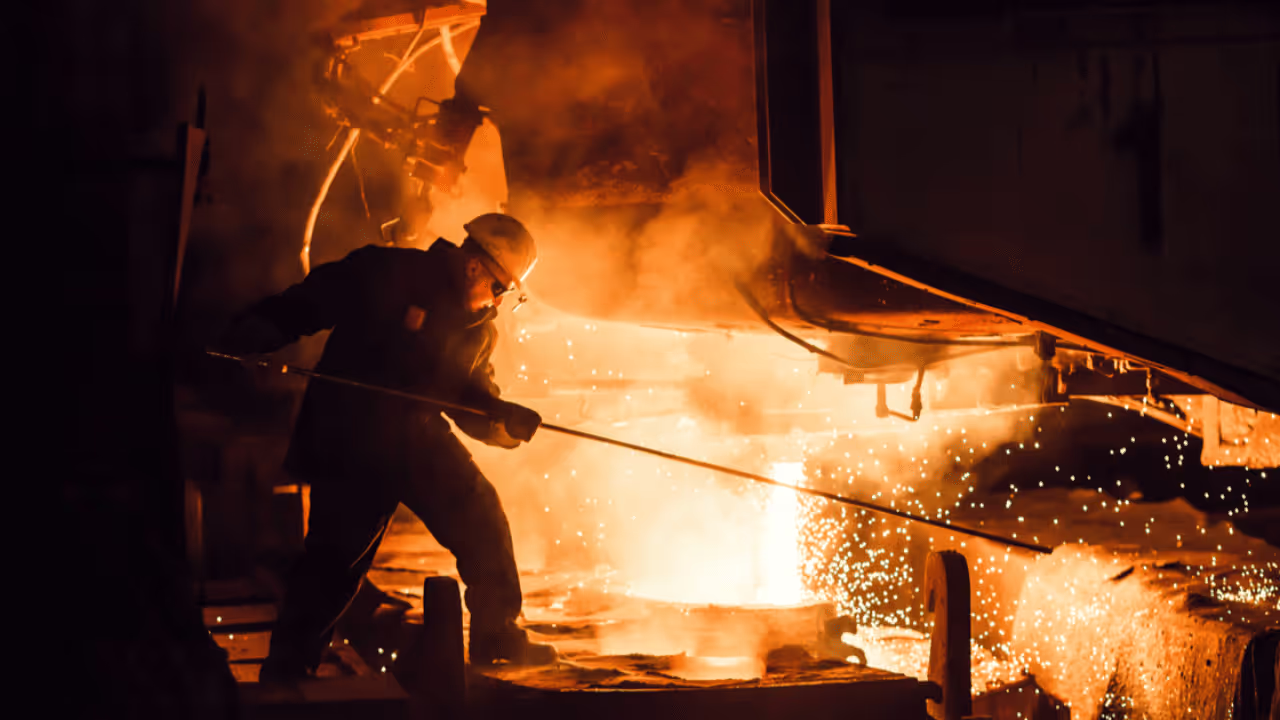
Ukraine's state railway Ukrzaliznytsia proposes a 45% freight tariff increase that could eliminate 300,000 steel sector jobs and force additional facilities into permanent closure. The steel union UkrMetalurgProm warns the sector has already suffered losses of 28 billion hryvnias ($632 million) and any additional freight burden would be "crippling." For context, a mid-sized Ukrainian steel mill shipping 100,000 tonnes of finished product annually by rail currently pays approximately $40/MT in freight costs the 45% increase adds $18/MT directly to production costs, with no ability to pass this through to export customers facing intense competition from Turkish and Chinese steel at current price levels.
Rail freight volumes have collapsed from 314 million metric tons in 2021 to a projected 160 million tons in 2026 a 49% decline driven by occupied territories and destroyed industrial assets. Half of this volume loss comes from the occupation of Ukrainian territories and destruction of industrial assets located there, with the remainder from reduced exports and economic decline. This creates the margin anatomy problem: Ukrzaliznytsia's infrastructure was designed and financed for 300+ million tonnes annually. Track maintenance, signaling systems, rolling stock depreciation, and workforce costs remain largely fixed regardless of volume. The railway cannot restructure mid-war it cannot abandon track in occupied territories or eliminate passenger service for social reasons.
On the buy side: European steel importers who historically sourced semi-finished products from Ukraine now face a delivered cost increase of $18–25/MT depending on transport distance to ports. The alternative sourcing from Turkey or India involves longer lead times but potentially lower all-in costs as competitors do not face this freight penalty. Major buyers like ArcelorMittal's European operations or ThyssenKrupp can shift sourcing within weeks, leaving Ukrainian producers with shrinking customer base.
On the sell side: Ukrainian steel producers operating at reduced capacity warn that additional transportation cost increases could become "the decisive factor that pushes additional enterprises from partial operation into permanent shutdown." The steel sector accounts for 5.5% of Ukraine's GDP, $6 billion in foreign exchange earnings, and over 150 billion UAH in tax revenues, making these closures economically devastating beyond the direct employment impact. Plants already operating at 40–60% capacity cannot absorb margin compression of this magnitude.
For large integrated steel producers those with captive iron ore mines, coking facilities, and blast furnaces the freight increase hits multiple input streams. Iron ore transport from Kryvyi Rih to Dnipro-area mills adds roughly $12/MT to the $18/MT finished product impact. Coking coal imports through western border crossings add another $8/MT in rail freight. The total margin impact approaches $38/MT on integrated production, compared to pre-war freight costs. These operators may hedge through advance contracting with Ukrzaliznytsia or shift to truck transport where rail infrastructure allows, though road freight capacity cannot handle bulk volumes.
For smaller regional steel producers electric arc furnace operators, specialty alloy producers, or processing facilities the impact concentrates on finished product movement to export terminals. These operators lack captive logistics or alternative transport modes. A regional rebar producer in Zaporizhzhia shipping 50,000 tonnes annually to Odesa ports faces an additional $900,000 in annual freight costs with no operational flexibility to absorb or avoid the increase. Many of these facilities employ 500–2,000 workers directly and support local supply chains worth thousands more jobs.
Ukrzaliznytsia posts a UAH 7.2 billion net loss for nine months, with passenger transport losses reaching UAH 18 billion annually and projected to grow to UAH 22.3 billion in 2026. The company proposes the 41.5–45% freight increase in two stages to avoid "shocks for industry" but acknowledges this creates a "tariff spiral" where each price hike reduces freight base and necessitates subsequent increases. This reveals the structural trap: freight transportation has subsidized passenger losses for decades, but freight profit is expected to drop to UAH 0.9 billion in 2025 before recovering as volumes continue declining.
The freight is profit dynamic works in reverse here Ukrainian steel producers effectively subsidize passenger rail service through freight rates that exceed economic cost of service. Iron and steel cargo accounts for 47% of Ukrainian Railways' total freight volume, making the sector the primary cash generator for the entire rail system. The 45% increase shifts an additional $2–3 billion annually from steel margins to rail operations, representing a direct industrial tax with no offsetting infrastructure benefit. Unlike typical freight markets where shippers can negotiate rates or choose alternative carriers, Ukraine's rail system operates as a state monopoly with no meaningful competition.
For observers: Monitor the Ukrainian hryvnia exchange rate against the dollar steel export competitiveness erodes rapidly if the currency strengthens while freight costs increase. Watch Ukrzaliznytsia's monthly export freight volumes, which fell 13.5% in the first half of 2025 to 38.7 million tonnes. A decline below 35 million tonnes by August 2026 signals that the tariff increase has triggered the predicted production shutdowns, as steel represents the majority of export freight volume. The EU steel price differential with Ukrainian product should widen by $20–30/MT if freight increases take effect, providing a measurable indicator of competitive impact.
.jpg)



'%3e%3cg id='Final-Copy-2_2_' transform='translate(1275.000000, 200.000000)'%3e%3cpath class='st0' d='M7.4,12.8h6.8l3.1-11.6H7.4C4.2,1.2,1.6,3.8,1.6,7S4.2,12.8,7.4,12.8z'/%3e%3c/g%3e%3c/g%3e%3c/g%3e%3cg id='final---dec.11-2020'%3e%3cg id='_x30_208-our-toggle' transform='translate(-1275.000000, -200.000000)'%3e%3cg id='Final-Copy-2' transform='translate(1275.000000, 200.000000)'%3e%3cpath class='st1' d='M22.6,0H7.4c-3.9,0-7,3.1-7,7s3.1,7,7,7h15.2c3.9,0,7-3.1,7-7S26.4,0,22.6,0z M1.6,7c0-3.2,2.6-5.8,5.8-5.8 h9.9l-3.1,11.6H7.4C4.2,12.8,1.6,10.2,1.6,7z'/%3e%3cpath id='x' class='st2' d='M24.6,4c0.2,0.2,0.2,0.6,0,0.8l0,0L22.5,7l2.2,2.2c0.2,0.2,0.2,0.6,0,0.8c-0.2,0.2-0.6,0.2-0.8,0 l0,0l-2.2-2.2L19.5,10c-0.2,0.2-0.6,0.2-0.8,0c-0.2-0.2-0.2-0.6,0-0.8l0,0L20.8,7l-2.2-2.2c-0.2-0.2-0.2-0.6,0-0.8 c0.2-0.2,0.6-0.2,0.8,0l0,0l2.2,2.2L23.8,4C24,3.8,24.4,3.8,24.6,4z'/%3e%3cpath id='y' class='st3' d='M12.7,4.1c0.2,0.2,0.3,0.6,0.1,0.8l0,0L8.6,9.8C8.5,9.9,8.4,10,8.3,10c-0.2,0.1-0.5,0.1-0.7-0.1l0,0 L5.4,7.7c-0.2-0.2-0.2-0.6,0-0.8c0.2-0.2,0.6-0.2,0.8,0l0,0L8,8.6l3.8-4.5C12,3.9,12.4,3.9,12.7,4.1z'/%3e%3c/g%3e%3c/g%3e%3c/g%3e%3c/g%3e%3c/svg%3e) Privacy Choices
Privacy Choices