.avif)
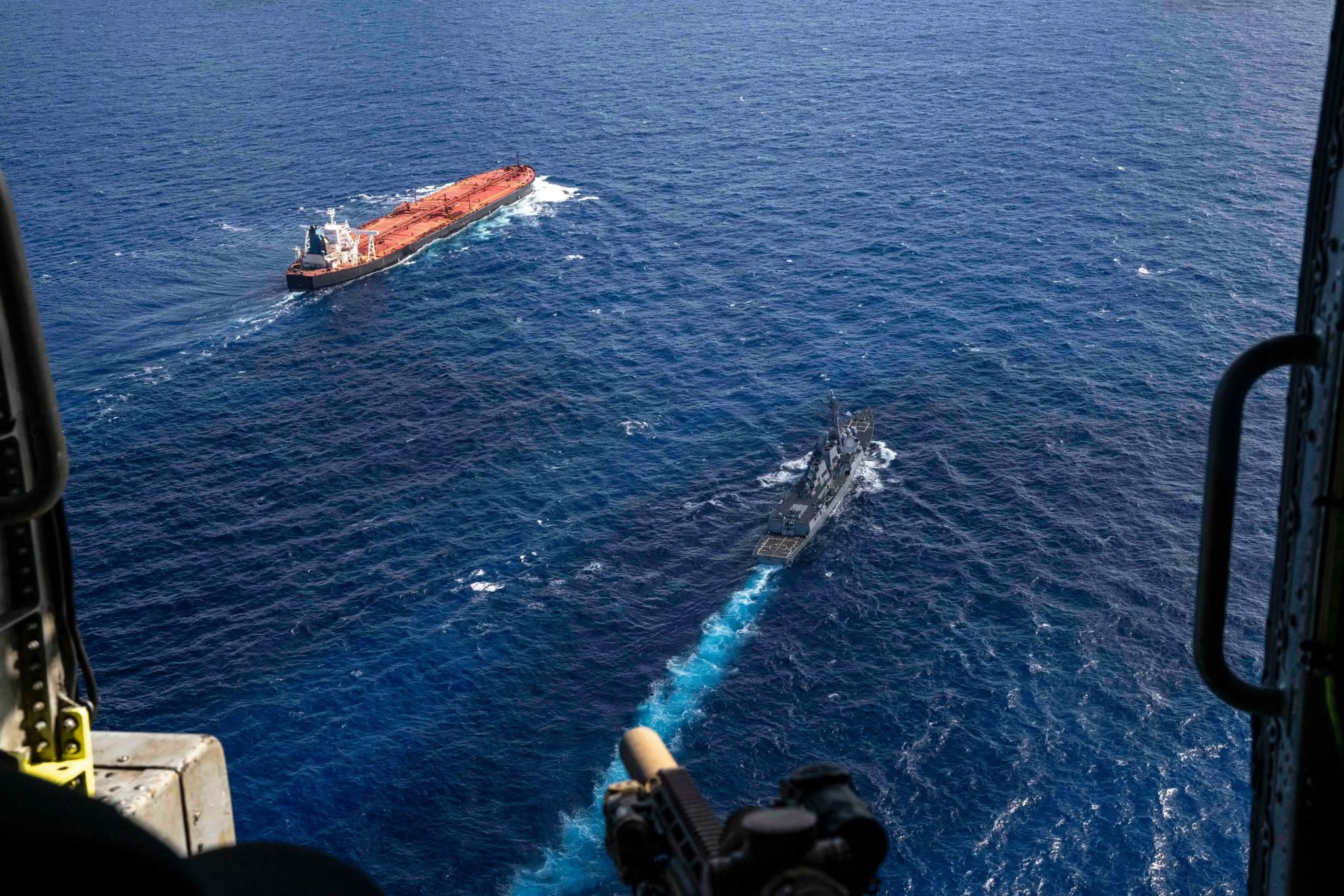
Shadow fleet operators face immediate margin destruction as US enforcement expands into international waters, with the seizure of the Iran linked VLCC Skywave removing a $90-120 million asset from their commercial operation. The vessel, carrying more than a million barrels of Iranian crude loaded at Kharg Island, was intercepted in the Indian Ocean not the Persian Gulf signalling Washington's expanded operational reach. At current Brent prices around $111 per barrel, the lost cargo represents approximately $111 million in crude value, compounding the vessel loss. The seizure cost to operators: vessel asset plus cargo value equals roughly $200-230 million in immediate losses.
The Skywave, a Very Large Crude Carrier (VLCC) a vessel class capable of transporting 2 million barrels of crude oil had been sanctioned by the US in March but continued operating in the shadow fleet network that moves Iranian oil to Asian buyers. Shadow fleet vessels are aging tankers, typically 15-20 years old, operating under opaque ownership structures and minimal insurance coverage to circumvent sanctions. These vessels trade at discounts to mainstream tonnage the Skywave's $90-120 million value compares to $118 million for a compliant five year old VLCC. The discount reflects sanctions risk, which materialised fully in this seizure.
On the buy side: Asian refiners, particularly in China and India, lose access to discounted Iranian crude and must source replacement barrels from compliant suppliers at market prices. At current Brent levels around $110-111 per barrel, Iranian crude typically trades at $8-12 per barrel discount to cover sanctions risk and transportation complications. Refiners now face the full market price for replacement crude, adding $8-12 million to the cost of a typical 1 million barrel cargo. On the sell side: Iranian exporters lose both vessel capacity and established trade routes, forcing reliance on an increasingly constrained shadow fleet. Each seized vessel reduces Iran's export capacity by approximately 2 million barrels per month, assuming typical VLCC utilisation patterns.
The seizure raises shipping risk premiums and insurance costs for shadow fleet operations, with analysts noting potential effects on tanker availability and freight rates if enforcement widens globally. For large integrated traders like Trafigura or Vitol with derivatives access: the reduced shadow fleet capacity creates arbitrage opportunities in compliant crude transportation, particularly on long-haul routes where VLCC economics matter most. These operators can hedge exposure through freight derivatives and secure premium rates from refiners needing guaranteed crude delivery. For smaller regional operators independent fuel importers, regional trading houses without derivatives access: the practical equivalent involves diversifying supplier relationships, avoiding Iranian-linked crude entirely, and accepting higher procurement costs for compliant supply chains.
The freight dimension concentrates margins with legitimate operators as shadow fleet capacity shrinks. Real supply in the spot market remains constrained as a growing share of the fleet trades shadow fleet activity, effectively removing compliant VLCCs from mainstream commercial markets. Average values of 10 year old VLCCs have reached $88 million while five year old ships are around $118 million, up approximately 4% since summer driven by tight compliant fleet supply. Each shadow fleet seizure transfers freight market share to legitimate operators. A VLCC earning current rates of approximately $65,000-85,000 per day generates $1.95-2.55 million per month. The Skywave's removal transfers this earning potential permanently to compliant operators.
Shadow fleet VLCC employment collapsed in January 2026, with many vessels sitting in floating storage offshore Asia, and available shadow fleet VLCCs now seeking employment primarily in Iranian trade the only remaining market of scale. This market concentration creates operational vulnerabilities. Iranian crude exports rely increasingly on a shrinking pool of aging, high-risk vessels operating under constant enforcement threat. Analysts note the enforcement escalation may affect tanker availability and freight rates if actions widen globally, as shadow operators face impossible operational economics: each voyage now carries asset seizure risk exceeding potential cargo margins.
Financing structures determine shadow fleet viability more than crude pricing. Traditional ship finance requires transparent ownership, verifiable insurance, and regulatory compliance all incompatible with sanctions evasion. Shadow fleet operators rely on cash purchases, opaque beneficial ownership through shell companies, and minimal or fraudulent insurance coverage. US officials indicate expanding efforts to disrupt these networks, with Treasury reiterating commitment to enforcing sanctions. The financing model breaks down when enforcement reaches international waters: operators cannot recover seized vessel values through insurance claims, and replacement vessel acquisition becomes increasingly difficult as compliant sellers withdraw from these markets.
Shadow fleet VLCC employment collapsed with many vessels in floating storage, while Aframaxes maintained employment by pivoting to Russian trades illustrating how vessel class affects enforcement vulnerability. VLCCs, designed for long-haul trades, transit multiple jurisdictions and extended international waters exposure. Aframaxes, typically used for regional trades, can avoid high-risk transit zones more effectively. The Skywave seizure in the Indian Ocean demonstrates that size creates vulnerability: larger vessels cannot hide in coastal waters and face inevitable exposure to international enforcement jurisdiction.
The seizure's timing coincides with broader US-Iran tensions and energy market volatility. Oil markets remain highly volatile with prices elevated as the Strait of Hormuz stays largely shut and attacks disrupt production, with shipping through the vital chokepoint effectively closed. Vice President Vance indicated Washington and Tehran are making progress in talks and that neither side wants renewed military campaign, with US officials noting Iranians want to make a deal. However, shadow fleet enforcement appears divorced from diplomatic progress, suggesting permanent operational risk elevation for sanctions evading vessels regardless of broader political settlements.
For observers: monitor Baltic Exchange VLCC freight rates on the TD3C route (Middle East Gulf to China) as the primary indicator of shadow fleet enforcement impact. With crude tanker freight markets being strong, most shipowners hold onto ships with relatively few VLCCs or Suezmaxes circulated for sale, and China buying more crude, especially long-haul barrels, increases tonne mile demand. Sustained rates above $65,000 per day indicate tight compliant fleet supply driven by shadow fleet attrition. Additionally, track Lloyd's List Intelligence reports on vessels going dark (turning off AIS transponders) in Iranian waters as a leading indicator of shadow fleet operational stress. Rising numbers of vessels going dark suggest increased enforcement pressure forcing deeper operational opacity, while declining numbers may indicate shadow fleet capacity reduction through seizures and commercial exit.
'%3e%3cg id='Final-Copy-2_2_' transform='translate(1275.000000, 200.000000)'%3e%3cpath class='st0' d='M7.4,12.8h6.8l3.1-11.6H7.4C4.2,1.2,1.6,3.8,1.6,7S4.2,12.8,7.4,12.8z'/%3e%3c/g%3e%3c/g%3e%3c/g%3e%3cg id='final---dec.11-2020'%3e%3cg id='_x30_208-our-toggle' transform='translate(-1275.000000, -200.000000)'%3e%3cg id='Final-Copy-2' transform='translate(1275.000000, 200.000000)'%3e%3cpath class='st1' d='M22.6,0H7.4c-3.9,0-7,3.1-7,7s3.1,7,7,7h15.2c3.9,0,7-3.1,7-7S26.4,0,22.6,0z M1.6,7c0-3.2,2.6-5.8,5.8-5.8 h9.9l-3.1,11.6H7.4C4.2,12.8,1.6,10.2,1.6,7z'/%3e%3cpath id='x' class='st2' d='M24.6,4c0.2,0.2,0.2,0.6,0,0.8l0,0L22.5,7l2.2,2.2c0.2,0.2,0.2,0.6,0,0.8c-0.2,0.2-0.6,0.2-0.8,0 l0,0l-2.2-2.2L19.5,10c-0.2,0.2-0.6,0.2-0.8,0c-0.2-0.2-0.2-0.6,0-0.8l0,0L20.8,7l-2.2-2.2c-0.2-0.2-0.2-0.6,0-0.8 c0.2-0.2,0.6-0.2,0.8,0l0,0l2.2,2.2L23.8,4C24,3.8,24.4,3.8,24.6,4z'/%3e%3cpath id='y' class='st3' d='M12.7,4.1c0.2,0.2,0.3,0.6,0.1,0.8l0,0L8.6,9.8C8.5,9.9,8.4,10,8.3,10c-0.2,0.1-0.5,0.1-0.7-0.1l0,0 L5.4,7.7c-0.2-0.2-0.2-0.6,0-0.8c0.2-0.2,0.6-0.2,0.8,0l0,0L8,8.6l3.8-4.5C12,3.9,12.4,3.9,12.7,4.1z'/%3e%3c/g%3e%3c/g%3e%3c/g%3e%3c/g%3e%3c/svg%3e) Privacy Choices
Privacy Choices