.avif)
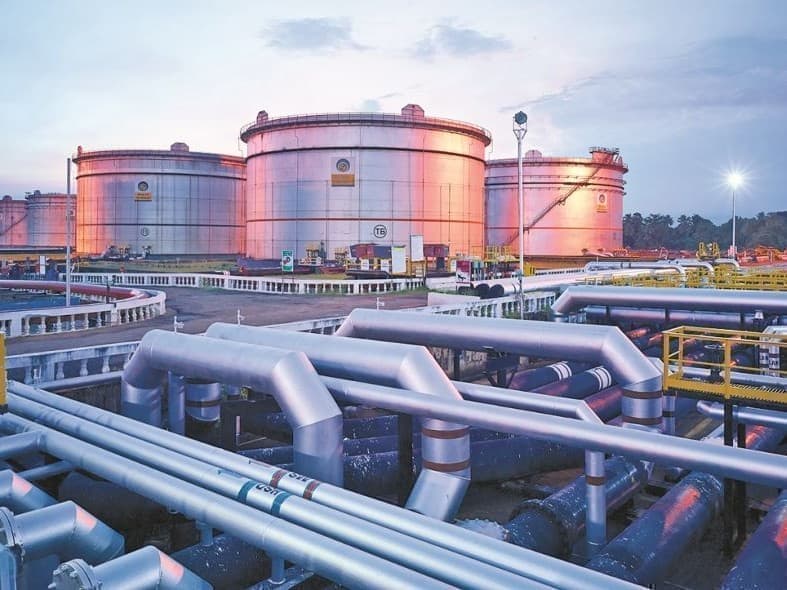
Indian oil marketing companies IOCL, BPCL, and HPCL stand to recover approximately ₹2–4 per litre in marketing margin on petrol and diesel over the second half of FY2026, but only if the reported US-Iran truce holds, the Strait of Hormuz normalises fully, and the Indian government does not reclaim that relief through retail price cuts or additional cess levies.
CRISIL's assessment, published 26 June 2026, projects a roughly 100 basis point (bps) one percentage point hit to aggregate Indian corporate margins for the full fiscal year, approximately half the 200 bps feared under a prolonged conflict scenario. The analysis covers 34 sectors with direct exposure to the West Asia crisis, representing approximately 65% of all rated corporate debt in India a figure that underscores how deeply energy price transmission runs through the country's credit architecture. Sectors facing minimal disruption account for roughly 24 additional industries. The headline number, however, contains an important arithmetic trap: Brent crude the international benchmark price for light sweet crude oil, used as the reference for most Indian import contracts has already spent weeks above the $80–85 per barrel average that CRISIL's model requires to land at 100 bps. The damage from the conflict peak is already embedded in H1 cost structures. For the full-year average to hold at $80–85/bbl, Brent must trade materially below that band for the remainder of the year which requires not just a truce but active Iranian supply re-entry into the market.
India's structural exposure explains why this matters beyond the oil sector. The country imports approximately 85% of its crude consumption, loading cargoes predominantly from the Arabian Gulf Abu Dhabi, Kuwait, Iraq's Basrah terminal, and Saudi Aramco's Ras Tanura. The dominant trade route runs through the Strait of Hormuz, a 33 kilometre wide chokepoint between Oman and Iran through which roughly 20% of globally traded oil passes daily. A VLCC (Very Large Crude Carrier a supertanker capable of loading approximately 2 million barrels) departing Ras Tanura takes roughly 18–22 days to reach Indian refineries at Jamnagar, Kochi, or Paradip. When Hormuz traffic falls significantly below pre-conflict levels, as it reportedly has in recent weeks, Indian refiners face two immediate problems: reduced availability of their preferred Gulf sour grades heavier, sulphur-rich crudes such as Arab Light and Basrah Heavy and forced substitution onto spot markets for West African Bonny Light or US WTI Midland, which carry a premium of $3–6 per barrel over equivalent Gulf grades on a delivered basis.
The margin anatomy here is precise and worth decomposing. A mid-sized Indian state refinery processing 200,000 barrels per day that shifts even 15% of its crude slate from Gulf sour grades to spot Atlantic Basin crudes absorbs an additional input cost of roughly $0.45–0.90 per barrel across its full throughput not just the substituted barrels because the entire refinery's yield optimisation changes when the crude diet shifts. At 200,000 bbl/day, that is $90,000–$180,000 in additional daily cost, or $8–16 million per month. Over four months of disrupted gas supply and elevated spot crude premiums, the cumulative hit to a single refinery approaches $30–65 million before any product price adjustment. This is the non-recoverable component that sits in H1 earnings regardless of where Brent trades in Q3 and Q4. CRISIL's 50–80 bps of margin erosion already absorbed by airlines and ceramics manufacturers follows the same logic: costs incurred are costs incurred.
The freight dimension compounds this, and freight is not a rounding error it is often where the margin lives. During the conflict peak, war-risk insurance premiums (surcharges levied by ship owners and insurers to cover vessels transiting politically unstable waters) added an estimated $1.50–3.00 per barrel to Gulf-origin crude freight costs for Indian buyers. A VLCC carrying 2 million barrels at an additional $2/bbl war-risk surcharge represents a $4 million per voyage premium that accrues entirely to the vessel owner and insurer, not the cargo. For a large integrated operator like Indian Oil Corporation (IOCL) running perhaps 15–20 VLCC liftings per month, that is $60–80 million in additional monthly freight exposure that no derivative position on crude price protects against freight risk and price risk are separate instruments. As Hormuz normalises, war-risk premiums should compress, and IOCL and its peers should recapture this cost layer, but the timing of that compression will lag behind any formal truce declaration by four to eight weeks as underwriters reassess.
On the buy side, Indian state refiners are the critical actors. If Brent sustains $80–85/bbl and Gulf sour grades become accessible again, IOCL, BPCL, and HPCL can progressively narrow the light-heavy differential the price gap between lighter Atlantic crudes and heavier Gulf crudes that has supported premium pricing for Bonny Light and WTI Midland. Refineries optimised for sour crude processing (Jamnagar's Reliance complex and state-sector Kochi and Paradip plants have significant secondary conversion capacity) run at structurally lower input cost on Arab Heavy or Basrah Heavy. Reverting the crude slate back toward Gulf sour grades is not instantaneous term contract re-negotiations with national oil companies like ADNOC, KPC, and SOMO take four to eight weeks to translate into changed cargo schedules but the directional margin benefit is real. On the sell side, the same refineries carry middle distillate crack spreads the refining margin earned on gasoil or diesel relative to crude that have been elevated by regional product tightness. As Hormuz resupply eases that tightness, export arbitrage windows to Singapore and the Middle East will compress. Any refiner currently long on diesel export contracts at crack spreads above $15/bbl should treat normalisation as a signal to redirect barrels domestically rather than chase thinning export margins.
For large integrated operators state-sector trading arms with access to futures and swap markets the instrument of this moment is a calendar spread position on Brent: specifically, selling the near-term backwardation (backwardation being the market condition where prompt crude prices are higher than forward prices, signalling physical scarcity right now) and locking in forward crude purchases at the lower prices the curve currently offers for Q3 and Q4. This protects against a scenario where the truce collapses and prompt prices spike again. For smaller regional operators independent fuel distributors, state electricity utilities buying furnace oil or naphtha, mid-scale petrochemical feedstock buyers derivatives access is limited or non-existent. The practical equivalent is extending bilateral fixed-price supply agreements with PSU refiners for 60–90 day tenors while spot premiums are compressing, and building two to three weeks of additional inventory buffer against renewed disruption risk. The truce, according to reports, is described as interim by CRISIL itself, and no structural ceasefire architecture is yet confirmed.
The sectors bearing asymmetric pain deserve specific attention. Airlines IndiGo, Air India, SpiceJet have already absorbed 50–80 bps of margin erosion in H1 FY2026 that cannot be clawed back through lower jet fuel prices in H2; forward bookings sold at fares that did not anticipate peak fuel costs have locked in the loss. Ceramics manufacturers in Morbi, Gujarat India's dominant export cluster are exposed through natural gas and LPG feedstock costs; gas supply disruptions lasting approximately four months, as CRISIL estimates, mean that even a full second-half normalisation recovers only half the annual damage. Diamond polishing units in Surat face a compounded problem: energy cost stickiness in polishing operations plus structurally weak global demand for rough diamonds means their 100–150 bps full-year margin compression is only partially an energy story and not recoverable through crude normalisation at all. Oil marketing companies and fertiliser producers are the inverse their EBITDA (earnings before interest, tax, depreciation and amortisation the standard measure of operating profitability) may expand 150–250 bps in H2 if ammonia and LPG feedstock costs normalise, provided the government does not reprice retail fuels downward to distribute the relief to consumers rather than allow it to flow to the balance sheet.
The single most important signal to watch over the next 30 days is the weekly Hormuz transit count published by tanker-tracking services such as Vortexa or Kpler specifically, whether VLCC and LR2 (Long Range 2 tanker, carrying 80,000–120,000 tonnes of refined product) northbound and southbound transits recover to within 85–90% of their January 2026 baseline. That threshold, if sustained for two consecutive weeks, is the operational confirmation that sour crude availability is genuinely normalising and that war-risk insurance premiums will begin to compress. Until that threshold is reached, the 100 bps CRISIL estimate remains aspirational rather than earned. The second signal is Brent's monthly average for July 2026: if it closes above $83/bbl, the arithmetic of the full-year $80–85 average becomes materially harder to achieve, and CRISIL's more benign scenario gives way to a 150–175 bps outcome that begins to look structurally like the prolonged-conflict case the market was pricing two months ago.
'%3e%3cg id='Final-Copy-2_2_' transform='translate(1275.000000, 200.000000)'%3e%3cpath class='st0' d='M7.4,12.8h6.8l3.1-11.6H7.4C4.2,1.2,1.6,3.8,1.6,7S4.2,12.8,7.4,12.8z'/%3e%3c/g%3e%3c/g%3e%3c/g%3e%3cg id='final---dec.11-2020'%3e%3cg id='_x30_208-our-toggle' transform='translate(-1275.000000, -200.000000)'%3e%3cg id='Final-Copy-2' transform='translate(1275.000000, 200.000000)'%3e%3cpath class='st1' d='M22.6,0H7.4c-3.9,0-7,3.1-7,7s3.1,7,7,7h15.2c3.9,0,7-3.1,7-7S26.4,0,22.6,0z M1.6,7c0-3.2,2.6-5.8,5.8-5.8 h9.9l-3.1,11.6H7.4C4.2,12.8,1.6,10.2,1.6,7z'/%3e%3cpath id='x' class='st2' d='M24.6,4c0.2,0.2,0.2,0.6,0,0.8l0,0L22.5,7l2.2,2.2c0.2,0.2,0.2,0.6,0,0.8c-0.2,0.2-0.6,0.2-0.8,0 l0,0l-2.2-2.2L19.5,10c-0.2,0.2-0.6,0.2-0.8,0c-0.2-0.2-0.2-0.6,0-0.8l0,0L20.8,7l-2.2-2.2c-0.2-0.2-0.2-0.6,0-0.8 c0.2-0.2,0.6-0.2,0.8,0l0,0l2.2,2.2L23.8,4C24,3.8,24.4,3.8,24.6,4z'/%3e%3cpath id='y' class='st3' d='M12.7,4.1c0.2,0.2,0.3,0.6,0.1,0.8l0,0L8.6,9.8C8.5,9.9,8.4,10,8.3,10c-0.2,0.1-0.5,0.1-0.7-0.1l0,0 L5.4,7.7c-0.2-0.2-0.2-0.6,0-0.8c0.2-0.2,0.6-0.2,0.8,0l0,0L8,8.6l3.8-4.5C12,3.9,12.4,3.9,12.7,4.1z'/%3e%3c/g%3e%3c/g%3e%3c/g%3e%3c/g%3e%3c/svg%3e) Privacy Choices
Privacy Choices