.avif)
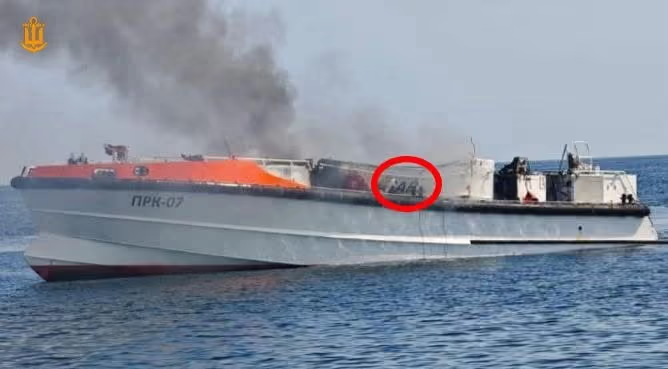
Ukrainian agricultural exporters face immediate cost escalation after Russian forces struck two civilian Maritime Search and Rescue Service vessels on June 6, causing casualties and triggering emergency evacuations. War risk premiums the additional insurance cost reflecting conflict exposure for Ukrainian Black Sea ports have already risen to 0.45–0.55% of vessel value per voyage from 0.4% in late November, with some underwriters now quoting 0.8–1%. For a standard 50,000-tonne grain carrier valued at $30 million, this represents an increase of $30,000–$120,000 per voyage. The arithmetic is unforgiving: at current Ukrainian wheat FOB prices of approximately $210/MT, these insurance costs add $0.60–$2.40/MT to delivered costs margin that many exporters cannot absorb.
A Maritime Search and Rescue Service the state agency responsible for emergency response at sea operates vessels that enjoy special protection under Article 27 of the Second Geneva Convention of 1949. These boats, marked with SAR (Search and Rescue) designations and appropriate colors, are protected under international humanitarian law when conducting search and rescue operations. Russia regularly attacks civilian vessels in the Black Sea, including foreign-flagged ships, as part of Moscow's systematic pressure on maritime exports and international shipping. The June 6 attack follows a documented pattern: on May 29, three foreign vessels were attacked by Russian drones, and on May 18, a Panamanian-flagged vessel and two ships flying Guinea-Bissau and Marshall Islands flags were damaged while transiting the Ukrainian corridor.
On the buy side: Mid-sized grain importers in Egypt, Jordan, and Pakistan Ukraine's primary alternative markets after EU quota restrictions now face $0.60–$2.40/MT additional costs passed through from Ukrainian exporters. Consider a 25,000-tonne wheat cargo to Alexandria: the insurance premium increase adds $15,000–$60,000 to the delivered cost, forcing buyers to either accept higher prices or shift to alternative suppliers. On the sell side: Ukrainian agricultural exporters, already operating on compressed margins due to overland transport costs and reduced Black Sea access, cannot absorb these insurance increases. With EU quotas capping Ukrainian wheat exports at just 583,000 MT for the remainder of 2025 a fraction of the 6.3 million MT shipped in 2024 exporters are forced to compete in price-sensitive Middle Eastern markets where every dollar matters.
For large integrated traders (Cargill, ADM, national oil company trading arms) with derivatives access: Support programs including the Unity Facility, AGRI-Ukraine, and international underwriters (Lloyd's, IUMI) can stabilize vessel insurance at around 2% even under high-risk conditions. These operators can hedge war risk exposure through political risk insurance and spread costs across diversified cargo portfolios. For smaller regional operators independent Ukrainian grain elevators, mid-sized exporters, regional cooperatives without derivatives access: The practical equivalent is bilateral risk-sharing with buyers, adjusting payment terms to net-30 from sight letters of credit, or reducing cargo sizes to spread exposure. Unlike 2023, when insurance rate increases were offset by Danube freight rates reaching $100/MT, current Danube costs of around €10/MT provide no cushion insurance increases flow directly to exporters and shipowners.
For observers: Monitor the Lloyd's of London Joint War Committee's area listing updates, typically published within 7–14 days of significant incidents affecting maritime war risk zones. Even with new Black Sea incidents, rates are expected to remain relatively stable due to government intervention and international insurance programs, but sustained attacks on protected vessels could trigger broader area reclassification. Ukraine's humanitarian corridor, controlled solely by Ukrainian forces, has returned freight rates to near pre-war levels, but insurance volatility threatens this cost advantage. Watch for Baltic Dry Index movements and Ukrainian port throughput data from Odesa port authority any deviation from the current 1.2–1.5 million tonnes monthly export capacity signals either successful risk mitigation or further logistics disruption.
.jpg)



'%3e%3cg id='Final-Copy-2_2_' transform='translate(1275.000000, 200.000000)'%3e%3cpath class='st0' d='M7.4,12.8h6.8l3.1-11.6H7.4C4.2,1.2,1.6,3.8,1.6,7S4.2,12.8,7.4,12.8z'/%3e%3c/g%3e%3c/g%3e%3c/g%3e%3cg id='final---dec.11-2020'%3e%3cg id='_x30_208-our-toggle' transform='translate(-1275.000000, -200.000000)'%3e%3cg id='Final-Copy-2' transform='translate(1275.000000, 200.000000)'%3e%3cpath class='st1' d='M22.6,0H7.4c-3.9,0-7,3.1-7,7s3.1,7,7,7h15.2c3.9,0,7-3.1,7-7S26.4,0,22.6,0z M1.6,7c0-3.2,2.6-5.8,5.8-5.8 h9.9l-3.1,11.6H7.4C4.2,12.8,1.6,10.2,1.6,7z'/%3e%3cpath id='x' class='st2' d='M24.6,4c0.2,0.2,0.2,0.6,0,0.8l0,0L22.5,7l2.2,2.2c0.2,0.2,0.2,0.6,0,0.8c-0.2,0.2-0.6,0.2-0.8,0 l0,0l-2.2-2.2L19.5,10c-0.2,0.2-0.6,0.2-0.8,0c-0.2-0.2-0.2-0.6,0-0.8l0,0L20.8,7l-2.2-2.2c-0.2-0.2-0.2-0.6,0-0.8 c0.2-0.2,0.6-0.2,0.8,0l0,0l2.2,2.2L23.8,4C24,3.8,24.4,3.8,24.6,4z'/%3e%3cpath id='y' class='st3' d='M12.7,4.1c0.2,0.2,0.3,0.6,0.1,0.8l0,0L8.6,9.8C8.5,9.9,8.4,10,8.3,10c-0.2,0.1-0.5,0.1-0.7-0.1l0,0 L5.4,7.7c-0.2-0.2-0.2-0.6,0-0.8c0.2-0.2,0.6-0.2,0.8,0l0,0L8,8.6l3.8-4.5C12,3.9,12.4,3.9,12.7,4.1z'/%3e%3c/g%3e%3c/g%3e%3c/g%3e%3c/g%3e%3c/svg%3e) Privacy Choices
Privacy Choices