.avif)
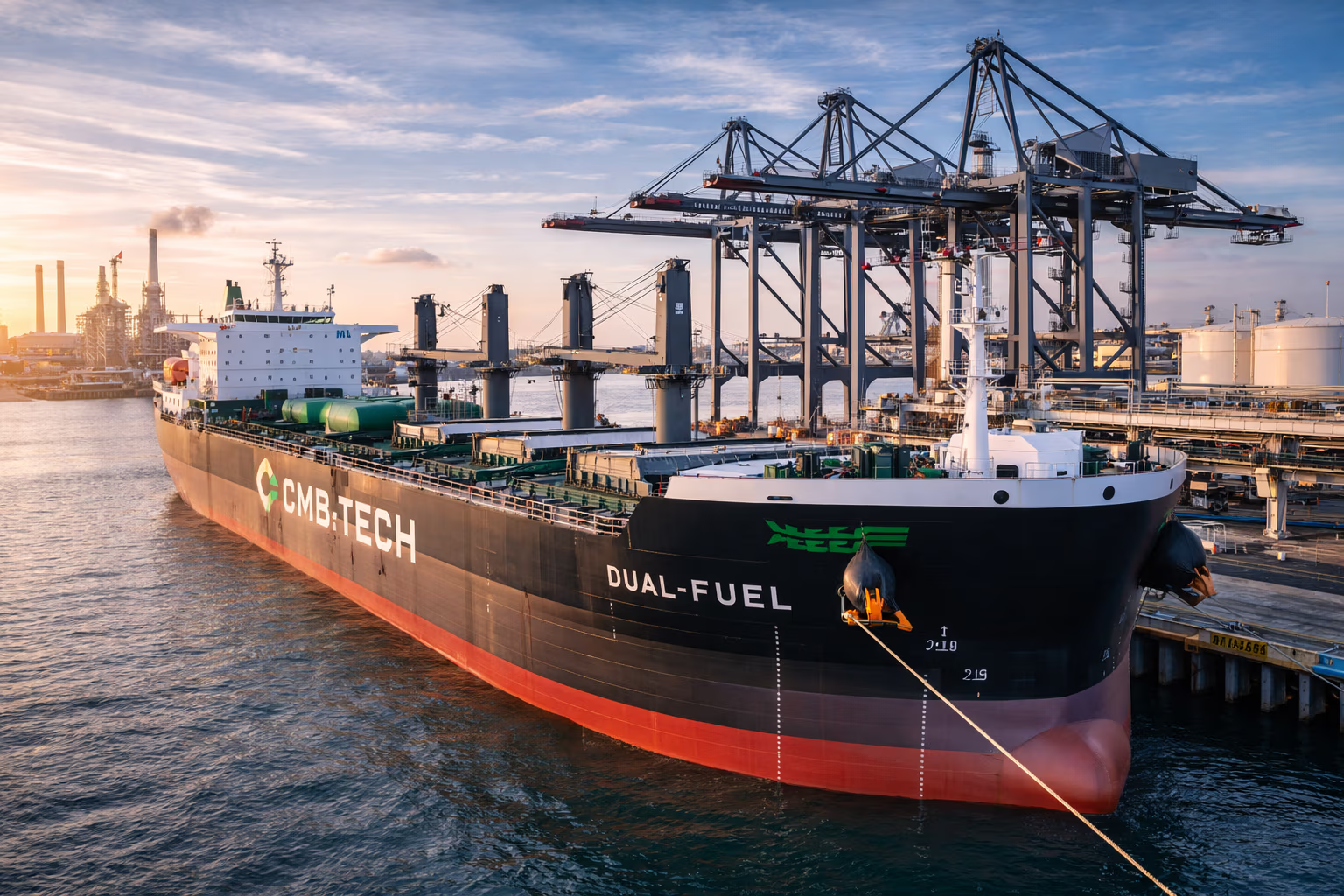
CMB.TECH's reported first quarter profit of $368.8 million and EBITDA of $558.3 million signals exceptional capture of freight market timing by Tanker Owners, but reveals structural vulnerability in shipping company earnings models that remains hidden in quarterly snapshots. The company's Baltic Dry Index currently trading at 3,224 points as of May 29, 2026, suggests broader market strength. Time charter equivalent earnings (TCE) the daily rate a vessel earns after voyage costs determine whether owners profit or merely cover operating expenses. CMB.TECH's contract backlog surged to $3.26 billion through adding one 5 year Suezmax time charter and extending two Suezmax charters to 10 years each, securing revenue predictability during market peaks. However, this $368.8 million quarterly windfall depends entirely on newbuilding delivery timing coinciding with strong charter markets a dependency that cannot be engineered or repeated at will.
The company highlighted strong dry bulk performance across all segments, particularly Capesizes and Newcastlemaxes, with Q1 spot results expected to strengthen further in Q2. Dry bulk carriers transport iron ore, coal, grain, and other commodities in unpackaged form, with vessel earnings tied directly to global trade volumes and seasonal patterns. With heavy fuel oil (HFO) prices up 50%, CMB.TECH's modern, fuel-efficient "eco" fleet extracts higher margins from prevailing market rates compared to older, less efficient vessels. The Baltic Dry Index a composite measure of freight rates for dry bulk vessels has risen 127.36% year over year and gained 20% in May alone. This creates a margin differential where newer vessels capture premium rates while older tonnage faces squeezed economics from fuel cost inflation.
CMB.TECH plans to distribute $0.64 per share while capitalizing on vessel sales at "stellar prices" amid the "red-hot tanker market". On the buy side, shipping companies dependent on older vessel fleets face margin compression as Suezmax rates averaged $88,445/day in January 2026 versus $25,556/day in January 2025 a tripling that benefits efficient operators while penalizing high-cost fleets. Regional operators without access to modern tonnage cannot capture these premiums. On the sell side, vessel owners with modern fleets positioned for charter renewals during this cycle extract exceptional returns. Baltic Suezmax TCE peaked at $94,299 per day on November 18, the strongest level in three years, demonstrating the earnings potential available to properly positioned owners.
For large integrated shipping companies like CMB.TECH, Frontline, or DHT Holdings, this environment enables strategic fleet repositioning through vessel sales and time charter extensions. Current Suezmax rates of $121,800 per day on 60% of available days allow these operators to lock in multiyear contracts at historically attractive levels. Smaller regional operators independent dry bulk traders, family-owned fleets, cooperative shipping ventures lack the scale to time newbuilding deliveries or negotiate long-term charters with major oil companies. They remain exposed to spot market volatility without hedging instruments. Capesize daily earnings increased to $44,314 while Panamax earnings reached $20,629, creating day rate differentials that reward vessel size and efficiency.
The crude tanker market faces a tight Q1 2026 with growing shadow fleet activity effectively removing compliant VLCCs and Suezmaxes from mainstream commercial activity, leaving real spot market supply constrained. This supply constraint, not demand growth, drives current rate premiums. Observers should monitor the Baltic Capesize Index (BCI) through July 2026 any sustained decline below 4,000 points would signal early inventory destocking ahead of seasonal demand patterns. Additionally, watch newbuilding delivery schedules from major Asian shipyards concentrated deliveries in Q3 2026 could overwhelm charter demand and reverse current rate premiums. The fundamental question for Tanker Owners: whether this exceptional timing can be systematically replicated, or whether CMB.TECH's $368.8 million quarter represents peak-cycle positioning that benefits early movers while leaving followers exposed to inevitable rate normalization.

.jpg)



'%3e%3cg id='Final-Copy-2_2_' transform='translate(1275.000000, 200.000000)'%3e%3cpath class='st0' d='M7.4,12.8h6.8l3.1-11.6H7.4C4.2,1.2,1.6,3.8,1.6,7S4.2,12.8,7.4,12.8z'/%3e%3c/g%3e%3c/g%3e%3c/g%3e%3cg id='final---dec.11-2020'%3e%3cg id='_x30_208-our-toggle' transform='translate(-1275.000000, -200.000000)'%3e%3cg id='Final-Copy-2' transform='translate(1275.000000, 200.000000)'%3e%3cpath class='st1' d='M22.6,0H7.4c-3.9,0-7,3.1-7,7s3.1,7,7,7h15.2c3.9,0,7-3.1,7-7S26.4,0,22.6,0z M1.6,7c0-3.2,2.6-5.8,5.8-5.8 h9.9l-3.1,11.6H7.4C4.2,12.8,1.6,10.2,1.6,7z'/%3e%3cpath id='x' class='st2' d='M24.6,4c0.2,0.2,0.2,0.6,0,0.8l0,0L22.5,7l2.2,2.2c0.2,0.2,0.2,0.6,0,0.8c-0.2,0.2-0.6,0.2-0.8,0 l0,0l-2.2-2.2L19.5,10c-0.2,0.2-0.6,0.2-0.8,0c-0.2-0.2-0.2-0.6,0-0.8l0,0L20.8,7l-2.2-2.2c-0.2-0.2-0.2-0.6,0-0.8 c0.2-0.2,0.6-0.2,0.8,0l0,0l2.2,2.2L23.8,4C24,3.8,24.4,3.8,24.6,4z'/%3e%3cpath id='y' class='st3' d='M12.7,4.1c0.2,0.2,0.3,0.6,0.1,0.8l0,0L8.6,9.8C8.5,9.9,8.4,10,8.3,10c-0.2,0.1-0.5,0.1-0.7-0.1l0,0 L5.4,7.7c-0.2-0.2-0.2-0.6,0-0.8c0.2-0.2,0.6-0.2,0.8,0l0,0L8,8.6l3.8-4.5C12,3.9,12.4,3.9,12.7,4.1z'/%3e%3c/g%3e%3c/g%3e%3c/g%3e%3c/g%3e%3c/svg%3e) Privacy Choices
Privacy Choices