.avif)
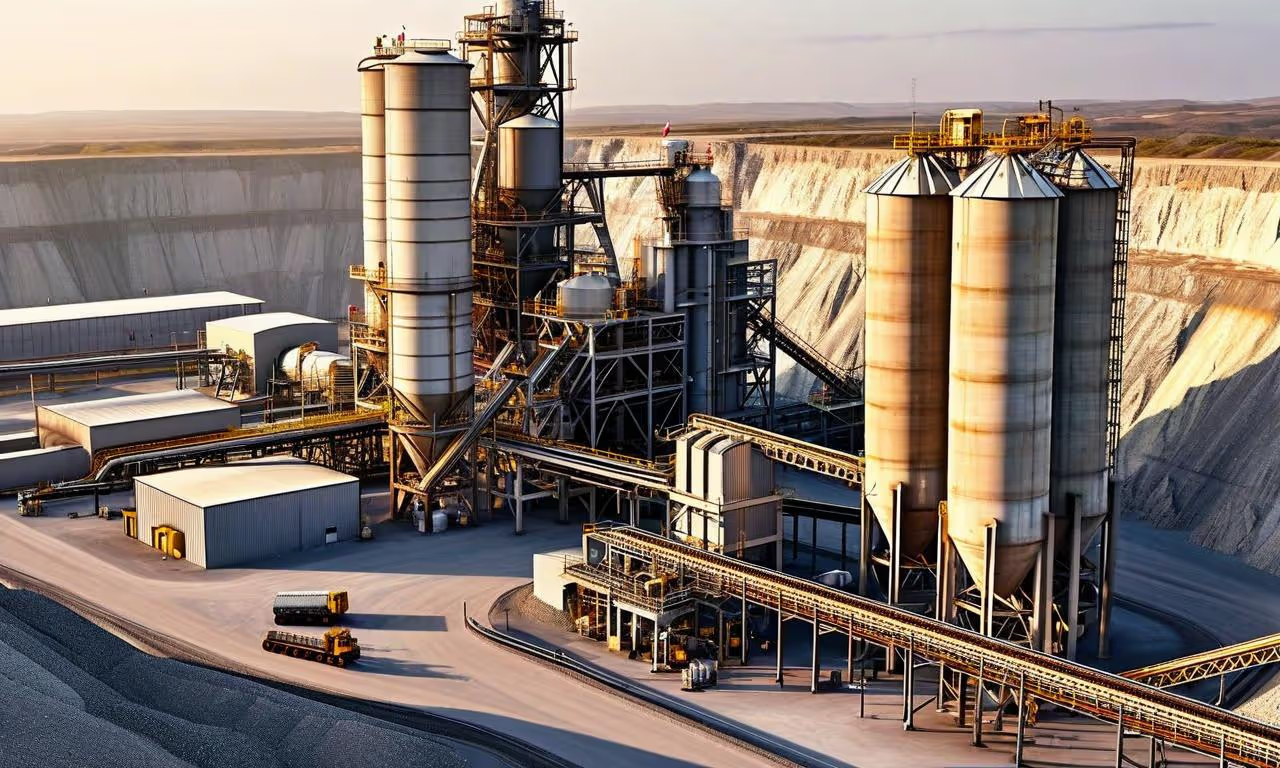
Cement buyers in eastern India face a 2-4 week supply crunch after Dalmia Bharat's 14-day kiln breakdown eliminated an estimated 250,000-300,000 tonnes of cement from March production schedules. The affected kiln at Rajgangpur in Odisha supplied the major share of clinker — the intermediate product ground into finished cement — to Dalmia's network across Odisha, West Bengal, and Jharkhand. While the kiln restarted March 27 and dispatches are normalizing, the timing coincided with early seasonal demand recovery, amplifying the market impact. Buyers previously locked into Dalmia supply agreements now scramble for alternatives in a market where cement's transport economics limit viable substitution sources within economical trucking radius.
The commercial mechanics reveal why this disruption creates genuine scarcity rather than simple inconvenience. Cement plants operate on hub-and-spoke models where kilns produce clinker at centralized locations, then ship to grinding units that add gypsum and produce finished cement for local markets. Dalmia's Rajgangpur kiln served as the primary clinker source for multiple grinding facilities across three states, meaning its breakdown cascaded through the entire eastern supply chain. Spot market rates (prices for immediate delivery rather than contract terms) have firmed as buyers compete for limited alternative sources. Replacement clinker from distant plants faces prohibitive transport costs, while local competitors may lack surplus capacity to absorb 300,000 tonnes of displaced demand.
Buyers with fixed-price contracts face the dual pressure of supply unavailability and potential force majeure claims, while those on spot terms confront elevated pricing as available volumes thin. Sellers in the region — including local competitors and smaller players — find themselves with unexpected pricing power as Dalmia's absence tightens market balance. The disruption occurred during peak construction season when cement demand typically accelerates, magnifying buyer urgency. For construction companies with project timelines, the supply gap forces difficult choices between paying premiums for alternative sources, accepting delivery delays, or sourcing from more distant suppliers at higher landed costs.
The broader question centers on whether eastern India's cement market has sufficient structural redundancy to absorb major supplier disruptions without price volatility. Dalmia's proactive disclosure to stock exchanges, despite the incident falling below materiality thresholds, suggests management recognizes the reputational stakes of supply reliability in a commodity market where buyers maintain multiple supplier relationships for exactly these contingencies. Yet the company's ambition to grow eastern market share toward the mid-60s to high-60s range — up from current levels — may face headwinds if channel partners diversify sourcing to reduce single-supplier risk. Whether competitors can sustainably serve displaced volumes or if capacity constraints force buyers back to Dalmia once operations fully stabilize remains the key uncertainty as Q1 2026 demand patterns emerge.

.jpg)





'%3e%3cg id='Final-Copy-2_2_' transform='translate(1275.000000, 200.000000)'%3e%3cpath class='st0' d='M7.4,12.8h6.8l3.1-11.6H7.4C4.2,1.2,1.6,3.8,1.6,7S4.2,12.8,7.4,12.8z'/%3e%3c/g%3e%3c/g%3e%3c/g%3e%3cg id='final---dec.11-2020'%3e%3cg id='_x30_208-our-toggle' transform='translate(-1275.000000, -200.000000)'%3e%3cg id='Final-Copy-2' transform='translate(1275.000000, 200.000000)'%3e%3cpath class='st1' d='M22.6,0H7.4c-3.9,0-7,3.1-7,7s3.1,7,7,7h15.2c3.9,0,7-3.1,7-7S26.4,0,22.6,0z M1.6,7c0-3.2,2.6-5.8,5.8-5.8 h9.9l-3.1,11.6H7.4C4.2,12.8,1.6,10.2,1.6,7z'/%3e%3cpath id='x' class='st2' d='M24.6,4c0.2,0.2,0.2,0.6,0,0.8l0,0L22.5,7l2.2,2.2c0.2,0.2,0.2,0.6,0,0.8c-0.2,0.2-0.6,0.2-0.8,0 l0,0l-2.2-2.2L19.5,10c-0.2,0.2-0.6,0.2-0.8,0c-0.2-0.2-0.2-0.6,0-0.8l0,0L20.8,7l-2.2-2.2c-0.2-0.2-0.2-0.6,0-0.8 c0.2-0.2,0.6-0.2,0.8,0l0,0l2.2,2.2L23.8,4C24,3.8,24.4,3.8,24.6,4z'/%3e%3cpath id='y' class='st3' d='M12.7,4.1c0.2,0.2,0.3,0.6,0.1,0.8l0,0L8.6,9.8C8.5,9.9,8.4,10,8.3,10c-0.2,0.1-0.5,0.1-0.7-0.1l0,0 L5.4,7.7c-0.2-0.2-0.2-0.6,0-0.8c0.2-0.2,0.6-0.2,0.8,0l0,0L8,8.6l3.8-4.5C12,3.9,12.4,3.9,12.7,4.1z'/%3e%3c/g%3e%3c/g%3e%3c/g%3e%3c/g%3e%3c/svg%3e) Privacy Choices
Privacy Choices